

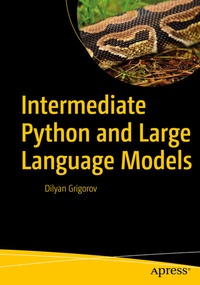
Intermediate Python and Large Language Models
Description

Harness the power of Large Language Models (LLMs) to build cutting-edge AI applications with Python and LangChain. This book provides a hands-on approach to understanding, implementing, and deploying LLM-powered solutions, equipping developers, data scientists, and AI enthusiasts with the tools to create real-world AI applications.
The journey begins with an introduction to LangChain, covering its core concepts, integration with Python, and essential components such as prompt engineering, memory management, and retrieval-augmented generation (RAG). As you progress, you'll explore advanced AI workflows, including multi-agent architectures, fine-tuning strategies, and optimization techniques to maximize LLM efficiency.
The book also takes a deep dive into practical applications of LLMs, guiding you through the development of intelligent chatbots, document retrieval systems, content generation pipelines, and AI-driven automation tools. You'll learn how to leverage APIs, integrate LLMs into web and mobile platforms, and optimize large-scale deployments while addressing key challenges such as inference latency, cost efficiency, and ethical considerations.
By the end of the book, you'll have gained a solid understanding of LLM architectures, hands-on experience with LangChain, and the expertise to build scalable AI applications that redefine human-computer interaction.
What You Will Learn
- Understand the fundamentals of LangChain and Python for LLM development
- Know advanced AI workflows, including fine-tuning and memory management
- Build AI-powered applications such as chatbots, retrieval systems, and automation tools
- Know deployment strategies and performance optimization for real-world use
- Use best practices for scalability, security, and responsible AI implementation
- Unlock the full potential of LLMs and take your AI development skills to the next level
Who This Book Is For
Software engineers and Python developers interested in learning the foundations of LLMs and building advanced modern LLM applications for various tasks
Reviews / Votes
" Intermediate Python and large language models is a solid reference for those seeking to understand and apply LLMs in real-world projects. Its balance of accessible explanation and guided practice makes it a highly recommended resource for developers interested in incorporating generative AI into their technological solutions." (Hector Antonio Villa-Martinez, Computing Reviews, February 18, 2026)
More details
Other editions
Additional editions
Person
Dilyan Grigorov is a software developer with a passion for Python software development, generative deep learning and machine learning, data structures, and algorithms. He is a Stanford student in the Graduate Program on Artificial Intelligence in the classes of people such as Andrew Ng, Fei-Fei Li, and Christopher Manning. He has been mentored by software engineers and AI experts from Google and Nvidia.
Dilyan is an advocate for open source and the Python language itself. He has 16 years of industry experience programming in Python and has spent five of those years researching and testing Generative AI solutions.
His passion stems from his background as an SEO specialist dealing with search engine algorithms daily. He enjoys engaging with the software community, often giving talks at local meetups and larger conferences. In his spare time, he enjoys reading books, hiking in the mountains, taking long walks, playing with his son, and playing the piano.
Content
Chapter 1: LangChain and Python: Basics.- Chapter 2: LangChain and Python: Adanced Components.- Chapter 3: Building Advanced Applications Powered by LLMs with LangChain and Python.- Chapter 4: Deploying LLM-powered Applications.- Chapter 5: Building and Fine-tuning LLMs.
