

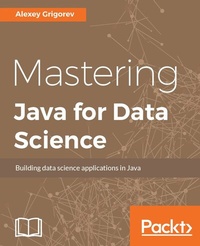
Mastering Java for Data Science
Analytics and more for production-ready applications
Published on 8. July 2025
364 pages
978-1-78588-739-0 (ISBN)
Description

Use Java to create a diverse range of Data Science applications and bring Data Science into production
Key Features
[*] An overview of modern Data Science and Machine Learning libraries available in Java
[*] Coverage of a broad set of topics, going from the basics of Machine Learning to Deep Learning and Big Data frameworks.
[*] Easy-to-follow illustrations and the running example of building a search engine.
Book DescriptionJava is the most popular programming language, according to the TIOBE index, and it is a typical choice for running production systems in many companies, both in the startup world and among large enterprises. Not surprisingly, it is also a common choice for creating data science applications: it is fast and has a great set of data processing tools, both built-in and external. What is more, choosing Java for data science allows you to easily integrate solutions with existing software, and bring data science into production with less effort. This book will teach you how to create data science applications with Java. First, we will revise the most important things when starting a data science application, and then brush up the basics of Java and machine learning before diving into more advanced topics. We start by going over the existing libraries for data processing and libraries with machine learning algorithms. After that, we cover topics such as classification and regression, dimensionality reduction and clustering, information retrieval and natural language processing, and deep learning and big data. Finally, we finish the book by talking about the ways to deploy the model and evaluate it in production settings.What you will learn
[*]Get a solid understanding of the data processing toolbox available in Java
[*]Explore the data science ecosystem available in Java
[*] Find out how to approach different machine learning problems with Java
[*]Process unstructured information such as natural language text
or images
[*]Create your own search engine
[*]Get state-of-the-art performance with XGBoost
[*]Learn how to build deep neural networks with DeepLearning4j
[*] Build applications that scale and process large amounts of data
[*] Deploy data science models to production and evaluate their
performance
Who this book is forThis book is intended for software engineers who are comfortable with developing Java applications and are familiar with the basic concepts of data science. Additionally, it will also be useful for data scientists who do not yet know Java but want or need to learn it. If you are willing to build efficient data science applications and bring them in the enterprise environment without changing the existing stack, this book is for you!
Key Features
[*] An overview of modern Data Science and Machine Learning libraries available in Java
[*] Coverage of a broad set of topics, going from the basics of Machine Learning to Deep Learning and Big Data frameworks.
[*] Easy-to-follow illustrations and the running example of building a search engine.
Book DescriptionJava is the most popular programming language, according to the TIOBE index, and it is a typical choice for running production systems in many companies, both in the startup world and among large enterprises. Not surprisingly, it is also a common choice for creating data science applications: it is fast and has a great set of data processing tools, both built-in and external. What is more, choosing Java for data science allows you to easily integrate solutions with existing software, and bring data science into production with less effort. This book will teach you how to create data science applications with Java. First, we will revise the most important things when starting a data science application, and then brush up the basics of Java and machine learning before diving into more advanced topics. We start by going over the existing libraries for data processing and libraries with machine learning algorithms. After that, we cover topics such as classification and regression, dimensionality reduction and clustering, information retrieval and natural language processing, and deep learning and big data. Finally, we finish the book by talking about the ways to deploy the model and evaluate it in production settings.What you will learn
[*]Get a solid understanding of the data processing toolbox available in Java
[*]Explore the data science ecosystem available in Java
[*] Find out how to approach different machine learning problems with Java
[*]Process unstructured information such as natural language text
or images
[*]Create your own search engine
[*]Get state-of-the-art performance with XGBoost
[*]Learn how to build deep neural networks with DeepLearning4j
[*] Build applications that scale and process large amounts of data
[*] Deploy data science models to production and evaluate their
performance
Who this book is forThis book is intended for software engineers who are comfortable with developing Java applications and are familiar with the basic concepts of data science. Additionally, it will also be useful for data scientists who do not yet know Java but want or need to learn it. If you are willing to build efficient data science applications and bring them in the enterprise environment without changing the existing stack, this book is for you!
All prices
More details
Edition
Digital original
Language
English
Place of publication
Birmingham
United Kingdom
Target group
Professional and scholarly
US School Grade: College Graduate Student
Edition type
Digital original
Product notice
Reflowable
File size
3,47 MB
ISBN-13
978-1-78588-739-0 (9781785887390)
Copyright in bibliographic data and cover images is held by Nielsen Book Services Limited or by the publishers or by their respective licensors: all rights reserved.
Schweitzer Classification
Other editions
Additional editions
Alexey Grigorev
Mastering Java for Data Science
Book
04/2017
Packt Publishing
€63.60
Shipment within 3-4 weeks
Person
Grigorev Alexey :
Alexey Grigorev is a skilled data scientist, machine learning engineer, and software developer with more than 8 years of professional experience. He started his career as a Java developer working at a number of large and small companies, but after a while he switched to data science. Right now, Alexey works as a data scientist at Simplaex, where, in his day-to-day job, he actively uses Java and Python for data cleaning, data analysis, and modeling. His areas of expertise are machine learning and text mining.
Alexey Grigorev is a skilled data scientist, machine learning engineer, and software developer with more than 8 years of professional experience. He started his career as a Java developer working at a number of large and small companies, but after a while he switched to data science. Right now, Alexey works as a data scientist at Simplaex, where, in his day-to-day job, he actively uses Java and Python for data cleaning, data analysis, and modeling. His areas of expertise are machine learning and text mining.
Content
Table of Contents
Data Science using Java
Data Processing toolbox
Exploratory Data Analysis
Supervised Learning: Classification and Regression
Unsupervised Learning: clustering and dimensionality reduction
Working with text: NLP/IR
Gradient Boosting Trees (xgboost)
Deep Learning (deeplearning4j)
Scaling Data Science
Deploying models
Data Science using Java
Data Processing toolbox
Exploratory Data Analysis
Supervised Learning: Classification and Regression
Unsupervised Learning: clustering and dimensionality reduction
Working with text: NLP/IR
Gradient Boosting Trees (xgboost)
Deep Learning (deeplearning4j)
Scaling Data Science
Deploying models
