

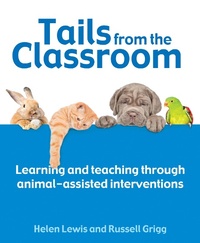
Tails from the Classroom
Learning and teaching through animal-assisted interventions
Published on 14. January 2021
256 pages
978-1-78583-516-2 (ISBN)
Description

Written by Helen Lewis and Russell Grigg, Tails from the Classroom: Learning and teaching through animal-assisted interventions (AAIs) is a fascinating exploration of the use of AAIs in educational settings and how they can inspire and support learners' all-round development.
There is growing interest in the idea of bringing animals into the classroom, but it is only recently that researchers have gathered clear data to show the impact of AAIs on the behavioural, emotional, physical and cognitive development of children and young people.
Tails from the Classroom brings together this research in a highly accessible way, illustrated with real-life case studies from a range of classroom contexts. It also includes lots of practical guidance on how to set up, manage and evaluate a project, ensuring that the welfare of all participants, including the animals, is a priority.
Helen and Russell discuss how AAIs can contribute towards learning in different subject areas and across the curriculum, sharing a wide range of examples to illustrate possible starting points for teachers in a range of subject and thematic contexts - even in less obvious areas such as the arts, literature, and religious and moral codes.
They also provide a historical overview of human-animal interactions, highlighting how animals have played a central part in humans' social, spiritual and cultural development. This then underpins the authors' exploration into animals' potential role in enhancing particular dimensions of children's social, emotional, intellectual and physical development and well-being.
This groundbreaking book is not just for animal-loving educators, however. It is for anyone who is serious about inspiring learners of all ages and prepared to explore new ways of doing so.
Suitable for educators working with learners of all ages.
There is growing interest in the idea of bringing animals into the classroom, but it is only recently that researchers have gathered clear data to show the impact of AAIs on the behavioural, emotional, physical and cognitive development of children and young people.
Tails from the Classroom brings together this research in a highly accessible way, illustrated with real-life case studies from a range of classroom contexts. It also includes lots of practical guidance on how to set up, manage and evaluate a project, ensuring that the welfare of all participants, including the animals, is a priority.
Helen and Russell discuss how AAIs can contribute towards learning in different subject areas and across the curriculum, sharing a wide range of examples to illustrate possible starting points for teachers in a range of subject and thematic contexts - even in less obvious areas such as the arts, literature, and religious and moral codes.
They also provide a historical overview of human-animal interactions, highlighting how animals have played a central part in humans' social, spiritual and cultural development. This then underpins the authors' exploration into animals' potential role in enhancing particular dimensions of children's social, emotional, intellectual and physical development and well-being.
This groundbreaking book is not just for animal-loving educators, however. It is for anyone who is serious about inspiring learners of all ages and prepared to explore new ways of doing so.
Suitable for educators working with learners of all ages.
More details
Language
English
Place of publication
Carmarthen
United Kingdom
Target group
College/higher education
Professional and scholarly
File size
4,31 MB
ISBN-13
978-1-78583-516-2 (9781785835162)
Copyright in bibliographic data and cover images is held by Nielsen Book Services Limited or by the publishers or by their respective licensors: all rights reserved.
Schweitzer Classification
Other editions
Additional editions
Dr Russell Grigg | Helen Lewis
Tails from the Classroom
Learning and teaching through animal-assisted interventions
Book
12/2020
Crown House Publishing
€22.00
Shipment within 3-4 weeks
Persons
Dr Russell Grigg was previously Associate Professor at the Wales Centre for Equity in Education. He has extensive experience in teacher training and has written widely on primary education including five books and more than forty articles. He has recently taken up a new post as school inspector and consultant for the Ministry of Education in the United Arab Emirates. Dr Helen Lewis is Director of Initial Teacher Education at Swansea University School of Education. A former primary school teacher and local authority adviser, she has been involved in teacher education for the past 12 years. Her research interests include the development of young children's thinking, teacher enquiry and research and the use of animals in educational settings.
Content
- Cover
- Title Page
- Copyright
- Dedication
- Acknowledgements
- Contents
- List of figures, tables and boxes
- Introduction
- Chapter 1: Tales from the past: human-animal relationships in history
- Chapter 2: Tales of friendship: animals and their impact on children's social development and behaviour
- Chapter 3: Tales with feelings: animals and their impact on children's emotional development
- Chapter 4: Literary tales: animals and their impact on children's language, literacy and communication skills
- Chapter 5: Tales of adventure: animals and their impact on children's physical well-being and development
- Chapter 6: Tales of all creatures great and small: animals and the curriculum
- Chapter 7: Tales of snails, wolves and teddies: animals as starting points for cross-curricular approaches
- Chapter 8: Cautionary tales: considering the practicalities and ethics of animal-assisted education
- Chapter 9: Tales of 'the dog in the playground': making the most of dogs in schools
- Conclusion
- Appendix 1: Example of a weekly planning sheet to enhance provision for young children's learning about the life cycle of birds
- Appendix 2: Example risk assessment form
- References and further reading
- Index
