

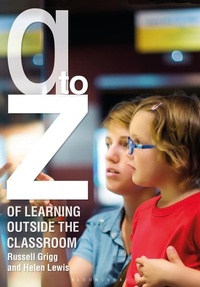
A-Z of Learning Outside the Classroom
1st Edition
Published on 7. April 2016
142 pages
978-1-4729-2121-5 (ISBN)
Description

Learning outside the classroom has been high on the political agenda for several years now, but recent Ofsted reports indicate that this can be confined to termly or yearly trips, as an 'extra'. This book provides a convincing and readable promotion of regular outdoor learning. It draws on relevant research to reinforce that working in 'real' environments benefits children's all-round development - cognitively, emotionally, physically and spiritually. This is illustrated through a wide range of engaging activities, from how to make a scarecrow, to interpreting a painting in a gallery, from getting the best from a library visit, to how best to attack a medieval castle.
This practical guide for busy teachers will help them to link what they do in and out of the class. It's a must for every staffroom bookshelf.
This practical guide for busy teachers will help them to link what they do in and out of the class. It's a must for every staffroom bookshelf.
More details
Edition
1. Auflage
Language
English
Place of publication
London
United Kingdom
Publishing group
Bloomsbury Publishing PLC (Digital)
Target group
Professional and scholarly
ISBN-13
978-1-4729-2121-5 (9781472921215)
Copyright in bibliographic data and cover images is held by Nielsen Book Services Limited or by the publishers or by their respective licensors: all rights reserved.
Schweitzer Classification
Other editions
Additional editions
Russell Grigg | Helen Lewis
A-Z of Learning Outside the Classroom
Book
04/2016
Bloomsbury Education
€44.75
Article exhausted; check different version
Persons
Dr Russell Grigg is Executive Head of Research at the Wales Centre for Equity in Education. He has written widely in the field of primary education including outstanding teaching and has more than twenty-five years' experience in various roles as teacher, researched, inspector and consultant.
Helen Lewis is Programme Director for PGCE Primary at the University of Wales Trinity Saint David. She has extensive experience as a primary school teacher, numeracy consultant, school inspector and senior leader. She has a particular interest in teacher education, children's learning and the development of thinking.
Helen Lewis is Programme Director for PGCE Primary at the University of Wales Trinity Saint David. She has extensive experience as a primary school teacher, numeracy consultant, school inspector and senior leader. She has a particular interest in teacher education, children's learning and the development of thinking.
Content
- Cover
- Half-title
- Title
- Copyright
- Contents
- Acknowledgements
- Introduction
- Part 1: Questions
- What is the nature and scope of out-of-class learning?
- Why is out-of-class learning important?
- What theories underpin out-of-class learning?
- What contribution can out-of-class experiences make to the teaching of literacy, numeracy and the wider curriculum?
- What are the practical things to consider?
- How do we evaluate out-of-class provision?
- Conclusion
- Part 2: A-Z entries
- A is for Allotments
- B is for Beaches
- C is for Castles
- D is for Dens
- E is for Environmental centres
- F is for Farms
- G is for Galleries
- H is for Home learning environments
- I is for Islands
- J is for Jungles
- K is for Kitchens
- L is for Libraries
- M is for Museums
- N is for Neighbourhood
- O is for Observatories and planetariums
- P is for Ponds
- Q is for Quiet places
- R is for Rivers
- S is for Shops
- T is for Theatres
- U is for Underground
- V is for Virtual Learning Environments (VLEs)
- W is for Worship, places of
- X is for X marks the spot
- Y is for Yards
- Z is for Zoos
- Appendices
- References
