

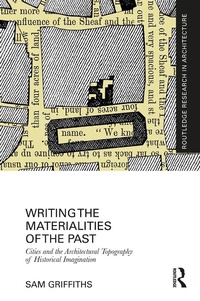
Writing the Materialities of the Past
Cities and the Architectural Topography of Historical Imagination
1st Edition
Published on 14. June 2021
266 pages
978-0-429-80406-9 (ISBN)
Description

Writing the Materialities of the Past offers a close analysis of how the materiality of the built environment has been repressed in historical thinking since the 1950s. Author Sam Griffiths argues that the social theory of cities in this period was characterised by the dominance of socio-economic and linguistic-cultural models, which served to impede our understanding of time-space relationality towards historical events and their narration.
The book engages with studies of historical writing to discuss materiality in the built environment as a form of literary practice to express marginalised dimensions of social experience in a range of historical contexts. It then moves on to reflect on England's nineteenth-century industrialization from an architectural topographical perspective, challenging theories of space and architecture to examine the complex role of industrial cities in mediating social changes in the practice of everyday life.
By demonstrating how the authenticity of historical accounts rests on materially emplaced narratives, Griffiths makes the case for the emancipatory possibilities of historical writing. He calls for a re-evaluation of historical epistemology as a primarily socio-scientific or literary enquiry and instead proposes a specifically architectural time-space figuration of historical events to rethink and refresh the relationship of the urban past to its present and future. Written for postgraduate students, researchers and academics in architectural theory and urban studies, Griffiths draws on the space syntax tradition of research to explore how contingencies of movement and encounter construct the historical imagination.
The book engages with studies of historical writing to discuss materiality in the built environment as a form of literary practice to express marginalised dimensions of social experience in a range of historical contexts. It then moves on to reflect on England's nineteenth-century industrialization from an architectural topographical perspective, challenging theories of space and architecture to examine the complex role of industrial cities in mediating social changes in the practice of everyday life.
By demonstrating how the authenticity of historical accounts rests on materially emplaced narratives, Griffiths makes the case for the emancipatory possibilities of historical writing. He calls for a re-evaluation of historical epistemology as a primarily socio-scientific or literary enquiry and instead proposes a specifically architectural time-space figuration of historical events to rethink and refresh the relationship of the urban past to its present and future. Written for postgraduate students, researchers and academics in architectural theory and urban studies, Griffiths draws on the space syntax tradition of research to explore how contingencies of movement and encounter construct the historical imagination.
More details
Series
Edition
1. Auflage
Language
English
Place of publication
London
United Kingdom
Publishing group
Taylor & Francis Ltd
Target group
College/higher education
Illustrations
2 Tables, black and white; 6 Line drawings, black and white; 6 Illustrations, black and white
ISBN-13
978-0-429-80406-9 (9780429804069)
Copyright in bibliographic data and cover images is held by Nielsen Book Services Limited or by the publishers or by their respective licensors: all rights reserved.
Schweitzer Classification
Other editions
Additional editions
Sam Griffiths
Writing the Materialities of the Past
Cities and the Architectural Topography of Historical Imagination
Book
01/2023
1st Edition
Routledge
€71.98
Shipment within 10-20 days
Sam Griffiths
Writing the Materialities of the Past
Cities and the Architectural Topography of Historical Imagination
Book
06/2021
1st Edition
Routledge
€230.27
Shipment within 10-20 days
Person
Sam Griffiths is Associate Professor in Spatial Cultures in the Space Syntax Laboratory at the UCL Bartlett School of Architecture. His research interests focus on theories and methods for studying the historical relationship between people and built environments, the spatial culture of industrial cities and space syntax as an interdisciplinary research perspective in the humanities and social sciences. He has published a number of articles and book chapters on these topics. He is co-editor, with Alexander von Luenen of Spatial Cultures: Towards a New Social Morphology of Cities published by Routledge in 2016.
Content
Introduction: the architectural topography of historical imagination Part I: Contingency in the historiographies of the English reformation, French revolution and era of the industrial revolution in England 1. Contingency and artifice 2. Encounter and utterance 3. Milieu and movement 4. Figure and event Part II: Writing history as a city 5. Proximity and distance 6. The revolutionary encounter field: Paris c.1789-94 and other stories 7. Recollection and re-enactment 8. Morphologies of feeling Appendix A: A notation for the architectural topographic sequencing of texts Appendix B: Synopsis of Cinderella Appendix C: Additional architectural topographic sequences from Cinderella Appendix D: Search terms and categories used in toponemic analysis references index
