

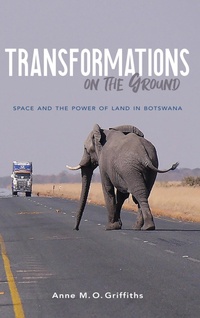
Transformations on the Ground
Description

Transformations on the Ground considers the ways in which power in all its forms-local, international, legal, familial-affects the collision of global with local concerns over access to land and control over its use. In Botswana's struggle to access international economies, few resources are as fundamental and fraught as control over land. On a local level, land and control over its use provides homes, livelihoods, and the economic security to help lift populations out of impoverishment. Yet on the international level, global capital concerns compete with strategies for sustainable development and economic empowerment. Drawing on extensive archival research, legal records, fieldwork, and interviews with five generations of family members in the village of Molepolole, Anne M. O. Griffiths provides a sweeping consideration of the scale of power from global economy to household experience in Botswana. In doing so, Griffiths provides a frame through which the connections between legal power and local engagement can provide fresh insight into our understanding of the global.
"Botswana is a darling of international donors and regularly praised as an upwardly mobile, prosperous and successful country. At the same time, it is characterized by poverty and exclusion, especially of women. In her insightful case study on land politics, Anne Griffiths effectively contrasts the image of a coherent state against myriad realities and confusion of competences on the ground. Based on decades of ethnographic fieldwork, this book masterfully demonstrates how in the realm of land and law, international, national, regional and local domains intersect and overlap, and come into conflict with one another." -Andreas Eckert, Humboldt University Berlin
"Anne Griffiths' ambitious and original book reveals how the "global" is always situated in specific places and times through her insightful analysis of how land in Botswana has figured in practices, policy and politics from the standpoints of household, family, village, district, national and international levels. Griffiths' astute use of political and legal history, legal documents, observation of statutory and customary law settings, multi-generational life histories and detailed ethnography enable her to provide a rich and informative account that goes well beyond the mantra of "the global in the local." While insisting on foregrounding "the voices, perceptions, and experiences of people's relationships with land," Griffiths shows how these interact with national politics, policies, laws and legal practice and with the effects of international and global agencies and processes to produce inequality and class differences, despite some improvement in gendered patterns of land entitlement." -Pauline Peters, Faculty Associate, Harvard Kennedy School and Center for African Studies
More details
Other editions
Additional editions
Person
Anne M. O. Griffiths before retirement held the personal chair in Anthropology of Law at the School of Law, Edinburgh University. Her research focuses on anthropology of law, comparative and family law, African law, gender, culture and rights. She is the author of In the Shadow of Marriage: Gender and Justice in an African Community.
Content
Preface
Introduction
Section I: Historical Dimensions of Land in Botswana: Contemporary Entanglements
1. The International Landscape and its Influence on Land in Botswana
2. Reframing the Governance of Land
3. Institutional Frameworks and Governance
Section II: The Bottom Up Impact of Land on Diverging Family Lifeworlds and Gender Relations
4. Families, Networks and Status
5. Transformations on the Ground
Section III: Law and Space: Negotiating Legal Plurality in Botswana
6. Negotiating Conflict: The Handling of Disputes in the Land Tribunal
7. Constructing Legality in the High Court and Court of Appeal
Final Reflections
Appendix
Bibliography
Index
