

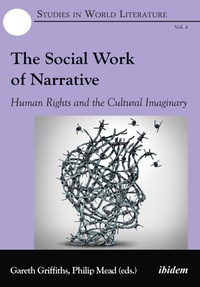
The Social Work of Narrative
Human Rights and the Cultural Imaginary
Published on 22. March 2018
408 pages
978-3-8382-6858-3 (ISBN)
Description

This book addresses the ways in which a range of representational forms have influenced and helped implement the project of human rights across the world, and seeks to show how public discourses on law and politics grow out of and are influenced by the imaginative representations of human rights. It draws on a multi-disciplinary approach, using historical, literary, anthropological, visual arts, and media studies methods and readings, and covers a wider range of geographic areas than has previously been attempted. A series of specifically-commissioned essays by leading scholars in the field and by emerging young academics show how a multidisciplinary approach can illuminate this central concern.
Reviews / Votes
This finger-on-the-pulse collection dramatically expands debates on human rights, law, and literature. Recognizing the paradox of human rights as universal but exclusionary, these elegant essays cover an impressive range of media genres, showing how narrative form shapes claims-for-rights, not the other way around. Addressing pressing issues like new technologies of war, indigenous struggles, the refugee crisis, and much more, this interdisciplinary volume needs to be on the bookshelf of anyone interested in human rights. Isabel Hofmeyr Global Distinguished Professor, NYU Professor of African Literature, University of the WitwatersrandMore details
Series
Edition
New edition
Language
English
Place of publication
Hannover
Germany
Target group
Professional and scholarly
Edition type
New edition
Illustrations
Illustrations
File size
5,44 MB
ISBN-13
978-3-8382-6858-3 (9783838268583)
Copyright in bibliographic data and cover images is held by Nielsen Book Services Limited or by the publishers or by their respective licensors: all rights reserved.
Schweitzer Classification
Other editions
Additional editions
Book
03/2018
ibidem
€45.90
Shipment within 10-15 days
Gareth Griffiths | Philip Mead
The Social Work of Narrative - Human Rights and the Cultural Imaginary
Human Rights and the Cultural Imaginary
Book
approx. 03/2016
ibidem
€52.00
Not yet published
Persons
Content
- Intro
- Acknowledgements
- Introduction: Where do we come from? Who are we? Where are we going?
- Part 1: Narrative and Human Rights in the Contemporary Moment
- Life, Story, Violence: What Narrative Doesn't Say
- Writing Transgenderism and Human-Rights-with-a-Difference in Post-Apartheid South Africa
- Human Rights After the Human Being per se: Narration and Numbers in Net-centric War
- "The massacre of our voices": Indigenous Rights and Narrative in Contemporary Australian Literature and Law
- Ethnographic Collections, Indigenous Narratives, and Post-Colonial Rights in Australia
- Contrary Narratives in Contemporary Chinese Fiction
- How to Kick Ass when Life's a Bitch:1 A Human Rights Bulletin from India
- Bringing Literature to Rights: Asylum Seekers as Subjects of English
- Part 2: Imaginative Representation and Human Rights
- The Universal and the Local in Mukoma wa Ngugi's Human Rights Novel Nairobi Heat
- The Politics of Representation in Joe Sacco's Palestine
- "Pictures on the Wall, Music in the Air": Popular Culture Forms, Human Rights Agitation and Fiction in Africa
- On Show: Truth and Reconciliation in Canada
- Cognitive Maps and Spatial Narratives: US Deportation Hearings and the Imaginative Cartographies of Forced Removal
- "Visual history at its best!": Visual Narrative and UNESCO's 1951 Human Rights Exhibition
- Balancing the Quotidian and the Political: Beyond Empathy in Australian Multi-platform Refugee Narratives
- Humanism's Pharmakon: Subalternity and Universality
- Sovereignty of the Mind
- Afterword
- Contributors
- Index
