

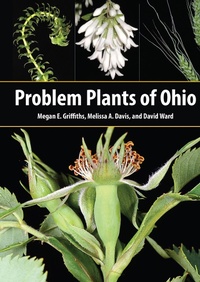
Problem Plants of Ohio
Description

A guide to identification and control of invasive plants
Problem Plants of Ohio is an informative guide, providing information on the identification and control of nonnative plant species formally listed as invasive or prohibited noxious weeds in Ohio. In addition, the book treats many additional species that are considered a nuisance in gardens, landscaping, or natural settings.
The book includes more than 900 photographs of diagnostic features to aid in the identification of 148 plant species. The accompanying text details the origin of the species' introduction to North America, provides thorough and accessible botanical descriptions, explains the economic and environmental impacts of each species, and includes basic information on control measures. The authors also include suggestions for native alternatives to use in gardens in place of problematic horticultural species.
The first book of this kind written specifically about the state, Problem Plants of Ohio presents new research on the change in nonnative species over time and discusses how climate change will further exacerbate the issue of invasive species. It includes current distribution maps for each plant species.
A useful resource for master gardeners, landscapers, farmers, academics, and natural areas managers, Problem Plants of Ohio will be of interest to nonspecialists as well.
More details
Other editions
Additional editions
Person
Megan E. Griffiths is an adjunct professor in the department of Biological Science at Kent State University. Over the past two decades, Dr. Griffiths has studied plant-plant interactions with particular focus on understanding the mechanisms by which disturbance and competition impact plant communities.
Melissa A. Davis is a botany instructor and the horticulture facilities director at Kent State University Herrick Conservatory and collections manager of the Tom S. and Miwako K. Cooperrider Kent State University Herbarium.
David Ward is the Art and Margaret Herrick Endowed Professor of Plant Biology at Kent State University. His research interests lie in the field of the ecology of plant species redistributions, including the study of both invasive and encroaching plant species.
Content
- Intro
- Halftitle Page
- Title Page
- Copyright Page
- Contents
- Introduction
- 1. Grasses
- 2. Forbs
- 3. Creepers and Climbers
- 4. Shrubs
- 5. Trees
- 6. Aquatic and Wetland Plants
- Acknowledgments
- Appendix A: Plant Species Designated as Invasive in Ohio
- Appendix B: Ohio Invasive Plants Council Plant Assessment Results
- Appendix C: Plant Species Designated as Prohibited Noxious Weeds in Ohio
- Appendix D: Herbicides
- Appendix E: Additional Synonyms of Scientific Names for Problem Plant Species
- Glossary
- Online Resources
- Bibliography
- Index
- Metric-Imperial Conversions
