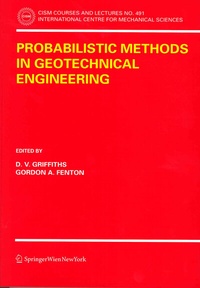
Probabilistic Methods in Geotechnical Engineering
Description

Soils and rocks are among the most variable of all engineering materials, and as such are highly amenable to a probabilistic treatment. The application of statistical and probabilistic concepts to geotechnical analysis is a rapidly growing area of interest for both academics and practitioners. The book is therefore aimed at students, researchers, and practitioners of geotechnical engineering who wish to keep abreast of developments in this evolving field of study. The course content and will assume no more that an introductory understanding of probability and statistics on the part of the course participants.
The main objective is to present a state-of-the-art training on probabilistic techniques applied to geotechnical engineering in relation to both theory and practice.
Including:
(a) discussion of potential benefits of probabilistic approaches as opposed to the classical "Factor of Safety" methods, to review sources of uncertainty in geotechnical analysis and to introduce methods of LRFD and reliability concepts in Eurocode 7,
(b) review of relevant statistical theories needed to develop the methodologies and interpret the results of probabilistic analysis,
(c) examples of established probabilistic methods of analysis in geotechnical engineering, such as the First Order Second Moment (FOSM) method, the Point Estimate Method (PEM), the First and Second Order Reliability Methods (FORM SORM) and Random Set (RS) theory,
(d) description of numerical methods of probabilistic analysis based on the finite element method, such as the Stochastic Finite Element Method (SFEM) and recent developments on the Random Finite Element Method (RFEM),
(e) practical examples and case histories of probabilistic applications in geotechnical engineering.
More details
Other editions
Additional editions