

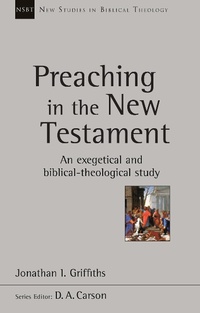
Preaching in the New Testament
An Exegetical And Biblical-Theological Study
Published on 19. January 2017
128 pages
978-1-78359-492-4 (ISBN)
Description

Part 1 addresses three foundational matters: a theology of the word of God; an overview of NT Greek terms related to preaching; the scope and character of NT word ministries. Part 2 concentrates on exegetical studies of sections of NT teaching that relate especially to the post-apostolic context. Part 3 summarizes the exegetical findings, sets them within the context of biblical theology, and addresses some broader theological implications.
More details
Series
Language
English
Place of publication
London
United Kingdom
Publishing group
SPCK Publishing
Product notice
Reflowable
ISBN-13
978-1-78359-492-4 (9781783594924)
Copyright in bibliographic data and cover images is held by Nielsen Book Services Limited or by the publishers or by their respective licensors: all rights reserved.
Schweitzer Classification
Other editions
Additional editions
Book
01/2017
Apollos
€17.30
Shipment within 3-4 weeks
Person
Lead Pastor of the Metropolitan Bible Church, Ottawa, Canada. Previously served as an instructor on the Cornhill Training Course at the Proclamation Trust, London. Editor of The Perfect Saviour (IVP). PhD University of Cambridge.
Content
- Intro
- Series preface
- Author's preface
- Abbreviations
- Introduction
- Why another book on preaching?
- Why these questions matter
- The shape and scope of this study
- Part I:
- Foundational matters
- Chapter One
- The word of God in biblical theology
- God speaks through his word
- God acts through his word
- God is encountered in his word
- Chapter Two
- The language of 'preaching' in the New Testament
- Euangelizomai
- Katangello
- Kerysso
- Summary, conclusions and further reflections
- Excursus 1: The identity of the preachers in Philippians 1:14-18
- Chapter Three
- The word ministries of all believers
- Part II:
- Exegetical studies
- Chapter Four
- 2 Timothy 3 - 4: The preacher's charge
- Paul's charge to Timothy establishes a bridge between apostolic and post-apostolic preaching
- Timothy is to make an authoritative proclamation of God's word
- Timothy's preaching is to address the believers in Ephesus
- Timothy is a commissioned and authoritative speaker of God's word
- Summary
- Excursus 2: Biblical-theological connections between New Testament preaching and Old Testament prophecy
- Chapter Five
- Romans 10: The preacher's commission
- Preaching reflects the nature of the gospel as something given and received
- Christian preaching stands in a line of continuity with Old Testament prophetic proclamation
- Preaching rests upon and involves the action of Christ
- Preaching requires a commission, but is not restricted to the apostles
- Summary
- Chapter Six
- 1 Corinthians: The power of the gospel in authentic Christian preaching
- Preaching is the central function of Paul's ministry in Corinth
- Preaching is distinct from other forms of oratory in its style and source of 'power'
- Preachers have a specific identity and role within the church, carrying particular rights and obligations
- Christian preaching is the delivery of the received gospel of Christ
- Preaching requires a believing response and leads to salvation
- Summary
- Chapter Seven
- 2 Corinthians 2 - 6: Beholding the glory of God in preaching
- Paul is reflecting on the nature of new-covenant ministry
- The ministry he has in view is a shared ministry
- The particular ministry he has in view is a ministry of public proclamation
- The ministry of proclamation is grounded in Scripture
- God the Trinity is at work in the ministry of proclamation
- The glory of God is revealed in the ministry of proclamation
- The people of God are transformed through the ministry of proclamation
- New-covenant preaching ministry has affinities to old-covenant prophetic ministry
- Summary
- Chapter Eight
- 1 Thessalonians 1 - 2: Preaching the very words of God
- The ministry Paul recalls is a ministry of authoritative public proclamation
- This ministry was a shared ministry
- The proclamation is made by 'approved' agents
- God stands behind this proclamation as the primary actor
- The proclaimed word effects change in the hearers
- Summary
- Chapter Nine
- Hebrews: Preaching to the gathered people of God
- Hebrews is a sermon intended to be read aloud in the Christian assembly
- Hebrews provides a model for us of the shape of Christian preaching
- 'Speaking the word' through preaching is a characteristic function of the post-apostolic leaders of the church
- The writer believes that in his sermon he is speaking God's word
- The preaching act carries judicial implications and offers the opportunity to access the place of divine rest
- The writer expects the congregation to encounter Christ as he preaches the word
- Summary
- Part III:
- Summary and conclusions
- Chapter Ten
- Summary and conclusions
- Summary of exegetical findings
- Biblical-theological conclusions
- Final reflections
- Bibliography
- Search names for authors
- Search terms for Scripture references
- Titles in this series:
- Notes
