

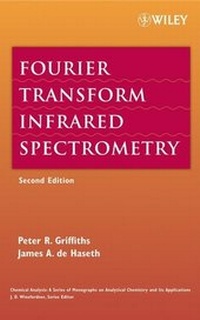
Fourier Transform Infrared Spectrometry
Description

Reviews / Votes
"The book is a great learning tool and reference guide forspectroscopy today." (Applied Spectroscopy, December 2007) "The discussion of NIR spectroscopy is on the whole verypositive... I recommend you buy it." (NIR News,October 2007)More details
Other editions
Additional editions
Persons
Content
CHAPTER 1. INTRODUCTION TO VIBRATIONAL SPECTROSCOPY.
1.1. Introduction.
1.2. Molecular Vibrations.
1.3. Vibration-Rotation Spectroscopy.
1.4. Widths of Bands and Lines in Infrared Spectra.
1.5. Quantitative Considerations.
1.6. Polarized Radiation.
1.7. Raman Spectrometry.
1.8. Summary.
CHAPTER 2 THEORETICAL BACKGROUND.
2.1. Michelson Interferometer.
2.2. Generation of an Interferogram.
2.3. Effect of Finite Resolution.
2.4. Apodization.
2.5. Phase Effects.
2.6. Effect of Beam Divergence.
2.7. Effect of Mirror Misalignment.
2.8. Effect of a Poor Mirror Drive.
2.9. Rapid-Scan Interferometers.
2.10. Step-Scan Interferometers.
CHAPTER 3 SAMPLING THE INTERFEROGRAM.
3.1. Sampling Frequency.
3.2. Aliasing.
3.3. Dynamic Range.
3.4. Analog-to-Digital Converters.
CHAPTER 4 FOURIER TRANSFORMS.
4.1. Classical Fourier Transform.
4.2. Fast Fourier Transform.
4.3. Phase Correction.
4.4. Fourier Transform: Pictorial Essay.
4.5. Data Systems.
CHAPTER 5 TWO-BEAM INTERFEROMETERS.
5.1. Michelson-Type Interferometers.
5.2. Tilt-Compensated Interferometers.
5.3. Refractively Scanned Interferometers.
5.4. Polarization Interferometers.
5.5. Step-Scan Interferometers.
5.6. Stationary Interferometers.
5.7. Beamsplitters.
5.8. Lamellar Grating Interferometers.
Appendix: Manufacturers of FT-IR Spectrometers.
CHAPTER 6 OTHER COMPONENTS OF FT-IR SPECTROMETERS.
6.1. Infrared Radiation Sources for Transmission and Reflection Spectrometry.
6.2. Detectors.
6.3. Optics.
6.4. Spectrometer Design.
CHAPTER 7 SIGNAL-TO-NOISE RATIO.
7.1. Detector Noise.
7.2. Trading Rules in FT-IR Spectrometry.
7.3. Digitization Noise.
7.4. Other Sources of Noise.
7.5. Interferometers Versus Grating Spectrometers.
CHAPTER 8 PHOTOMETRIC ACCURACY IN FT-IR SPECTROMETRY.
8.1. Introduction.
8.2. Effect of Spectral Resolution.
8.3. Effect of Apodization.
8.4. 100% Lines.
8.5. Zero Energy Level.
8.6. Linearity Between 100% and 0%T.
CHAPTER 9 QUANTITATIVE ANALYSIS.
9.1. Introduction.
9.2. Beer's Law.
9.3. Spectral Subtraction.
9.4. Linear Least-Squares Fitting Methods.
9.5. Classical Least Squares.
9.6. Inverse Least-Squares Regression.
9.7. Principal Component Analysis.
9.8. Principal Component Regression.
9.9. Partial Least-Squares Regression.
9.10. Validation.
9.11. Multivariate Curve Resolution.
9.12. General Guidelines for Calibration Data Sets.
9.13. Neural Networks.
CHAPTER 10 DATA PROCESSING.
10.1. Baseline Correction.
10.2. Interpolation.
10.3. Peak Picking.
10.4. Spectral Smoothing.
10.5. Band Fitting.
10.6. Derivatives of Spectra.
10.7. Fourier Self-Deconvolution.
10.8. Spectral Searching.
CHAPTER 11 CONVENTIONAL TRANSMISSION SPECTROMETRY.
11.1. Condensed-Phase Samples.
11.1.4 Trace Analysis.
11.2. Gas- and Vapor-Phase Samples.
CHAPTER 12 POLARIZATION.
12.1. Plane-Polarized Radiation.
12.2. Circular Polarization.
12.3. Polarization Modulation.
12.4. Applications of Linear Dichroism.
12.5. Vibrational Circular Dichroism.
CHAPTER 13 SPECULAR REFLECTION.
13.1. Introduction.
13.2. Fresnel Reflection from Bulk Samples.
13.3. Infrared Reflection-Absorption Spectrometry with Metal Substrates.
13.4. IRRAS with Dielectric Substrates.
13.5. Transflection.
13.6. Summary.
CHAPTER 14 MICROSPECTROSCOPY AND IMAGING.
14.1. Microsampling with Beam Condensers.
14.2. Microscopes.
14.3. Diamond Anvil Cells.
14.4. Reflection Microscopy.
14.5. Hyperspectral FT-IR Imaging.
CHAPTER 15 ATTENUATED TOTAL REFLECTION.
15.1. Introduction.
15.2. Theory.
15.3. Practical Considerations.
15.4. Accessories for Multiple Internal Reflection.
15.5. Single-Reflection Accessories.
15.6. Infrared Fibers.
15.7. Summary.
CHAPTER 16 DIFFUSE REFLECTION.
16.1. Theory of Diffuse Reflection.
16.2. Accessories for Diffuse Reflection.
16.3. Applications of Mid-Infrared Diffuse Reflection Spectrometry.
16.4. Applications of Near-Infrared Diffuse Reflection Spectrometry.
16.5. Reference Materials for Diffuse Reflection Spectrometry.
CHAPTER 17 EMISSION.
17.1. Introduction.
17.2. Infrared Emission Spectra of Gases.
17.3. Infrared Emission Spectra of Condensed-Phase Samples.
17.4. Transient Infrared Emission Spectroscopy.
CHAPTER 18 FOURIER TRANSFORM RAMAN SPECTROMETRY.
18.1. Introduction.
18.2. Instrumentation.
18.3. FT Raman Versus CCD Raman Spectrometry.
18.4. Applications of FT-Raman Spectrometry.
18.5. Summary.
CHAPTER 19 TIME-RESOLVED SPECTROMETRY.
19.1. Continuous-Scanning Interferometers.
19.2. Time-Resolved Measurements Using Step-Scan Interferometers.
19.3. Stroboscopic Spectrometry.
19.4. Asynchronous Time-Resolved FT-IR Spectrometry.
CHAPTER 20 PHOTOACOUSTIC SPECTROMETRY.
20.1. Photoacoustic Spectroscopy of Gases.
20.2. Photoacoustic Spectroscopy of Solids with a Rapid-Scanning Interferometer.
20.3. Photoacoustic Spectroscopy of Solids with a Step-Scan Interferometer.
CHAPTER 21 SAMPLE MODULATION SPECTROMETRY WITH A STEP-SCAN INTERFEROMETER.
21.1. Dynamic Infrared Linear Dichroism Measured with a Monochromator.
21.2. DIRLD Spectrometry with a Step-Scan Fourier Transform Spectrometer.
21.3. Two-Dimensional Correlation Plots.
21.4. DIRLD Spectrometry with a FT-IR Spectrometery and Digital Signal Processing.
21.5. Other Sample Modulation Measurements with Step-Scan Interferometers.
CHAPTER 22 ATMOSPHERIC MONITORING.
22.1. Extractive Atmospheric Monitoring.
22.2. Open-Path Atmospheric Monitoring.
CHAPTER 23 COUPLED TECHNIQUES.
23.1. Introduction.
23.2. Light-Pipe-Based GC/FT-IR Interfaces.
23.3. Mobile-Phase Elimination Approaches for GC/FT-IR.
23.4. HPLC/FT-IR Interface.
23.5. SFC/FT-IR Interface.
23.6. TGA/FT-IR.
23.7. Other Coupled Techniques.
INDEX.
