

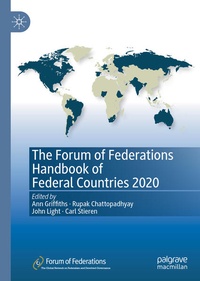
The Forum of Federations Handbook of Federal Countries 2020
Description

Federal models of government have shaped history and demonstrated how diverse people can live together and govern together in relative harmony. The Forum of Federations Handbook of Federal Countries 2020 builds on the previous 2005 edition and offers a much-needed update to this signature resource in comparative federalism. Outlining every federal country in the world, each chapter provides a brief yet comprehensive overview of the history of federalism in its specific country, the constitutional nature of federalism, and recent historical dynamics. As new countries have joined the Federal ranks, this handbook brings readers up to speed offering an authoritative look at both the older federal countries as well as new federal countries like Nepal. The Forum of Federations Handbook of Federal Countries 2020 is an essential resource for academics, researchers, university students, libraries, history and governance teachers, politicians and civil servants, and casual observers of federalism.
More details
Other editions
Additional editions
Persons
Rupak Chattopadhyay is the CEO and President of the Forum of Federations in Canada. He did his doctoral work in Political Science at the University of Toronto, and his edited/co-edited collections include Dialogues on Diversity and Unity in Federal Countries (2009), Finance and Governance of Capital Cities in Federal System (2009) and Governance and Finance of Metropolitan Area in Federal Countries (2013).
John Light is the senior director of communications and publications at the Forum of Federations in Canada. He spent over a decade working at the Canadian Parliament and holds a BA in marketing and expertise in communications.
Carl Stieren is a writer and editor based in Ottawa, Canada. He has worked for the Forum of Federations for eight years as a writer and editor, and also serves as the Associate Editor of Federations magazine.
Content
1. Introduction.- 2. Argentina.- 3. Australia.- 4. Austria.- 5. Belgium.- 6. Bosnia and Herzegovina.- 7. Brazil.- 8. Canada.- 9. Comoros.- 10. Cyprus.- 11. Ethiopia.- 12. European Union.- 13. Germany.- 14. India.- 15. Malaysia.- 16. Mexico.- 17. Micronesia.- 18. Nepal.- 19. Nigeria.- 20. Pakistan.- 21. Russia.- 22. St. Kitts and Nevis.- 23. South Africa.- 24. Spain.- 25. Switzerland.- 26. United Arab Emirates.- 27. United States of America.- 28. Federal Constitution-Making Processes and the Stable Cessation of Conflict.
