

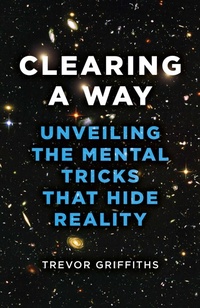
Clearing a Way
Unveiling the Mental Tricks That Hide Reality
Published on 26. January 2024
424 pages
978-1-80341-290-0 (ISBN)
Description

How to make better life-enhancing choices when environments crumble and population shifts disrupt our ways of living? Dr Griffiths takes a deep look at how our brains trick us into seeing the surface of things so that we lose sight of the deep relatedness on which our survival as groups will increasingly depend. Many astonishing insights follow. Body-mind dualism dissolves, as the ecological person moves with others in a renewed group-approach to thriving. Dilemmas in the standard quantum view of matter and spirituality resolve so that groups of people are empowered by the same fusion energy burning in stars to renew their power of creative choice. Human inner heart is restored over mind, to its central place, as personal values reshape the future.
Reviews / Votes
I really like this. This is the most interesting model I have come across in years. -- Sarah Knox, Emeritus Professor of Biophysics, West VirginiaMore details
Language
English
Place of publication
New York
United Kingdom
Publishing group
Collective Ink
File size
12,71 MB
ISBN-13
978-1-80341-290-0 (9781803412900)
Copyright in bibliographic data and cover images is held by Nielsen Book Services Limited or by the publishers or by their respective licensors: all rights reserved.
Schweitzer Classification
Other editions
Additional editions
Book
01/2024
John Hunt Publishing
€28.50
Shipment within 3-4 weeks
Person
Trevor Griffiths studied medicine, neuroscience, and immunology at Oxford University before becoming a pioneering doctor for 25 years in systemic family healthcare, promoting healthy communications. He founded a charity, the Emotional Logic Centre, to prevent illness and socially disruptive behaviour by teaching about the 'rough end of emotional literacy'. He lives in Devon, UK.
Content
- Front Cover
- Half-Title Page
- Title Page
- Copyright Page
- Contents
- List of Figures and Tables
- Preface
- Acknowledgements
- Introduction
- Part I: The Knowing Brain and the Known World
- Chapter 1: Orientated and Aware
- Three sensory association areas of the brain
- Informational patterning in the triquetra
- Physical, social, and inner ecologies
- Alerting, searching, anticipating-the orientation horizon
- The core limbic brain
- Orientated to prepare for action or rest
- Behavioural output balancing in the core brain
- Sensory input and memory balancing in the core brain
- Feedback loops create patterns of connection
- Social feedback loops link world with brain
- Unity in the limbic brain
- diversity in the neocortex
- Chapter 2: An Informational View of Personhood
- Information is a verb misused as a noun
- Informational processes link your brain and immune system
- Informational unity above and below the orientation horizon
- Who is 'a person'?
- Conversational orientation needs feedback
- Informational features of the double triquetra
- A synergic model of the reality behind the obvious
- Harmonisation and variability of feedback
- The emergence of internal awareness
- Time and the triquetral 4D phase space
- Fractal variability within a phase space of cyclical changes
- A brief neuroanatomy summary
- Chapter 3: Becoming Informationally Orientated
- Life is in continuous creation and renewal
- Moving on from a dualistic view of the body
- Orientating perspectives in diverse settings
- Demystifying the language of mathematics
- Preparing emotionally for the paradigm shift
- The veiling of changing relatedness by object recognition
- (a) By Shannon's numerical quantifying of information (noun)
- (b)By images representing quanta in loop quantum gravity
- Part II: Heart-Level Emotion Is Energy in Motion
- Chapter 4: Mind as Consciousness, Thought, Will, and Emotion
- The person as a social context for emotion
- Mindshifts about emotion
- (a)Emotion is physical
- (b)Emotion is the social messaging of changing inner states
- (c)Emotion is preparation for movement towards or away
- (d)Emotions move an integrated adjustment process
- Thinking logically about adaptive system responses
- The truth criterion in an open system is transferability
- Nine features of a healthy, adaptive, dynamic system
- Fractal scaling and replicating relatedness patterns
- Fuzzy boundaries between healthy systems
- Softening and hardening boundaries by personal values
- Conversations
- Sensitive dependence of conversations on initial conditions
- Personal values are physical settings in core brain filters
- Chapter 5: Emotional Chaos Theory and Emergent Order
- Adaptability is systemic repatterning of values
- Overcoming the practical difficulty of naming personal values
- Mapping emotional chaos
- Recognising harmful effects from whirlpools of loss emotions
- Mapping the personal inscape
- The inner ecology as a complex adaptive system
- Feedback from the neocortex into the inner human heart
- The triquetral icon of self-organisation in systems
- Complementarity of analysis and synthesis in the cerebrum
- Releasing informenergy from whirlpools of loss emotions
- Chapter 6: Energy and Informational Processes Are 'Informenergy'
- Personal energy is physiological order
- The archer and the timing of choices
- Relatedness and synergy scale into energy
- Fusion and fission as energetic movement
- Triquetral people and informational links with the land
- A flight over the landscape of relevant philosophy
- Dualism
- Monism and dual-aspect monism
- Process philosophy
- Process triunity in open systems
- Triune means alive or living
- Informenergy moves people in open systems
- Informenergy is holomovement in implicate order
- Closed-system communications are robotic
- Open-system communications are human
- Chapter 7: A Place for the Human Heart in Physical Science
- Letting go of scientific dualist language
- Letting go of religious or philosophical dualist language
- The person's name
- Classical terms applied to personhood
- Soul
- Spirit
- Body
- Mind and heart as modes of the person
- The inclination of the human heart
- Hardening the heart and softening the heart
- A broken heart and healing of the heart
- The thoughts of your heart
- Part III: Conversations between People Who See Life Differently
- Chapter 8: Three Analytical Perspectives Can Disrupt Conversations
- Preparing to adapt in conversations
- Grief for loss of personal identity hides in ideas
- The individual-potentially an isolated person
- Hypothesis revision: how conversational orientation is constructed
- The triquetral principles of projection
- The Structuralist (Materialist) analytical perspective on life
- The arrow of time and objective time
- Psychology and cosmology in a Structuralist-Materialist view
- A summary of the Structuralist (Materialist) analytical perspective
- The Individualist (Informationist) analytical perspective on life
- Timeframes
- A summary of the Individualist (Informationist) analytical perspective
- The Collectivist (Vitalist) analytical perspective on life
- Eternity and reincarnation in the eternal now
- Vitalism
- Integrating the ego by synergic resonance with others
- Participation in life is not passivity
- A summary of the Collectivist (Vitalist) analytical perspective
- Making yes-and-no-no judgements
- The importance of timing when making choices
- Chapter 9: Other Variants of Triquetral Diversity in Unity
- Monism
- Tripartite thinking
- Creating no-and-yes-yes political comfort zones
- No-and-yes-yes-don't like relatedness
- No-and-yes-yes-don't like change
- No-and-yes-yes-don't like form
- Infinitely diverse variants of triquetral unity
- Chapter 10: Speaking Life
- Triquetral yes-yes-yes balance and curiosity
- Information (verb) creation in the human brain
- Information (verb) loss in the human brain
- Triquetral Systems In Parallel EXchange: the TSIPEX model of conscious mind
- Balancing molecular and informenergy physiology
- Sensitivities reimagined enlighten consciousness
- Part IV: Belonging Together in a Land of Quantum Gravity
- Chapter 11: Movement Shapes a Quantum Gravity Universe
- A quantum change
- Scaling down to an informenergy view of nature
- How the power of choice scales triquetrally in energy-mass
- 3D-printed models of triquetral informenergy
- Space
- Substance
- Time and warmth
- Gravity meets light in triquetral cosmology
- A range of particles emerge from extended SLMs
- Particles from topological folding of extended SLMs
- Emergence and dispersal of movement out of nothing
- The power of choice in the cosmos
- Chapter 12: Movement Shapes Our Social Ecology
- Triquetral informenergy extends into e-motion
- The presence of loving kindness is the core human state
- Friendship shapes the local substance of life
- Exclusive group identities can corrupt humanity
- Exclusive group mentality imposing form
- Exclusive group mentality imposing change
- Exclusive group mentality imposing qualities of relatedness
- Attempts to balance a moral philosophy
- Duty-based and utilitarian love in analytical perspectives
- A triquetral balance of ethical principles
- Epilogue: The Renewal of Life by the Call of One Who Loves Us
- Notes
- Glossary
- From the Author
- Back Cover
