

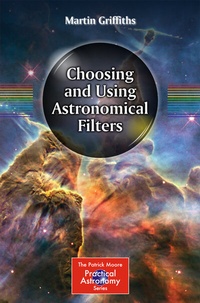
Choosing and Using Astronomical Filters
Description

Reviews / Votes
From the book reviews:
"The book covers light pollution filters, planetary filters, solar filters, ND filters for lunar observing and the range of filters for Deep sky imaging. . Overall this is a very nice book, and the first one that concentrates solely on filters. The most useful part of this book for me is the list of objects and what filters work best on that object." (astronomylog.co.uk, February, 2015)More details
Other editions
Additional editions
Person
Dr. Martin Griffiths from the UK, is an enthusiastic observer, science communicator, and professional astronomer who utilizes astronomy, history, and science fiction as tools to encourage greater public understanding of science. He is Senior Lecturer in Astronomy at the University of Glamorgan in Wales. To promote public interest in the night sky he has written an observational guide entitled "Alien Worlds" (University of Glamorgan Press, 2004), and contributes articles on varied astronomical topics for popular magazines. His observational abilities have resulted in him being honored with awards on the Messier and Herschel objects by the Astronomical League. He is the recipient of the Astrobiology Society of Britain's Public Engagement Award.
Martin was a founding member of NASA's Astrobiology Institute Science Communication Group, active between 2003-2006 and managed a multi-million pound ESF program in Astrobiology for adult learners between 2003-2008. He continues to promote cross-disciplinary links between science and culture that reflect his educational background and interests. He is an avid astronomer and is a Fellow of the Royal Astronomical Society; a member of the British Astronomical Association; the Webb Deep-Sky Society; the Society for Popular Astronomy and the Astronomical League. He is also the local representative for the British Astronomical Association's Campaign. He has recently published "Planetary Nebulae and How to Observe Them" (Springer, 2012).
Content
A Brief History of Astronomical Imaging.- Filters and General Equipment for Astronomical Observing.- Observing the Moon with Filters.- Observing the Solar System with Filters.- Using Filters to Observe the Sun.- Filters for Astrophotography.- A Brief Introduction to Photography and Image Manipulation.- Observing and Imaging Objects.
