

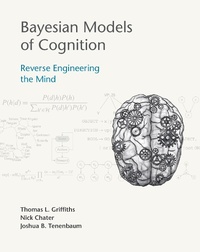
Bayesian Models of Cognition
Reverse Engineering the Mind
Published on 12. November 2024
648 pages
978-0-262-38104-8 (ISBN)
Description

The definitive introduction to Bayesian cognitive science, written by pioneers of the field.
How does human intelligence work, in engineering terms? How do our minds get so much from so little? Bayesian models of cognition provide a powerful framework for answering these questions by reverse-engineering the mind. This textbook offers an authoritative introduction to Bayesian cognitive science and a unifying theoretical perspective on how the mind works. Part I provides an introduction to the key mathematical ideas and illustrations with examples from the psychological literature, including detailed derivations of specific models and references that can be used to learn more about the underlying principles. Part II details more advanced topics and their applications before engaging with critiques of the reverse-engineering approach. Written by experts at the forefront of new research, this comprehensive text brings the fields of cognitive science and artificial intelligence back together and establishes a firmly grounded mathematical and computational foundation for the understanding of human intelligence.
- The only textbook comprehensively introducing the Bayesian approach to cognition
- Written by pioneers in the field
- Offers cutting-edge coverage of Bayesian cognitive science's research frontiers
- Suitable for advanced undergraduate and graduate students and researchers across the sciences with an interest in the mind, brain, and intelligence
- Features short tutorials and case studies of specific Bayesian models
More details
Other editions
Additional editions

Book
11/2024
MIT Press
€140.50
Article in reprint
Persons
Thomas L. Griffiths is Henry R. Luce Professor of Information Technology, Consciousness and Culture in the Departments of Psychology and Computer Science at Princeton University and coauthor of Algorithms to Live By: The Computer Science of Human Decisions. His research, which has received awards from the American Psychological Association and the National Academy of Sciences, among other organizations, explores connections between human and machine learning, using ideas from statistics and artificial intelligence to understand how people solve the challenging computational problems they encounter in everyday life.
Nick Chater is Professor of Behavioural Science at Warwick Business School and author of The Mind Is Flat: The Remarkable Shallowness of the Improvising Brain, among many other books. He studies the cognitive and social foundations of rationality and language and is the recipient of four national awards for psychological research and, in 2023, the Cognitive Science Society's David E. Rumelhart Prize for contributions to the foundation of cognition.
Joshua B. Tenenbaum is Professor of Computational Cognitive Science in the Department of Brain and Cognitive Sciences at MIT. He has received awards for research in mathematical and cognitive psychology from the American Psychological Association, the National Academy of Sciences, and the Society of Experimental Psychologists, and is a Macarthur Fellow.
Nick Chater is Professor of Behavioural Science at Warwick Business School and author of The Mind Is Flat: The Remarkable Shallowness of the Improvising Brain, among many other books. He studies the cognitive and social foundations of rationality and language and is the recipient of four national awards for psychological research and, in 2023, the Cognitive Science Society's David E. Rumelhart Prize for contributions to the foundation of cognition.
Joshua B. Tenenbaum is Professor of Computational Cognitive Science in the Department of Brain and Cognitive Sciences at MIT. He has received awards for research in mathematical and cognitive psychology from the American Psychological Association, the National Academy of Sciences, and the Society of Experimental Psychologists, and is a Macarthur Fellow.
Content
Preface
Part I: The Basics
1 Introducing the Bayesian approach to cognitive science
2 Probabilistic models of cognition in historical context
3 Bayesian inference
4 Graphical models
5 Building complex generative models
6 Approximate probabilistic inference
7 From probabilities to actions
Part II: Advanced Topics
8 Learning inductive bias with hierarchical Bayesian models
9 Capturing the growth of knowledge with nonparametric Bayesian models
10 Estimating subjective probability distributions
11 Sampling as a bridge across levels of analysis
12 Bayesian models and neural networks
13 Resource-rational analysis
14 Theory of mind and inverse planning
15 Intuitive physics as probabilistic inference
16 Language processing and language learning
17 Bayesian inference over logical representations
18 Probabilistic programs as a unifying language of thought
19 Learning as Bayesian inference over programs
20 Bayesian models of cognitive development
21 The limits of inference and algorithmic probability
22 A Bayesian conversation
Conclusion
Acknowledgments
References
Part I: The Basics
1 Introducing the Bayesian approach to cognitive science
2 Probabilistic models of cognition in historical context
3 Bayesian inference
4 Graphical models
5 Building complex generative models
6 Approximate probabilistic inference
7 From probabilities to actions
Part II: Advanced Topics
8 Learning inductive bias with hierarchical Bayesian models
9 Capturing the growth of knowledge with nonparametric Bayesian models
10 Estimating subjective probability distributions
11 Sampling as a bridge across levels of analysis
12 Bayesian models and neural networks
13 Resource-rational analysis
14 Theory of mind and inverse planning
15 Intuitive physics as probabilistic inference
16 Language processing and language learning
17 Bayesian inference over logical representations
18 Probabilistic programs as a unifying language of thought
19 Learning as Bayesian inference over programs
20 Bayesian models of cognitive development
21 The limits of inference and algorithmic probability
22 A Bayesian conversation
Conclusion
Acknowledgments
References
