

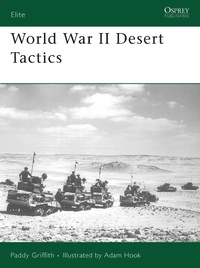
World War II Desert Tactics
1st Edition
Published on 20. January 2013
64 pages
978-1-4728-0098-5 (ISBN)
Description

A fascinating insight into the dangers and difficulties of operating within the desert terrain
From 1940 to 1943 North Africa saw the first major desert campaign by modern mechanised armies. The British, Italians, German Afrika Korps and US Army all addressed and learned from the special problems human, logistical, mechanical and tactical of the desert environment, most significantly fighting in a terrain empty of resources and offering little chance of concealment.
In this compact yet detailed volume, Paddy Griffith traces the fast-learned development in armour, artillery and infantry tactics in this exceptional arena. Featuring illustrations throughout, the book explores major engagements in the North African theatre, which involved some of the greatest tacticians of World War II in one of the pivotal theatres.
From 1940 to 1943 North Africa saw the first major desert campaign by modern mechanised armies. The British, Italians, German Afrika Korps and US Army all addressed and learned from the special problems human, logistical, mechanical and tactical of the desert environment, most significantly fighting in a terrain empty of resources and offering little chance of concealment.
In this compact yet detailed volume, Paddy Griffith traces the fast-learned development in armour, artillery and infantry tactics in this exceptional arena. Featuring illustrations throughout, the book explores major engagements in the North African theatre, which involved some of the greatest tacticians of World War II in one of the pivotal theatres.
More details
Series
Edition
1. Auflage
Language
English
Place of publication
London
United Kingdom
Publishing group
Bloomsbury Publishing PLC
Illustrations
50 b/w
ISBN-13
978-1-4728-0098-5 (9781472800985)
Copyright in bibliographic data and cover images is held by Nielsen Book Services Limited or by the publishers or by their respective licensors: all rights reserved.
Schweitzer Classification
Other editions
Additional editions
Paddy Griffith
World War II Desert Tactics
Book
04/2008
Osprey Publishing
€20.00
Shipment within 3-4 weeks
Persons
Paddy Griffith is a freelance military historian based in Manchester. His groundbreaking books on low-level tactics include Forward Into Battle (1981 and 1990), Battle Tactics of the Civil War (1986) and Battle Tactics of the Western Front (1994). He has also written extensively on wargames, and is currently active in the South Manchester Tactical Society and in the Battlefields Trust.
Adam Hook studied graphic design, and began his work as an illustrator in 1983. He specializes in detailed historical reconstructions, and has illustrated Osprey titles on the Aztecs, the Greeks, several 19th century American subjects, and a number of books in the Fortress series. His work features in exhibitions and publications throughout the world.
Adam Hook studied graphic design, and began his work as an illustrator in 1983. He specializes in detailed historical reconstructions, and has illustrated Osprey titles on the Aztecs, the Greeks, several 19th century American subjects, and a number of books in the Fortress series. His work features in exhibitions and publications throughout the world.
Content
INTRODUCTION
LESSONS OF OPERATION 'CRUSADER', WINTER 1941/2
LESSONS OF GAZALA, SPRING 1942
LESSONS OF FIRST ALAMEIN: successes of British artillery, minefields and infantry night attacks - failure of German high-risk tank tactics
MONTGOMERY: successes of Alam el Halfa and Second Alamein - new equipment and strength
TUNISIA: ARRIVAL OF US ARMY: early failures, tactical lessons and later successes - failure of German Tiger tanks
LESSONS OF OPERATION 'CRUSADER', WINTER 1941/2
LESSONS OF GAZALA, SPRING 1942
LESSONS OF FIRST ALAMEIN: successes of British artillery, minefields and infantry night attacks - failure of German high-risk tank tactics
MONTGOMERY: successes of Alam el Halfa and Second Alamein - new equipment and strength
TUNISIA: ARRIVAL OF US ARMY: early failures, tactical lessons and later successes - failure of German Tiger tanks
