
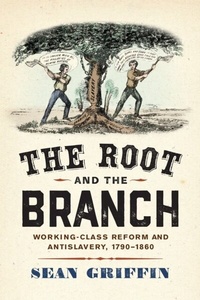
The Root and the Branch
Description
Alles über E-Books | Antworten auf Fragen rund um E-Books, Kopierschutz und Dateiformate finden Sie in unserem Info- & Hilfebereich.
The Root and the Branch examines the relationship between the early labor movement and the crusade to abolish slavery between the early national period and the Civil War. Tracing the parallel rise of antislavery movements with working-class demands for economic equality, access to the soil, and the right to the fruits of labor, Sean Griffin shows how labor reformers and radicals contributed to the antislavery project, from the development of free labor ideology to the Republican Party's adoption of working-class land reform in the Homestead Act. By pioneering an antislavery politics based on an appeal to the self-interest of ordinary voters and promoting a radical vision of "free soil" and "free labor" that challenged liberal understandings of property rights and freedom of contract, labor reformers helped to birth a mass politics of antislavery that hastened the conflict with the Slave Power, while pointing the way toward future struggles over the meaning of free labor in the post-Emancipation United States.
Bridging the gap between the histories of abolitionism, capitalism and slavery, and the origins of the Civil War, The Root and the Branch recovers a long-overlooked story of cooperation and coalition-building between labor reformers and abolitionists and unearths new evidence about the contributions of artisan reformers, transatlantic radicals, free Black activists, and ordinary working men and women to the development of antislavery politics. Based on painstaking archival research, The Root and the Branch addresses timely questions surrounding the relationships between slavery, antislavery, race, labor, and capitalism in the early United States.
All prices
More details
Other editions
Additional editions
Person
Content
Introduction
Chapter 1. Tom Paine's Progeny: Slavery, Labor, and Democracy
in the Radical Atlantic
Chapter 2. "A Very Intimate Connexion": The Working Men's Parties,
Equal Rights Democrats, and Antislavery Immediatism
Chapter 3. "The Genius of Integral Emancipation": Antislavery and Association
Chapter 4. "The Greatest of All Anti-Slavery Measures": Working-Class Land
Reform and Antislavery's Common Ground
Chapter 5. A "Union of Reformers": The National Industrial Congress and
the Antislavery-Land Reform Alliance
Chapter 6. From Free Soil to Homestead: Working-Class Land Reform
and Antislavery Politics
Chapter 7. Antislavery, Labor, and the Res Publica: The Rise of the Republican Party
Epilogue
Notes
Index
Acknowledgments

System requirements
File format: ePUB
Copy protection: Adobe-DRM (Digital Rights Management)
System requirements:
- Computer (Windows; MacOS X; Linux): Install the free reader Adobe Digital Editions prior to download (see eBook Help).
- Tablet/smartphone (Android; iOS): Install the free app Adobe Digital Editions or the app PocketBook before downloading (see eBook Help).
- E-reader: Bookeen, Kobo, Pocketbook, Sony, Tolino and many more (not Kindle).
The file format ePub works well for novels and non-fiction books – i.e., „flowing” text without complex layout. On an e-reader or smartphone, line and page breaks automatically adjust to fit the small displays.
This eBook uses Adobe-DRM, a „hard” copy protection. If the necessary requirements are not met, unfortunately you will not be able to open the eBook. You will therefore need to prepare your reading hardware before downloading.
Please note: We strongly recommend that you authorise using your personal Adobe ID after installation of any reading software.
For more information, see our ebook Help page.
File format: PDF
Copy-Protection: Adobe-DRM (Digital Rights Management)
System requirements:
- Computer (Windows; MacOS X; Linux): Install the free reader Adobe Digital Editions prior to download (see eBook Help).
- Tablet/smartphone (Android; iOS): Install the free app Adobe Digital Editions or the app PocketBook before downloading (see eBook Help).
- E-reader: Bookeen, Kobo, Pocketbook, Sony, Tolino and many more (only limited: Kindle).
The file format PDF always displays a book page identically on any hardware. This makes PDF suitable for complex layouts such as those used in textbooks and reference books (images, tables, columns, footnotes). Unfortunately, on the small screens of e-readers or smartphones, PDFs are rather annoying, requiring too much scrolling.
This eBook uses Adobe-DRM, a „hard” copy protection. If the necessary requirements are not met, unfortunately you will not be able to open the eBook. You will therefore need to prepare your reading hardware before downloading.
Please note: We strongly recommend that you authorise using your personal Adobe ID after installation of any reading software.
For more information, see our eBook Help page.
File format: ePUB
Copy protection: Watermark-DRM (Digital Rights Management)
System requirements:
- Computer (Windows; MacOS X; Linux): Use a reading software that can process the file format ePUB: e.g., Adobe Digital Editions or FBReader – both free (see eBook Help).
- Tablet/Smartphone (Android; iOS): Before downloading, install the free app Adobe Digital Editions (see eBook Help).
- E-reader: Bookeen, Kobo, Pocketbook, Sony, Tolino and many more (not Kindle).
The file format ePUB works well for novels and non-fiction books – i.e., „flowing” text without complex layout. On an e-reader or smartphone, line and page breaks automatically adjust to fit the small displays.
This eBook uses Watermark-DRM, a „soft” copy protection. This means that there are no technical restrictions to prevent illegal distribution. However, there is a personalised watermark embedded in the eBook that can be used to identify the purchaser of the eBook in the event of misuse and to provide evidence for legal purposes.
For more information, see our eBook Help page.
