

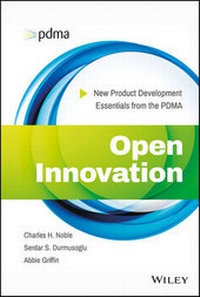
Open Innovation
Description

More details
Other editions
Additional editions
Persons
Content
Introduction: The Journey into Open Innovation xiii
Charles H. Noble
Serdar S. Durmusoglu
PART 1: OPEN INNOVATION IN THE FUZZY FRONT END 1
1 DE?]BOTTLENECKING OPEN INNOVATION: TURNING PATENT?]BASED TECHNOLOGY NETWORK ANALYSIS INTO VALUE 3
Manfred Stadlbauer
Gerhard Drexler
1.1 Methods of Patent Analysis and Data Mining 3
1.2 Patent Analytics for Identifying Open Innovation Partners 12
1.3 Nanotechnology Case Study 18
1.4 Conclusion 24
2 OPEN FORESIGHT WORKSHOPS FOR OPPORTUNITY IDENTIFICATION 27
Christiane Rau
Fiona Schweitzer
Oliver Gassmann
2.1 Corporate Foresight Workshops and Processes 28
2.2 Opening Up the Foresight Process 30
2.3 Stages of Opening Up the Foresight Process 32
2.4 Pitfalls to Avoid 45
2.5 Keys to Success 46
2.6 Conclusion 50
PART 2: OPEN INNOVATION IN THE DEVELOPMENT STAGE 53
3 KEEPING UP WITH THE VIRTUAL VOICE OF THE CUSTOMER-SOCIAL MEDIA APPLICATIONS IN PRODUCT INNOVATION 57
Anna Dubiel
Tim Oliver Brexendorf
Sebastian Glöckner
3.1 Introduction 57
3.2 The Voice of the Virtual Customer 59
3.3 The Social Media Phenomenon 59
3.4 Social Media in New Product Development 62
3.5 Success Factors 76
3.6 Conclusion 78
4 PREDICTION, PREFERENCE, AND IDEA MARKETS: HOW CORPORATIONS CAN USE THE WISDOM OF THEIR EMPLOYEES 81
Peter Koen
4.1 Introduction 81
4.2 Virtual Stock Markets in Corporations: Prediction, Preference, and Idea Markets 83
4.3 How Well Do Prediction, Preference, and Idea Markets Work in Corporations? 89
4.4 Implementing a Stock Market in Corporations 95
4.5 Choosing a Virtual Stock Market Software Platform 100
4.6 Conclusions 103
About the Contributor 105
5 CATALYZING TACIT KNOWLEDGE EXCHANGE WITH VISUAL THINKING TECHNIQUES TO ACHIEVE PRODUCTIVE OPEN INNOVATION COLLABORATIONS 107
Karen A. Kreutz
Kim D. Benz
5.1 Introduction 107
5.2 Visual Thinking Introduction 109
5.3 Visual Thinking and Open Innovation Endeavors 114
5.4 Understanding the Tacit Knowledge Exchange Challenges 117
5.5 Using Visual Thinking in OI Teams 122
5.6 Conclusions 129
6 USER COLLABORATION THROUGH PRIVATE ONLINE COMMUNITIES 135
Thomas Troch
Tom De Ruyck
6.1 Introduction 135
6.2 From Crowd?]Everything to Co?]Everything 136
6.3 Crowdsourcing, Co?]creation, and Structural Collaboration 137
6.4 Private Online Communities 138
6.5 How to Get Started with Private Online Communities 153
6.6 Conclusion 169
PART 3: OPEN INNOVATION WITH UNIVERSITIES 173
7 COLLABORATIVE INNOVATION ACROSS INDUSTRYACADEMY AND FUNCTIONAL BOUNDARIES: HOW COMPANIES INNOVATE WITH INTERDISCIPLINARY FACULTY AND STUDENT TEAMS 175
Jelena Spanjol
Michael J. Scott
Stephen Melamed
Albert L. Page
Donald Bergh
Peter Pfanner
7.1 Introduction 176
7.2 The IPD Model: Resolving Major Open Innovation Challenges 177
7.3 Concept Prototypes: Virtual and Physical 194
7.4 Conclusion 199
Appendix A 200
Appendix B 201
Appendix C 212
Appendix D 214
Appendix E 218
About the Contributors 222
8 OPEN INNOVATION: A FRAMEWORK FOR COLLABORATIVE PRODUCT DEVELOPMENT BETWEEN
INDUSTRY AND UNIVERSITIES 225
Aruna Shekar
8.1 Introduction 225
8.2 Open Innovation Program 226
8.3 A Framework for Open Innovation between University and Industry 227
8.4 An Example of an Open Innovation Project 234
8.5 What Industry Partners Can Expect from Open Innovation Projects 237
8.6 Challenges in University?]Industry Collaborations 239
8.7 Company Feedback from Industry Partners 240
8.8 Keys to Success 240
8.9 Pitfalls to Avoid 242
8.10 Benefits of the Open Innovation Program 243
8.11 Conclusions 243
About the Contributor 244
Appendix A 246
Appendix B 248
Appendix C 253
Appendix D 254
PART 4: OPEN INNOVATION FOR REALLY BIG INITIATIVES 257
9 OPEN INNOVATION AS A DISCOVERY SOLUTION FOR CONFRONTING THE
EXTRAORDINARY CHALLENGE 259
Christopher W. Miller
9.1 Surfing on Innovation Impact Waves: The Source of the Really Big Problem 260
9.2 Process, Purpose, and Payoff 260
9.3 Conclusion 276
PART 5: BEST PRACTICES AND ADVICE FOR OPEN INNOVATION 279
10 HOW TO WORK WITH SMALL COMPANIES TO EXPAND YOUR OPEN INNOVATION CAPABILITIES 281
Donna Rainone
Mike Rainone
Louise Musial
10.1 Introduction 281
10.2 Definitions 282
10.3 Background of Open Innovation 283
10.4 Two Paths: The Intraprenurial Organization versus the Outsourced Organization 284
10.5 How to Build Entrepreneurship within a Large Corporation 288
10.6 Why Working With Small Companies Is Important 293
10.7 Conclusion 295
11 BOOSTING OPEN INNOVATION BY LEVERAGING BIG DATA 299
Gerhard Drexler
Andrej Duh
Andreas Kornherr
Dean KoroSak
11.1 Open Innovation and Big Data 299
11.2 Big Data Applications in Today's World 306
11.3 Big Data Analytics in Action 308
11.4 Keys to Success and Pitfalls to Avoid 313
11.5 Conclusions 315
12 AMERICAN PRODUCTIVITY AND QUALITY CENTER BEST PRACTICES STUDY: USING OPEN INNOVATION TO GENERATE IDEAS 319
Christopher W. Miller
G. Anne Orban
Becky Partida
Andrea Stroud
Paige Leavitt
12.1 Open Innovation Best Practices Study 320
12.2 Open Innovation Best Practices 321
12.3 Eleven Best Open Innovation Practices 322
12.4 Open Innovation Enablers 333
12.5 Conclusion 337
INDEX 339
INTRODUCTION
THE JOURNEY INTO OPEN INNOVATION
The idea of cultivating firm innovation has long been associated with secrecy, fear of competition, and a general distrust of any entity outside the corporate walls. In this view (shown in Figure 1), product concepts are developed across various organizational functions, but it is a "hard-walled" process in which input from outside the firm is not sought or valued, and concepts are jealously guarded from leaks to the outside world.
Figure 1: A Typical Closed Approach to Innovation
The term "Open Innovation" is generally credited to Henry Chesbrough from his 2005 book and prior writings1, though its origins and concepts certainly appear in earlier thinking. Chesbrough's definition highlights the breaking down of traditional walls and veils of secrecy surrounding the organizational innovation process. As he describes it formally, "[Open Innovation is] . . . the use of purposive inflows and outflows of knowledge to accelerate internal innovation and expand the markets for the external use of innovation, respectively." In somewhat simpler terms, this is "punching holes in the funnel" that historically depicts the innovation process, allowing good ideas, technologies, materials, and other knowledge to flow in, and viable ideas, concepts, and technologies that aren't going to be commercialized by the firm to be passed out through licenses, joint ventures, and other approaches. Figure 2 illustrates this general concept. More than ever, the benefits of Open Innovation (OI) are being explored and under its umbrella can be found increasingly popular techniques such as consumer co-creation, crowdsourcing, idea competitions, collaborative design, and other approaches.
Figure 2: A General View of Open Innovation
Despite the recent focus on this approach, elements of OI have in fact been in existence for centuries. Consider the following:
- In 1714, the British government, through an Act of Parliament, offered the Longitude Prize to anyone who could develop a practical method for the precise determination of a ship's longitude. The winner was John Harrison, who received £14,315 for his work on chronometers.
- In 1795, Napoleon offered a 12,000-franc prize to drive innovation in food preservation, spurring a French brewer and confectioner named Nicholas Appert to develop an effective canning process to avoid spoilage.
- In 1919, New York City hotel owner Raymond Orteig offered a $25,000 reward to the first allied aviator(s) to fly nonstop from New York City to Paris or vice versa. It was a relatively unknown individual, Charles Lindbergh, who won the prize in 1927 in his aircraft, Spirit of St. Louis, and made history.
- In recent years, the X PRIZE Foundation sponsored a space competition and offered a $10,000,000 prize for the first nongovernment organization to launch a reusable manned spacecraft into space twice within two weeks.
- Eli Lilly pioneered the modern idea of crowdsourcing in 2001 when they began to post research questions openly (online) to scientists and other outsiders to augment their own R&D efforts. From this effort, they developed and spun off a new company, InnoCentive, to offer crowdsourcing to other companies.
- The use of "beta invitations" has been practiced for decades in the video game industry. In this model, which could be considered a form of OI crowdsourcing, a software developer releases a "beta" (or early, likely flawed) version to users for testing and commentary. This results in many expert hours of development being applied in a short time, thereby improving the product quickly and cost-effectively.
While these principles have been sporadically tried in the past, the recent move to focus thinking around the term "Open Innovation" has increased attention and has helped explore the full breadth of the concept with its many dimensions and implications.
Despite the hoopla and the calls for many goods and service firms to pursue this approach, there are certainly hurdles and cautions to consider. The loss of control is a fundamental worry, manifesting itself in many ways-in that competitors can have more insight into your early stage product pipeline and in that the same core ideas may be shared with others. There is also a valid concern that allowing users to enter into your innovation process creates an expectation with them that their ideas will be valued and implemented, which may not always be the case, resulting in disappointment. Last is the potentially more daunting worry that "great" ideas can't come from a crowd, which inherently produce compromise and mediocrity.
Idea sifting also can be an overwhelming challenge for firms pursuing this approach with gusto. For example, the community-driven innovation site "Quirky" has, as of this writing, almost 700,000 individuals who have contributed somehow to various product innovation processes-through raw ideas, branding suggestions, design insights, and so on. All of that enormous energy has culminated in only just over 400 products reaching the marketplace to this point. The vast majority of ideas and refinements are rejected, either by the community or, in a more organizationally taxing way, by the firm's own marketing, design, and manufacturing experts. This illustrates the skill shift seemingly required in firms pursuing Open Innovation-from technical expertise in personal product development to screening and sifting through potentially thousands of inputs for a few with "radical" potential. Therefore, it seems fairly clear that cost savings should not be the main driver for the firm embarking down the path to Open Innovation.
Despite these cautions, the general focus on Open Innovation is growing at breakneck speed. A recent report showed that 61 percent of firms were growing or expanding their OI efforts with the focus on partner networks, ideation programs, problem/solver networks, and co-creation programs.2 Interestingly, this study also showed that the drive for OI is largely coming from the CEO level with mid-level and functional management much less likely to be in a championing position. Perhaps you are one of those middle- or even higher-level managers who have been tasked by a well-intentioned CEO to explore this "Open Innovation thing" and this is one of your first steps down that path. If so, you have come to the right place!
This book is not a theoretical treatise on the conceptual underpinnings of Open Innovation, nor is it proposing an untested agenda for further development. In the chapters within, you will find clear and usable tools and ideas to help you implement the principles of Open Innovation in your firm. The authors have taken their lumps and achieved their victories, and share both here. We are fortunate to have insights here from an exceptionally talented group of innovators and appreciate their willingness to share this knowledge. This is a collection of stories of the OI journey, not all of which may apply to your particular situation, but which will inspire you shake up your own approaches to maximizing your innovation potential.
In this book, we consider applications of OI principles in all phases of the new product development process-from idea generation to evaluation, development, and delivery (i.e., launch). The views and techniques offered come from authors with diverse and exciting experiences. This exploration is useful in understanding the full breadth and potential of an incredibly rich concept in Open Innovation. We summarize these insights in several ways, including a model of Open Innovation which highlights the contributing perspectives of this book. We think you will enjoy the offerings here, as a source of thought-provoking ideas for your own OI applications.
Why Open Innovation?
As described in various previous writings in the area, there are many reasons to consider the route of Open Innovation. Briefly, these include the value of bringing in new, outside perspectives on innovation challenges, the ability to profit from ideas that weren't necessarily initiated within the company, increasing speed through development to market, and the ability of smaller firms to effectively scale up innovation resources to match those of larger competitors.3 Many companies seek OI for both "inbound" and "outbound" innovation benefits. From an inbound perspective, OI can complement traditional, internal R&D. On the outbound side, OI principles are used to find creative markets and earning opportunities from developed ideas that aren't put through a traditional development pipeline.
There are numerous examples of Open Innovation successes in the popular press, including efforts such as Heineken's "Ideas Brewery," an OI portal which asks for creative solutions to specific problems. In one effort to better understand the beer needs of 60+-year-old consumers, winning entries including fruitier and sweeter brews to suit more senior tastes, added iron (an important mineral for the elderly), and easier-opening packaging concepts.4
In a more unusual setting, the U.S. Department of Defense launched a major OI program in 2010 to design the next-generation infantry fighting vehicle through a series of design challenges. Their goals were to achieve a broader range of ideas and to...
