

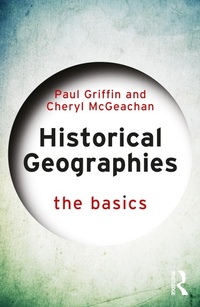
Historical Geographies
The Basics
1st Edition
Published on 30. December 2025
230 pages
978-1-040-50300-3 (ISBN)
Description

Historical Geographies: The Basics provides readers with a thorough grounding in a sub-discipline that revisits the past through a geographical lens. It encourages the reader to pursue researching the past in a usable manner, reflecting on the role of the past in the present and how it might inform geographical thinking.
Across seven chapters, the authors guide readers through their engagement with the past, via direct encounters with archives and memories, as well as buildings, artefacts and landscapes. It poses critical reflections on how we might work with the potential gaps and fragments in revisiting the past and the ways in which we can follow traces to unearth hidden histories. In doing so, it covers both conceptual questions and practical skills in historical geography. Critical questions include; how might we apply concepts and theories to case studies from the past? How does a researcher move from an historical idea, through to working in an archive, to writing historical geographies? Similarly, and perhaps more practically, how can we find archives or historical methods that work for our project?
The book will be of particular value to undergraduate and postgraduate geographers and historians. Whether taking a historical geography module, preparing a historical geography dissertation, or reflecting on how the past might inform engagement with geographical study, this book will provide a foundational understanding of the sub-discipline for students of global history, environmental history and further afield.
Across seven chapters, the authors guide readers through their engagement with the past, via direct encounters with archives and memories, as well as buildings, artefacts and landscapes. It poses critical reflections on how we might work with the potential gaps and fragments in revisiting the past and the ways in which we can follow traces to unearth hidden histories. In doing so, it covers both conceptual questions and practical skills in historical geography. Critical questions include; how might we apply concepts and theories to case studies from the past? How does a researcher move from an historical idea, through to working in an archive, to writing historical geographies? Similarly, and perhaps more practically, how can we find archives or historical methods that work for our project?
The book will be of particular value to undergraduate and postgraduate geographers and historians. Whether taking a historical geography module, preparing a historical geography dissertation, or reflecting on how the past might inform engagement with geographical study, this book will provide a foundational understanding of the sub-discipline for students of global history, environmental history and further afield.
Reviews / Votes
'An essential guide for students new to historical geography. It demystifies the research process with a practical toolkit of hands-on exercises and timely case studies designed to build confidence, spark curiosity, and powerfully demonstrate why the past matters now.'Jake Hodder, University of Nottingham, UK
'Historical Geographies: The Basics is a significant and unique contribution for those researching or teaching historical geography. The title in the plural form makes an insightful reference to the sub-discipline's thematic and methodological diversity over recent decades. Organised into seven chapters, the book uses understandable language, creative pedagogical resources, and rich visual aids. The authors provide relevant reflections on how historical geography can contribute to a critical understanding of 'past geographies' and envision different futures. This book will be a valuable addition for the international community of historical geographers.'
Patricia Silveira, Fluminense Federal University/UFF, Brazil
More details
Series
Edition
1. Auflage
Language
English
Place of publication
London
United Kingdom
Publishing group
Taylor & Francis Ltd
Target group
College/higher education
Illustrations
2 Tables, black and white; 1 Line drawings, black and white; 25 Halftones, black and white; 26 Illustrations, black and white
File size
9,05 MB
ISBN-13
978-1-040-50300-3 (9781040503003)
Copyright in bibliographic data and cover images is held by Nielsen Book Services Limited or by the publishers or by their respective licensors: all rights reserved.
Schweitzer Classification
Other editions
Additional editions
Book
approx. 12/2025
1st Edition
Routledge
€193.45
Not yet published
Book
approx. 12/2025
1st Edition
Routledge
€37.20
Not yet published
Persons
Paul Griffin is an Assistant Professor in Human Geography at Northumbria University. He teaches Historical Geographies: Hidden Histories and Usable Pasts at Northumbria. His research has considered the spatial politics of labour organising and more recently the histories of community responses to unemployment. This research has utilised both archival and oral history research methods. His work can be found in journals such as Antipode, Transactions of the Institute of British Geographers, Political Geography, Journal of Geography in Higher Education, and Progress in Human Geography.
Cheryl McGeachan is a Senior Lecturer in Human Geography at the University of Glasgow. She specialises in the historical geographies of mental ill-health, including exploration of issues of crime, conflict, and incarceration. She has written extensively on doing historical geography, particularly through participatory and fragmentary perspectives. She teaches Historical Geographies of Care, Conflict and Confinement at the University of Glasgow and has supervised several historical geography PhD students. Her work can be found in journals such as Progress in Human Geography, Annals of the Association of American Geographers, Journal of Historical Geography, and Area.
Cheryl McGeachan is a Senior Lecturer in Human Geography at the University of Glasgow. She specialises in the historical geographies of mental ill-health, including exploration of issues of crime, conflict, and incarceration. She has written extensively on doing historical geography, particularly through participatory and fragmentary perspectives. She teaches Historical Geographies of Care, Conflict and Confinement at the University of Glasgow and has supervised several historical geography PhD students. Her work can be found in journals such as Progress in Human Geography, Annals of the Association of American Geographers, Journal of Historical Geography, and Area.
Content
1. Why historical geography? 2. Sparking curiosity 3. Archives and practising historical geography 4. Historical geography and the vibrancy of theory 5. Working with historical materials 6. Writing historical geographies 7. Future imaginings in historical geography Index
