

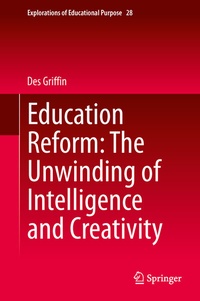
Education Reform: The Unwinding of Intelligence and Creativity
Description

This book pays special attention to the impact that a student's early childhood and socioeconomic status has on his or her educational achievement. It argues that discussions of education reform need a broader scope, one that encompasses a student's background as well as standardized testing, merit pay for teachers, and other issues regarding the quality of the teaching and learning.
Education Reform: the Unwinding of Intelligence and Creativity
features cases and examples from schools in Australia, the USA, and Britain. It offers a breadth of coverage, from early childhood to effective teaching and learning to teacher pay and conditions, standardized testing and public and private (independent) schooling and universities as well as creativity. It also includes summaries of educational policies in many developed countries.
Reforms which emphasize concern for early childhood, school leadership and respect for teachers are contrasted with ones based on standardized tests, private schools and sacking bad teachers.
More details
Other editions
Additional editions
Content
Foreword.- Preface.- Chapter 1 Introduction.- Chapter 2 A Word on Economics.- Chapter 3 Community and Inequality - Part 1: Creating an Enabling Environment.- Chapter 4 Community and Inequality.- Part 2 - Australia.- Chapter 5 Early Childhood: A World of Relationships.- Chapter 6 Effective Teaching and Learning.- Part 1: John Hattie, Graham Nuthall and Jonathan Osborne.- Chapter 7 Effective Teaching and Learning.- Part 2: Lessons from the US.- Chapter 8 Teacher Pay, Performance and Leadership.- Chapter 9 Public or Private Schools, Tests and League Tables, Parental Choice and Competition in Australia, the USA and Britain.- Chapter 10 Curriculum Matters.- Chapter 11 Creativity to Free Choice Learning.- Chapter 12 International Comparisons.- Chapter 13 Universities and Tertiary Education.- Chapter 14 Policy Development in Education and Schooling in Australia.- Chapter 15 Concluding Essay - What have we learned and where are we going?.- Index.
