

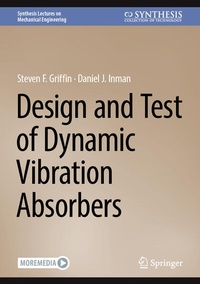
Design and Test of Dynamic Vibration Absorbers
Description

The aim of this book is to educate the beneficiaries of this technology, because there is so little awareness and understanding of what can be achieved with tuned mass dampers and vibration absorbers and of the relatively small increase in mass and complexity in exchange for the tremendous benefit in vibration reduction. It introduces the feedback approach to help understand why these devices work and are very helpful in modeling the devices on complicated structures.
The hardware demonstrators are simple and directly scalable to more complicated structures. Once a reader successfully operates the demonstration hardware, the concepts in the book are directly scalable to implementations on very complex structures like airplanes and rockets. A recipe is provided to 3D print most of the parts as well as easy-to-find brackets and sensors. The whole kit can be assembled in an afternoon. The directions will be similar in detail to a DIY magazine article, providing simple, step-by-step procedures.
Via app: download the SN More Media app for free, scan a link with play button and access MP4 directly on your smartphone or tablet.
More details
Other editions
Additional editions
Persons
Daniel J. Inman received his Ph.D. from Michigan State University in Mechanical Engineering in 1980 and is the Harm Buning Collegiate Professor in the Department of Aerospace Engineering at the University of Michigan and former department chair (2011-2018). Since 1980, he has published eight books (on vibration, energy harvesting, control, statics, and dynamics), eight software manuals, 20 book chapters, over 390 journal papers, and 690 proceedings papers, given 72 keynote or plenary lectures, graduated 67 Ph.D.students and supervised more than 75 MS degrees. He is the Editor-in-Chief of the Journal of Intelligent Material Systems and Structures and works in the area of applying smart structures to solve aerospace engineering problems including energy harvesting, structural health monitoring, vibration suppression, and morphing aircraft. He is a Fellow of AIAA, ASME, IIAV, SEM, and AAM.
