

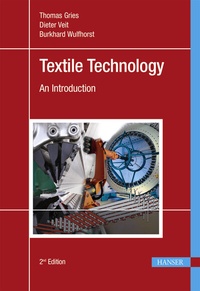
Textile Technology
An Introduction
1st Edition
Published on 15. January 2015
457 pages
978-1-56990-566-1 (ISBN)
Description

Textile Technology is a unique and readable introduction into the field of textile engineering. It is based on an elementary level course focusing on the manufacture (processes and machines) of yarn, fabric, knitwear, nonwovens, braids, reinforcing fabrics, and technical textiles, but also provides technicians and engineers in the textile industry with an up-to-date review of processes and equipment for textile manufacturing.
The book covers all processing steps for the manufacturing of textiles, describing materials, processes and machines, finishing, making-up, and recycling. To provide a better understanding of the individual textile processes, each chapter ends with an example describing the respective processing steps for a specific textile product. In addition, current and future development trends are discussed.
The second edition is brought up to date with extensive coverage of new developments, such as in the fields of testing, measurement, and simulation.
Contents
Raw materials
Yarn production
Fabric production
Knitwear production
Nonwovens production
Braiding processes and machines
Noncrimp fabrics
Textile finishing
Clothing manufacture
Technical textiles
Textile testing
Disposal and recycling
Simulation
More details
Other editions
Additional editions
Book
01/2015
2nd Edition
Hanser Publications
€129.99
Article not available at the moment
Persons
Author
Prof. Thomas Gries studied at RWTH Aachen University, Germany, and holds a degree in mechanical engineering and economics. After obtaining his doctorate in mechanical engineering, he worked from 1995 to 2001 at Lurgi Zimmer AG, Frankfurt am Main, in the Technologies for Fibers and Textiles department in a managerial capacity. Since 2001 he has been director of the Institute of Textile Technology (ITA) at RWTH Aachen University.
ISNI:
ISNI:
Content
- Intro
- Preface to the Second Edition
- Preface to the First Edition
- Preface to the First German Edition
- 1 Introduction
- 1.1 Why Are There Fibers and Yarns?
- 1.1.1 Tenacity and Elongation
- 1.1.2 Surface and Porosity
- 1.1.3 Mechanics of Solid Bodies and Textile Structures
- 1.2 Evolution of Textile Technology
- 1.3 Production Stages
- 1.4 Typical Products Made from Natural and Man-Made Fibers
- 1.5 Yarns
- 1.6 Textiles
- 1.7 Textile Products
- 1.8 Multiscale Model
- 1.9 Importance of the Textile Industry
- 1.10 World Trade with Textiles
- 2 Raw Materials
- 2.1 Natural Fibers
- 2.1.1 Plant Fibers
- 2.1.1.1 Cotton (CO)
- 2.1.1.2 Flax (Linen) (LI)
- 2.1.1.3 Other Bast and Hard Fibers
- 2.1.2 Animal Fibers
- 2.1.2.1 Wool (Sheep's Wool
- WO) and Fine Animal Hair
- 2.1.2.2 Silk (Mulberry Silk
- SE)
- 2.1.3 Mineral Fibers
- 2.2 Chemical Fibers
- 2.2.1 Manufacturing Processes
- 2.2.2 Chemical Fibers from Natural Polymers
- 2.2.2.1 Viscose Fibers (CV)
- 2.2.2.2 Lyocell Fibers (CLY)
- 2.2.2.3 Cupro Fibers (CUP)
- 2.2.2.4 Acetate Fibers (CA)
- 2.2.3 Chemical Fibers from Synthetic Polymers
- 2.2.3.1 Mechanisms for the Generation of Macromolecules
- 2.2.4 Chemical Fibers from Inorganic Raw Materials
- 2.2.4.1 Glass Fibers (GF)
- 2.2.4.2 Carbon Fibers (CF)
- 2.2.4.3 Metal Fibers (MTF)
- 2.2.5 Further Processing
- 2.2.5.1 Drawing
- 2.2.5.2 Texturing
- 2.2.5.3 Production of Staple Fibers
- 2.3 Examples
- 2.3.1 Jeans
- 2.3.2 Carpet
- 2.3.3 Airbags
- 3 Principles and Machinery for Yarn Production
- 3.1 Cotton Spinning
- 3.1.1 Spinning Preparation Machines
- 3.1.1.1 Bale Opening
- 3.1.1.2 Opening and Cleaning
- 3.1.1.3 Mixing
- 3.1.1.4 Carding
- 3.1.1.5 Draw Frames
- 3.1.1.6 Homogenization of the Sliver
- 3.1.2 Combing Room
- 3.1.2.1 Purpose of Combing
- 3.1.2.2 Combing Machine
- 3.1.3 Ring Spinning Process
- 3.1.3.1 Flyer Spinning
- 3.1.3.2 Ring Spinning
- 3.1.3.3 Compact Spinning
- 3.1.4 Nonconventional Spinning Principles
- 3.1.4.1 OE-Rotor Spinning
- 3.1.4.2 Air-Jet Spinning
- 3.1.4.3 Air False-Twist Wrap-Spinning
- 3.1.4.4 Summary of Other Nonconventional Spinning Methods
- 3.1.4.5 Comparison of the Most Important Nonconventional Spinning Methods
- 3.2 Special Spinning Methods
- 3.2.1 Carded Woolen Spinning
- 3.2.1.1 Carding
- 3.2.1.2 Nonconventional Carded Woolen Spinning
- 3.2.2 Worsted Spinning
- 3.2.2.1 Intersecting Gill Box and Chain Gill Box
- 3.2.3 Mock-Worsted Spinning
- 3.3 Development Trends
- 3.3.1 Machines for Spinning Preparation
- 3.3.2 Production of Staple Fiber Yarns with Defined Properties
- 3.3.3 Production Increase of Ring Spinning Frames
- 3.3.4 Ring/Traveler Combination
- 3.3.5 Sliver Spinning
- 3.3.6 Compact and Condension Spinning
- 3.3.7 Process Control Engineering
- 3.4 Fineness Measurements of Fibers and Yarns
- 3.4.1 Length Numbering
- 3.4.2 Mass/Weight Numbering
- 3.5 Summary of the Measurement Systems
- 3.5.1 Spinning Preparation
- 3.5.2 Combing Room
- 3.5.3 Ring Spinning
- 3.5.4 Rotor Spinning
- 3.6 Examples
- 3.6.1 Jeans
- 3.6.2 Carpet
- 3.6.3 Airbag
- 4 Principles and Machinery for Production of Woven Fabrics
- 4.1 Production Principles
- 4.2 Weaving Preparation
- 4.2.1 Winding
- 4.2.2 Twisting
- 4.2.3 Preparation of the Warp Beam
- 4.2.4 Warping
- 4.2.5 Section Warping
- 4.2.6 Sizing
- 4.3 Construction of Woven Fabrics
- 4.3.1 Definitions of Woven Fabrics
- 4.3.2 Repeating Pattern
- 4.3.3 Floatation
- 4.3.4 Weave Diagram
- 4.3.5 Weave Symbol
- 4.3.6 Basic Weave Patterns
- 4.3.6.1 Plain Weave
- 4.3.6.2 Twill Weave
- 4.3.6.3 Atlas or Satin Weave
- 4.3.7 Special Weaving Techniques
- 4.3.7.1 Cord and Velveteen
- 4.3.7.2 Terry Woven
- 4.3.7.3 Two-Ply Fabric
- 4.4 Design and Principle of Weaving Looms
- 4.4.1 Warp Let-Off Systems
- 4.4.2 Machines with Eccentric Drive
- 4.4.3 Machines with Shaft Drive
- 4.4.4 Jacquard Looms
- 4.4.5 Shuttle Loom
- 4.4.6 Projectile Loom
- 4.4.7 Rapier Loom
- 4.4.8 Jet Loom
- 4.4.9 Multiphase Loom
- 4.4.10 Weft Insertion Speed
- 4.4.11 Open-Reed Weaving
- 4.5 Development Trends
- 4.6 Examples
- 4.6.1 Jeans
- 4.6.2 Carpet
- 4.6.3 Airbag
- 5 Processes and Machines for Knitwear Production
- 5.1 Knitting
- 5.1.1 Design and Structure
- 5.1.2 Loop Formation
- 5.1.2.1 Jacquard Technique
- 5.1.3 Knitting Machines
- 5.1.3.1 Flat-Bed Knitting Machines
- 5.1.3.2 Circular Knitting Machines
- 5.1.3.3 Spacer Knitting Machines
- 5.2 Warp Knitting
- 5.2.1 Design and Structure
- 5.2.2 Warp-Knitting Machines
- 5.2.2.1 Coulier Warp-Knitting Machines
- 5.2.2.2 Warp-Knitting Machines
- 5.2.2.3 Warp-Knitted Spacer Fabrics
- 5.3 Development Trends
- 5.4 Examples
- 5.4.1 Carpets
- 6 Processes and Machines for Nonwovens Production
- 6.1 Basics
- 6.2 Market
- 6.3 Raw Materials
- 6.4 Processes and Machines
- 6.4.1 Processes of Web Formation
- 6.4.1.1 Mechanical Web Formation Processes
- 6.4.1.2 Aerodynamic Web Formation Processes
- 6.4.1.3 Hydrodynamic Web Formation Processes
- 6.4.1.4 Spun-Bonded Nonwovens
- 6.4.1.4.1 Melt-Blown Process
- 6.4.1.4.2 Reifenhäuser Process
- 6.4.1.5 Market Overview
- 6.4.2 Processes of Web Consolidation
- 6.4.2.1 Web Bonding by Friction Force
- 6.4.2.1.1 Needle Punching
- 6.4.2.1.2 Hydroentangling
- 6.4.2.2 Thermal Bonding
- 6.4.2.3 Chemical Bonding
- 6.4.2.4 Stitch Bonding
- 6.4.2.5 Market Overview
- 6.4.3 Drying
- 6.4.4 Finishing
- 6.4.4.1 Processes for the Improvement of Textile Drapeability
- 6.4.4.2 Processes for Leather Finishing
- 6.4.4.3 Heat-Sealing Coating
- 6.5 Applications
- 7 Braiding Processes and Machines
- 7.1 Classification of Braids
- 7.1.1 Pattern
- 7.2 Braiding Processes
- 7.2.1 Conventional Braiding Processes
- 7.2.1.1 Strand-Forming Braiding Machine
- 7.2.1.2 Lace Braiding Machine
- 7.2.1.3 Package Braiding Machine
- 7.2.2 Processes for the Production of 3-D Braids
- 7.2.2.1 Circular Braiding (Multilayer-Interlock Braiding or Through-the-Thickness Braiding) and Overbraiding
- 7.2.2.2 Magnaweave/Omniweave or Four-Step Braiding Processes
- 7.2.2.3 Two-Step Braiding Process
- 7.2.2.4 Further Developments of the Known Processes
- 7.2.2.5 3-D Rotary Braiding
- 7.3 2-D and 3-D Braids
- 7.4 Development Trends
- 8 Noncrimp Fabrics
- 8.1 From Warp-Knit to Multiaxial Fabric
- 8.2 Biaxial Noncrimp Fabrics
- 8.2.1 Structure
- 8.2.2 Principle
- 8.2.3 Stitch Types
- 8.3 Multiaxial Noncrimp Fabrics
- 8.3.1 Structure
- 8.3.2 Principle
- 8.4 Spacer Noncrimp Fabrics
- 8.4.1 Structure
- 8.4.2 Principle
- 8.5 Weft-Knitted NCF
- 8.5.1 Structure
- 8.5.2 Principle
- 8.6 Development Trends
- 9 Textile Finishing
- 9.1 Pretreatment
- 9.1.1 Dry Pretreatment
- 9.1.2 Wet Pretreatment
- 9.1.3 Fiber-Specific Processes
- 9.1.3.1 Cotton
- 9.1.3.2 Wool
- 9.1.3.3 Silk
- 9.2 Drying
- 9.3 Coloration
- 9.3.1 Dyeing
- 9.3.2 Printing
- 9.4 Appret
- 9.4.1 Chemical Appret
- 9.4.2 Mechanical Finishing
- 9.4.3 Thermal Finishing
- 9.5 Coating
- 9.6 Embroidery
- 9.6.1 Standard Embroidery (Sozni Stitch)
- 9.6.2 Chain Stitch Embroidery (Ari Stitch)
- 9.6.3 Tailored Fiber Placement (TFP)
- 9.7 Development Trends
- 9.8 Examples
- 9.8.1 Jeans
- 9.8.2 Carpets
- 9.8.3 Airbags
- 10 Processes and Machines for Clothing Manufacture
- 10.1 Separation
- 10.1.1 Pattern Design
- 10.1.2 Directional Orientation
- 10.1.3 Pattern Orientation
- 10.1.4 Types of Patterns
- 10.1.5 Processes for the Construction and Transfer of Patterns
- 10.1.6 Cutting
- 10.1.7 Marking
- 10.1.8 Work Preparation
- 10.2 Joining Processes
- 10.2.1 Sewing
- 10.2.1.1 Take-Up Lever
- 10.2.1.2 Thread Tightener
- 10.2.1.3 Transport
- 10.2.1.4 Seam Classification
- 10.2.2 Bonding and Setting
- 10.2.3 Welding
- 10.3 Forming
- 10.4 Automation
- 10.5 Development Trends
- 11 Technical Textiles
- 11.1 Definitions
- 11.2 Examples of Technical Textiles
- 11.2.1 Fiber-Reinforced Material (FRM)
- 11.2.1.1 Fiber-Reinforced Plastics
- 11.2.1.2 Conveyor Belts
- 11.2.1.3 Tires
- 11.2.2 Protective Textiles (Mobiltech, Protech)
- 11.2.2.1 Mobility Textiles (Mobiltech)
- 11.2.2.2 Airbags
- 11.2.2.3 Armoring of Automobiles
- 11.2.2.4 Protective Garments for Firefighters
- 11.2.3 Textiles for Civil Engineering (Buildtech)
- 11.2.3.1 Textile-Reinforced Concrete
- 11.2.3.2 Coated Textiles
- 11.2.3.3 Ecological Laboratory House of TU Dresden
- 11.2.4 Geotextiles (Geotech)
- 11.2.5 Medical Textiles (Medtech)
- 11.2.5.1 Hygiene Textiles
- 11.2.5.2 Medical Textiles
- 11.2.5.2.1 Extracorporeal Medical Textiles
- 11.2.5.2.2 Implants (Intracorporeal Textiles)
- 11.3 Development Trends
- 12 Textile Testing
- 12.1 Standards
- 12.2 Testing Chamber Climate
- 12.2.1 Determination of Testing Climate
- 12.3 Fiber Testing
- 12.3.1 Fineness (Linear Density)
- 12.3.1.1 Importance
- 12.3.1.2 Characteristic Values
- 12.3.1.3 Measuring Principles
- 12.3.2 Fiber Length
- 12.3.2.1 Staple Diagram
- 12.3.2.2 Measuring Methods
- 12.4 Yarn Testing
- 12.4.1 Fineness
- 12.4.2 Twist
- 12.4.2.1 Spun fiber Yarns
- 12.4.2.2 Filament Yarns
- 12.4.2.3 Ply-Yarns
- 12.4.3 Mechanical Properties
- 12.4.3.1 Measurement
- 12.4.4 Evenness
- 12.4.4.1 Measuring Principle
- 12.4.4.2 Diagram
- 12.4.4.3 CV Value
- 12.4.4.4 Normal Spectrogram
- 12.5 Textiles
- 12.5.1 Geometry and Design
- 12.5.1.1 Thickness
- 12.5.1.2 Length and Width
- 12.5.2 Tenacity (Stress) and Elongation (Strain)
- 12.5.3 Behavior against Water
- 12.5.3.1 Water Absorption
- 12.5.3.2 Water-Retention Capability
- 12.5.3.3 Water Repellency
- 12.6 Ready-Made Textiles
- 12.6.1 Surface Changes
- 12.6.1.1 Abrasion Resistance
- 12.6.1.2 Pilling
- 12.6.2 Behavior against Humidity and Water
- 12.6.2.1 Change of Geometric Dimensions
- 12.6.3 Colorfastness
- 12.6.3.1 Definitions
- 12.6.3.2 Gray Scale
- 12.6.3.3 Blue Scale (DIN EN ISO 105-B01 and -B02)
- 12.6.4 Fall and Drapeability
- 12.6.4.1 Measuring Methods
- 12.7 Physiology of Clothing
- 12.7.1 Heat Balance of the Human Body
- 12.7.2 Hohenstein Skin Model
- 12.7.3 Thermoregulation Model
- 12.8 Technical Textiles
- 12.8.1 Fibers
- 12.8.2 Yarns
- 12.8.3 Textiles
- 12.8.4 Composites
- 12.9 Development Trends
- 13 Disposal and Recycling of Textiles
- 13.1 Circulation of Material in the Textile Industry
- 13.1.1 Life Cycle of a Product
- 13.1.2 Economic Cycle and Waste Law
- 13.2 Material Recycling
- 13.2.1 Fiber Retrieval
- 13.2.2 Clothing
- 13.2.3 Carpets
- 13.2.4 Automotive Textiles
- 13.2.4.1 Seat Covers
- 13.2.4.2 Safety Belts
- 13.3 Processing and Treatment of Reprocessed Fibers
- 13.3.1 Preparation
- 13.3.2 Processing
- 13.4 Thermal Material Recycling
- 13.5 Depolymerization
- 13.6 Thermal Recycling
- 13.7 Environmental Issues in Textile Production
- 13.8 Development Trends
- 13.9 Examples
- 13.9.1 Jeans
- 13.9.2 Carpets
- 13.9.3 Airbags
- 14 Simulation
- 14.1 Simulation with and without Computer
- 14.2 Cost Effectiveness and Validation
- 14.3 Modeling
- 14.3.1 Types of Modeling
- 14.3.2 Expert Systems and Knowledge-Based Models
- 14.4 Analytical Simulation of Machines and Processes
- 14.4.1 Optimizing Machine Settings
- 14.4.2 Optimizing Product Quality
- 14.4.3 Simulating Yarn Production
- 14.4.4 Simulating Fabric Production
- 14.4.5 Simulating Finishing Techniques
- 14.4.6 Practical Advice
- 14.5 Numerical Simulation of Machines and Processes
- 14.5.1 Neural Networks
- 14.5.1.1 Biological Background
- 14.5.1.2 Model
- 14.5.1.3 Applications
- 14.5.1.4 Practical Advice
- 14.5.2 Genetic and Evolutionary Algorithms
- 14.5.2.1 Basics
- 14.5.2.2 Evolutionary Theory
- 14.5.2.3 Genotype and Phenotype
- 14.5.2.4 Mathematical Model
- 14.5.2.5 Applications
- 14.5.3 Fuzzy Logic
- 14.5.3.1 Basics
- 14.5.3.2 Mathematical Model
- 14.5.3.3 Applications
- 14.5.3.4 Practical Advice
- 14.6 Simulation of Yarns and Textile Structures
- 14.6.1 Yarns
- 14.6.2 Textile Structures
- 14.7 Industry 4.0: Control Systems and Cognitive Machines
- About the Authors
- Thomas Gries
- Dieter Veit
- Burkhard Wulfhorst
- Coauthors
- Acknowledgments
- Index
Raw materials
Yarn production
Fabric production
Knitwear production
Nonwovens production
Braiding processes and machines
Noncrimp fabrics
Textile finishing
Clothing manufacture
Technical textiles
Textile testing
Disposal and recycling
Simulation
