

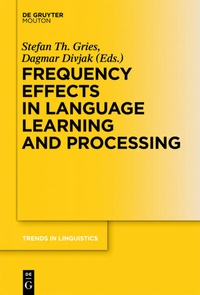
Frequency Effects in Language Learning and Processing
1st Edition
Published on 31. August 2012
V, 243 pages
978-3-11-027405-9 (ISBN)
Description

The volume contains a collection of studies on how the analysis of corpus and psycholinguistic data reveal how linguistic knowledge is affected by the frequency of linguistic elements/stimuli. The studies explore a wide range of phenomena , from phonological reduction processes and palatalization to morphological productivity, diachronic change, adjective preposition constructions, auxiliary omission, and multi-word units. The languages studied are Spanish and artificial languages, Russian, Dutch, and English. The sister volume focuses on language representation.
More details
Other editions
Additional editions
Book
08/2012
1st Edition
De Gruyter Mouton
€189.95
Shipment within 7-9 days
Persons
Stefan T. Gries, University of California, USA; Dagmar Divjak, University of Sheffield, UK.
Content
1 - Introduction [Seite 7]
2 - What can we count in language, and what counts in language acquisition, cognition, and use? [Seite 13]
3 - Are effects of word frequency effects of context of use? An analysis of initial fricative reduction in Spanish [Seite 41]
4 - What statistics do learners track? Rules, constraints and schemas in (artificial) grammar learning [Seite 59]
5 - Relative frequency effects in Russian morphology [Seite 89]
6 - Frequency, conservative gender systems, and the language-learning child: Changing systems of pronominal reference in Dutch [Seite 115]
7 - Frequency Effects and Transitional Probabilities in L1 and L2 Speakers' Processing of Multiword Expressions [Seite 151]
8 - You talking to me? Corpus and experimental data on the zero auxiliary interrogative in British English [Seite 183]
9 - The predictive value of word-level perplexity in human sentence processing: A case study on fixed adjective-preposition constructions in Dutch [Seite 213]
10 - Index [Seite 247]
2 - What can we count in language, and what counts in language acquisition, cognition, and use? [Seite 13]
3 - Are effects of word frequency effects of context of use? An analysis of initial fricative reduction in Spanish [Seite 41]
4 - What statistics do learners track? Rules, constraints and schemas in (artificial) grammar learning [Seite 59]
5 - Relative frequency effects in Russian morphology [Seite 89]
6 - Frequency, conservative gender systems, and the language-learning child: Changing systems of pronominal reference in Dutch [Seite 115]
7 - Frequency Effects and Transitional Probabilities in L1 and L2 Speakers' Processing of Multiword Expressions [Seite 151]
8 - You talking to me? Corpus and experimental data on the zero auxiliary interrogative in British English [Seite 183]
9 - The predictive value of word-level perplexity in human sentence processing: A case study on fixed adjective-preposition constructions in Dutch [Seite 213]
10 - Index [Seite 247]
