

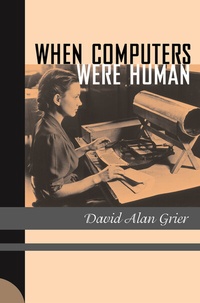
When Computers Were Human
1st Edition
Published on 1. November 2013
424 pages
978-1-4008-4936-9 (ISBN)
Description

Before Palm Pilots and iPods, PCs and laptops, the term "computer" referred to the people who did scientific calculations by hand. These workers were neither calculating geniuses nor idiot savants but knowledgeable people who, in other circumstances, might have become scientists in their own right. When Computers Were Human represents the first in-depth account of this little-known, 200-year epoch in the history of science and technology.
Beginning with the story of his own grandmother, who was trained as a human computer, David Alan Grier provides a poignant introduction to the wider world of women and men who did the hard computational labor of science. His grandmother's casual remark, "I wish I'd used my calculus," hinted at a career deferred and an education forgotten, a secret life unappreciated; like many highly educated women of her generation, she studied to become a human computer because nothing else would offer her a place in the scientific world.
The book begins with the return of Halley's comet in 1758 and the effort of three French astronomers to compute its orbit. It ends four cycles later, with a UNIVAC electronic computer projecting the 1986 orbit. In between, Grier tells us about the surveyors of the French Revolution, describes the calculating machines of Charles Babbage, and guides the reader through the Great Depression to marvel at the giant computing room of the Works Progress Administration.
When Computers Were Human is the sad but lyrical story of workers who gladly did the hard labor of research calculation in the hope that they might be part of the scientific community. In the end, they were rewarded by a new electronic machine that took the place and the name of those who were, once, the computers.
Beginning with the story of his own grandmother, who was trained as a human computer, David Alan Grier provides a poignant introduction to the wider world of women and men who did the hard computational labor of science. His grandmother's casual remark, "I wish I'd used my calculus," hinted at a career deferred and an education forgotten, a secret life unappreciated; like many highly educated women of her generation, she studied to become a human computer because nothing else would offer her a place in the scientific world.
The book begins with the return of Halley's comet in 1758 and the effort of three French astronomers to compute its orbit. It ends four cycles later, with a UNIVAC electronic computer projecting the 1986 orbit. In between, Grier tells us about the surveyors of the French Revolution, describes the calculating machines of Charles Babbage, and guides the reader through the Great Depression to marvel at the giant computing room of the Works Progress Administration.
When Computers Were Human is the sad but lyrical story of workers who gladly did the hard labor of research calculation in the hope that they might be part of the scientific community. In the end, they were rewarded by a new electronic machine that took the place and the name of those who were, once, the computers.
More details
Edition
Course Book
Language
English
Place of publication
Princeton, NJ
United States
Publishing group
De Gruyter
Target group
Professional and scholarly
Edition type
Digital original
Product notice
Reflowable
Illustrations
50 halftones.
File size
3,90 MB
ISBN-13
978-1-4008-4936-9 (9781400849369)
Schweitzer Classification
Other editions
Additional editions
David Alan Grier
When Computers Were Human
Book
09/2007
Princeton University Press
€42.40
Article not available at the moment
David Alan Grier
When Computers Were Human
Book
03/2005
Princeton University Press
€55.71
Article exhausted; check different version
Person
David Alan Grier is Associate Professor in the Center for International Science and Technology Policy at George Washington University. His articles on the history of science have appeared in the American Mathematical Monthly, Chance, the Christian Science Monitor, and the Washington Post. He is Editor in Chief of the IEEE Annals of the History of Computing. Long before he learned that his grandmother had been trained as a human computer, he absorbed the methods of programming the electronic computer from his father, who was a scientific computing specialist for the Burroughs Corporation.
Content
Introduction: A Grandmother's Secret Life 1
Part I: Astronomy and the Division of Labor 1682-1880 9
Chapter One: The First Anticipated Return: Halley's Comet 1758 11
Chapter Two: The Children of Adam Smith 26
Chapter Three: The Celestial Factory: Halley's Comet 1835 46
Chapter Four: The American Prime Meridian 55
Chapter Five: A Carpet for the Computing Room 72
Part II: Mass Production and New Fields of Science 1880-1930 89
Chapter Six: Looking Forward, Looking Backward: Machinery 1893 91
Chapter Seven: Darwin's Cousins 102
Chapter Eight: Breaking from the Ellipse: Halley's Comet 1910 119
Chapter Nine: Captains of Academe 126
Chapter Ten: War Production 145
Chapter Eleven: Fruits of the Conflict: Machinery 1922 159
Part III: Professional Computers and an Independent Discipline 1930-1964 175
Chapter Twelve: The Best of Bad Times 177
Chapter Thirteen: Scientific Relief 198
Chapter Fourteen: Tools of the Trade: Machinery 1937 220
Chapter Fifteen: Professional Ambition 233
Chapter Sixteen: The Midtown New York Glide Bomb Club 256
Chapter Seventeen: The Victor's Share 276
Chapter Eighteen: I Alone Am Left to Tell Thee 298
Epilogue: Final Passage: Halley's Comet 1986 318
Acknowledgments 323
Appendix: Recurring Characters, Institutions, and Concepts 325
Notes 333
Research Notes and Bibliography 373
Index 401
Illustration Credits 412
Part I: Astronomy and the Division of Labor 1682-1880 9
Chapter One: The First Anticipated Return: Halley's Comet 1758 11
Chapter Two: The Children of Adam Smith 26
Chapter Three: The Celestial Factory: Halley's Comet 1835 46
Chapter Four: The American Prime Meridian 55
Chapter Five: A Carpet for the Computing Room 72
Part II: Mass Production and New Fields of Science 1880-1930 89
Chapter Six: Looking Forward, Looking Backward: Machinery 1893 91
Chapter Seven: Darwin's Cousins 102
Chapter Eight: Breaking from the Ellipse: Halley's Comet 1910 119
Chapter Nine: Captains of Academe 126
Chapter Ten: War Production 145
Chapter Eleven: Fruits of the Conflict: Machinery 1922 159
Part III: Professional Computers and an Independent Discipline 1930-1964 175
Chapter Twelve: The Best of Bad Times 177
Chapter Thirteen: Scientific Relief 198
Chapter Fourteen: Tools of the Trade: Machinery 1937 220
Chapter Fifteen: Professional Ambition 233
Chapter Sixteen: The Midtown New York Glide Bomb Club 256
Chapter Seventeen: The Victor's Share 276
Chapter Eighteen: I Alone Am Left to Tell Thee 298
Epilogue: Final Passage: Halley's Comet 1986 318
Acknowledgments 323
Appendix: Recurring Characters, Institutions, and Concepts 325
Notes 333
Research Notes and Bibliography 373
Index 401
Illustration Credits 412
