

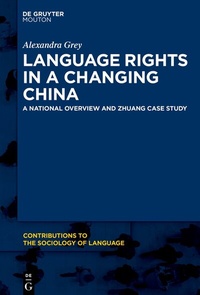
Language Rights in a Changing China
Description

China has had constitutional minority language rights for decades, but what do they mean today? Answering with nuance and empirical detail, this book examines the rights through a sociolinguistic study of Zhuang, the language of China's largest minority group. The analysis traces language policy from the Constitution to local government practices, investigating how Zhuang language rights are experienced as opening or restricting socioeconomic opportunity. The study finds that language rights do not challenge ascendant marketised and mobility-focused language ideologies which ascribe low value to Zhuang. However, people still value a Zhuang identity validated by government policy and practice.
Rooted in a Bourdieusian approach to language, power and legal discourse, this is the first major publication to integrate contemporary debates in linguistics about mobility, capitalism and globalization into a study of China's language policy.
The book refines Grey's award-winning doctoral dissertation, which received the Joshua A. Fishman Award in 2018. The judges said the study "decenter[s] all types of sociolinguistic assumptions." It is a thought-provoking work on minority rights and language politics, relevant beyond China.
More details
Other editions
Additional editions
Person
Content
- Intro
- Preface
- Contents
- List of Figures
- List of Tables
- Part I: Foundations
- 1 An ethnographic study of contemporary Chinese language rights
- 2 What is Zhuang? A critical sociolinguistic profile
- Part II: Laws and Governance Structures
- 3 The foundational language rights: Legal provisions about minority languages and minority peoples
- 4 Beliefs about law and language
- 5 The structural distribution of language governance powers
- Part III: Lived Linguistic Landscapes
- 6 Visual ideologies of Zhuang in linguistic landscapes
- 7 New semiotic displays of old "Zhuangness"
- 8 The multiple meanings of Zhuang displays in lived landscapes
- 9 Linguascaping through language policy
- Part IV: Conclusions
- 10 Summary and conclusions regarding language rights in a changing China
- 11 General implications for language rights and policy research and practice
- Appendix
- Acknowledgements
- References
- Index
