

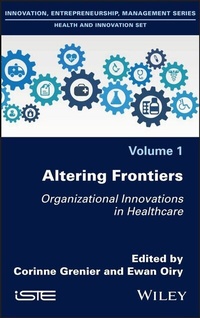
Altering Frontiers
Organizational Innovations in Healthcare
1st Edition
Published on 22. June 2021
256 pages
978-1-119-84241-5 (ISBN)
Description

How can healthcare systems be transformed by reimagining their multiple silos to favor processes and practices that are more responsive to local, horizontal initiatives? Altering Frontiers analyzes numerous experiences, using a multidisciplinary approach, paying attention to certain actors, collectives and organizational arrangements.
Through this work, levers are identified that promote lasting transformation: recognizing the legitimacy of the practices of many who are often "invisible"; trusting those who know their intervention territory; investing in methodological support; taking advantage of tools and procedures such as instruments for strategic and managerial discussion; and developing the capacity to absorb innovative ideas and experiences that circulate within the environment.
Through this work, levers are identified that promote lasting transformation: recognizing the legitimacy of the practices of many who are often "invisible"; trusting those who know their intervention territory; investing in methodological support; taking advantage of tools and procedures such as instruments for strategic and managerial discussion; and developing the capacity to absorb innovative ideas and experiences that circulate within the environment.
More details
Other editions
Additional editions
Book
09/2021
1st Edition
ISTE Ltd
€164.50
Shipment within 3-4 weeks
Persons
Corinne Grenier is Professor of Strategy and Innovation at KEDGE Business School, France, and is the director of the Center of Expertise Health & Innovation. She is also the scientific director of the MSAIS (Mastere Specialise Management des Structures et Activites Innovantes en Sante) program.
Ewan Oiry is Full Professor in HRM at Ecole des Sciences de Gestion - Universite du Québec a Montreal (ESG-UQAM), Canada. His research focuses on competence management. He is co-lead of the AGRH Thematic Research Group "Competency Management - Didier Retour".
Ewan Oiry is Full Professor in HRM at Ecole des Sciences de Gestion - Universite du Québec a Montreal (ESG-UQAM), Canada. His research focuses on competence management. He is co-lead of the AGRH Thematic Research Group "Competency Management - Didier Retour".
Content
- Intro
- Table of Contents
- Title Page
- Copyright
- Foreword by Jean-Louis Denis Adaptation, Trust and Methodology
- Foreword by Norbert Nabet The Challenges of Altering Frontiers: For Other More Collaborative Approaches
- Introduction The Challenges of "Altering Frontiers": The Multiple Facets of Boundaries to Cross and Articulate
- I.1. Altering frontiers: a boundary concept
- I.2. Conclusion
- I.3. References
- PART 1: Innovations as Seen by Stakeholders
- Introduction to Part 1
- 1 Recognition of Patients' Experiential Knowledge and Co-production of Care Knowledge with Patients and Citizens in the 21st Century
- 1.1. Introduction
- 1.2. From "empowerment" to the "patient revolution", an international trend
- 1.3. From paternalism to different forms of participation and partnership with patients
- 1.4. Innovative practices
- 1.5. Conclusion
- 1.6. References
- 2 Innovative Organizations and Professional Strategies: The Nursing Professional Space
- 2.1. Introduction: experimenting experimentation
- 2.2. Participatory evidence-based policy: a new conceptual framework?
- 2.3. Article 51: a full-scale test
- 2.4. The nursing space: a controlled extension
- 2.5. Conclusion: new ways of doing things
- 2.6. Appendix: examples of emancipatory innovations in the 1990s
- 2.7. References
- 3 Managed Communities of Practice in the Gerontology Sector: Case of a CoP of Gerontology Volunteers in Sweden
- 3.1. Introduction
- 3.2. Context and questions
- 3.3. Conceptual framework
- 3.4. Illustrations
- 3.5. Conclusion
- 3.6. References
- PART 2: Innovations on the Collective Side
- Introduction to Part 2
- 4 Moving from Partitioning to Transversality in Operating Rooms using Robot-assisted Surgery
- 4.1. Introduction
- 4.2. The context of operating rooms mobilizing the surgical robot
- 4.3. The issue of technical and non-technical skills in the context of robotic surgery
- 4.4. The effects of new technologies in terms of individual and collective skills
- 4.5. Viewing at the heart of robot-assisted surgery in urology
- 4.6. Discussion
- 4.7. References
- 5 Clinical Poles of Activity, an Opportunity for New Cooperation Between the Actors? The Case of a Hospital
- 5.1. Key elements and objectives of polar reform
- 5.2. Improving cooperation and better articulating the logics present in the hospital: challenges and theoretical identification
- 5.3. Context and methodology of the study
- 5.4. Modalities of cooperation permitted by the establishment of the clinical poles
- 5.5. Conditions for the use of articulations
- 5.6. Cooperation in a polar structure, some research avenues
- 5.7. References
- 6 Learning from Reforms Aiming to Disseminate Innovative Organizational Models: The Case of Family Medicine Groups in Quebec
- 6.1. Introduction
- 6.2. Conceptual framework
- 6.3. Illustration of the analytical framework: the reflexive processes related to the implantation of family medicine groups in Quebec
- 6.4. Discussion
- 6.5. Conclusion
- 6.6. References
- 7 Variety and Performance of Innovative Organizational Structures: The Emergence of Territorial Support Platforms1
- 7.1. Introduction
- 7.2. Context of the study
- 7.3. Conceptual framework
- 7.4. Empirical analysis
- 7.5. Conclusion
- 7.6. Acknowledgments
- 7.7. References
- PART 3: Reflective Insights on Organizational Innovations in Healthcare
- Introduction to Part 3
- 8 Proposals for New Approaches to Contributory Evaluation of Healthcare Pathways from Interface Organizations
- 8.1. Introduction
- 8.2. Context and research questions
- 8.3. Framework for analyzing the processes of diffusion of organizational innovations: definition and principles (conceptual framework)
- 8.4. Empirical illustrations of the innovation diffusion processes supported by coordination platforms
- 8.5. Conclusion
- 8.6. Acknowledgments
- 8.7. References
- 9 Innovation and Absorptive Capacity of Organizations in the Healthcare Field
- 9.1. Introduction: absorbing to innovate
- 9.2. Context and questions: the challenge of openness
- 9.3. Theoretical framework: the notion of organizational absorption capacity
- 9.4. Responses to the three OAC pitfalls: illustrations
- 9.5. Conclusion
- 9.6. References
- 10 Quality Management in Hospitals: The Two Faces of Rationalization Through Indicators
- 10.1. Introduction: are quality indicators a managerial innovation?
- 10.2. Context and issues
- 10.3. Management tools and organizational rationalization dynamics
- 10.4. A dynamic of professional rationalization?
- 10.5. A dynamic of managerial rationalization?
- 10.6. Conclusion: rationalizing through indicators to rationalize "softly"
- 10.7. References
- List of Authors
- Index
- Other titles from iSTE in Innovation, Entrepreneurship and Management
- End User License Agreement
