

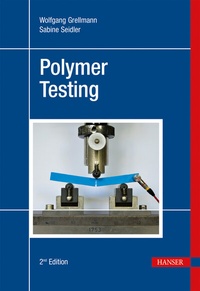
Polymer Testing
1st Edition
Published on 1. October 2013
712 pages
978-1-56990-549-4 (ISBN)
Description

Rapid growth and development in plastics production and application created a demand for meaningful
measuring and analysis methods in polymer testing. Advances in electronic measuring techniques led to
further developments in classic testing methods as well as to completely new methods, for which the first
edition of Polymer Testing was written.
Considerable advances in the evaluation of structure-property correlations and standardization have taken
place since the first edition of Polymer Testing, so the book has been comprehensively revised. This
updated edition covers the latest developments in the field, including amendments to the most important
polymer testing standards.
Included in this edition is essential information about damage processes and deformation mechanisms
that can be discovered with the help of coupled non-destructive polymer testing methods and hybrid
methods of polymer diagnostics, respectively. Numerous examples for the optimization of polymers and
their composites and the assessment of component properties provide a material science focused insight
into modern polymer testing.
Contents:
Preparation of Specimens
Determining Process-Related Properties
Mechanical Properties of Polymers
Fracture Toughness Measurements in Engineering Plastics
Testing of Physical Properties
Evaluating Environmental Stress Cracking Resistance
Non-Destructive Polymer Testing
Hybrid Methods of Polymer Diagnostics
Testing of Composite Materials
Technological Testing Methods
Testing of Microcomponents
More details
Other editions
New editions
Wolfgang Grellmann | Sabine Seidler
Polymer Testing
E-Book
06/2022
3rd Edition
Hanser Publications
€249.99
Available for download
Additional editions
Wolfgang Grellmann | Sabine Seidler
Polymer Testing
Book
10/2013
2nd Edition
Hanser Publications
€199.99
Article exhausted; check for reprint
Persons
Editor
Prof. Wolfgang Grellmann has been Head of the Department of Material Diagnostics and Testing at the Martin Luther University, Halle-Wittenberg, Germany, since 1995.
ISNI:
ISNI:
Prof. Sabine Seidler is, since 1996, Chair of Nonmetallic Materials at the Technical University Vienna, Austria, at which she is also rector.
ISNI:
ISNI:
Translation
Content
- Intro
- Preface to the Second Edition
- Preface to the First Edition
- Listing of Co-authors
- Table of Contents
- Nomenclature (Selection)
- Terminology
- Symbols and Abbreviated Terms
- 1 Introduction
- 1.1 The Genesis of Polymer Testing as a Science
- 1.2 Factors Influencing Data Acquisition
- 1.3 Classification of Polymer Testing Methods
- 1.4 Standards and Regulatory Codes for Polymer Testing
- 1.5 Compilation of Standards
- 1.6 References by Area of Specialization
- 2 Preparation of Specimens
- 2.1 IntroductionThe main
- 2.2 Testing Molding Materials
- 2.3 Specimen Preparation
- 2.3.1 General Remarks
- 2.3.2 Specimen Preparation by Direct Shaping
- 2.3.2.1 Production of Specimens from Thermoplastic Molding Materials
- 2.3.2.2 Production of Specimens from Thermosetting Molding Materials
- 2.3.2.3 Production of Specimens from Elastomeric Materials
- 2.3.3 Specimen Preparation by Indirect Shaping
- 2.3.4 Characterization of Specimen State
- 2.4 Specimen Preparation and Conditioning
- 2.5 Compilation of Standards
- 2.6 References
- 3 Determining Process-Related Properties
- 3.1 Molding Materials
- 3.2 Determining Bulk Material Properties
- 3.2.1 Bulk Density, Compacted Apparent Density, Fill Factor
- 3.2.2 Pourability, Angle of Repose, Slide Angle
- 3.3 Determining the Properties of Fluids
- 3.3.1 Rheological Fundamentals
- 3.3.1.1 Viscosity of Newtonian and non-Newtonian Fluids
- 3.3.1.2 Temperature and Pressure Dependence of Viscosity
- 3.3.1.3 Molecular Mass Influence on Viscosity
- 3.3.1.4 Volume Properties
- 3.3.2 Measuring Rheological Properties
- 3.3.2.1 Rheometry/Viscometry
- 3.3.2.2 Rotational Rheometers
- 3.3.2.3 Capillary Rheometers
- 3.3.3 Selecting Measurement Methods for Characterizing PolymerMaterials
- 3.4 Compilation of Standards
- 3.5 References
