

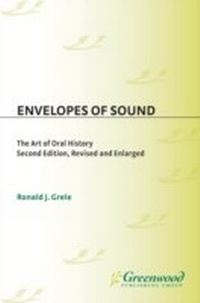
Envelopes of Sound
The Art of Oral History
2nd Edition
Published on 30. September 1991
312 pages
978-0-313-39018-0 (ISBN)
Description

What is it that oral historians do? Prior to the publication of Envelopes of Sound oral history was regarded as an archival practice and interviews were considered the repositories of data. Envelopes shows that the interview is a series of dialectical relationships embedded in language, social practice, and historical imagination. It merges theory and method through the analysis of the basic structures of the interview. It incorporates new thinking on the nature of narrative and conversation, and it covers new ground in examining fieldwork in a number of disciplines. While strongly theoretical, it also has direct application in conducting oral history interviews. Ronald Grele is the dean of oral history in the United States, and Envelopes of Sound is the volume by which others will continue to be judged. Its contributions to methods and to meaning are still the place to start a serious discussion, whether with scholars or with high school students interviewing their grandparents.
Paul M. Buhle Director, Oral History of the American Left New York University
Grele's early, groundbreaking book on oral history remains a classic. It continues to challenge the practitioner to be more self-conscious of and attentive to the nuances of the oral history interview.
Sherna Berger Gluck Director, Oral History California State University, Long Beach
What is it that oral historians do? Prior to the publication of Envelopes of Sound oral history was regarded as an archival practice and interviews were considered the repositories of data. Envelopes shows that the interview is a series of dialectical relationships embedded in language, social practice, and historical imagination. It calls upon oral historians to begin to step back, to think seriously about what it is they do, and to ask what kind of documentation it is that they produce and how they can make it better.
This volume merges theory and method through the analysis of the basic structures of the interview. It incorporates new thinking on the nature of narrative and conversation, and it covers new ground in examining fieldwork in a number of disciplines. While strongly theoretical, it also has direct application in conducting oral history interviews. It moves from relatively easy and simple considerations to increasingly complex issues. Envelopes of Sound can be used by a variety of students in discplines ranging from history and sociology to anthropology and contemporary literature, and it can be used in a variety of ways to raise issues on a number of theoretical levels.
Paul M. Buhle Director, Oral History of the American Left New York University
Grele's early, groundbreaking book on oral history remains a classic. It continues to challenge the practitioner to be more self-conscious of and attentive to the nuances of the oral history interview.
Sherna Berger Gluck Director, Oral History California State University, Long Beach
What is it that oral historians do? Prior to the publication of Envelopes of Sound oral history was regarded as an archival practice and interviews were considered the repositories of data. Envelopes shows that the interview is a series of dialectical relationships embedded in language, social practice, and historical imagination. It calls upon oral historians to begin to step back, to think seriously about what it is they do, and to ask what kind of documentation it is that they produce and how they can make it better.
This volume merges theory and method through the analysis of the basic structures of the interview. It incorporates new thinking on the nature of narrative and conversation, and it covers new ground in examining fieldwork in a number of disciplines. While strongly theoretical, it also has direct application in conducting oral history interviews. It moves from relatively easy and simple considerations to increasingly complex issues. Envelopes of Sound can be used by a variety of students in discplines ranging from history and sociology to anthropology and contemporary literature, and it can be used in a variety of ways to raise issues on a number of theoretical levels.
More details
Edition
2nd edition
Language
English
Place of publication
New York
United States
Publishing group
Bloomsbury Publishing Plc
Target group
Interest Age: From 7 to 17 years
ISBN-13
978-0-313-39018-0 (9780313390180)
Copyright in bibliographic data and cover images is held by Nielsen Book Services Limited or by the publishers or by their respective licensors: all rights reserved.
Schweitzer Classification
Other editions
Additional editions
Book
09/1991
2nd Edition
Praeger Publishers Inc
€49.80
Shipment within 15-20 days
Person
RONALD J. GRELE is Director of the Oral History Research Office at Columbia University. In addition to teaching and research, Dr. Grele has served as the editor of the International Journal of Oral History and subsequently the International Annual of Oral History and is the co-author of Where Cities Meet and 1968.
Content
Preface
Introduction
Riffs and Improvisations: An Interview with Studs Terkel
It's Not the Song, It's the Singing: Panel Discussion on Oral History
Oral History as Poetry by Dennis Tedlock
Movement Without Aim
A Surmisable Variety: Interdisciplinarity and Oral History
Can Anyone Over Thirty Be Trusted? A Friendly Critique of Oral History
Listen to Their Voices: Two Case Studies in the Interpretation of Oral History Interviews
Private Memories and Public Presentation: The Art of Oral History
Introduction
Riffs and Improvisations: An Interview with Studs Terkel
It's Not the Song, It's the Singing: Panel Discussion on Oral History
Oral History as Poetry by Dennis Tedlock
Movement Without Aim
A Surmisable Variety: Interdisciplinarity and Oral History
Can Anyone Over Thirty Be Trusted? A Friendly Critique of Oral History
Listen to Their Voices: Two Case Studies in the Interpretation of Oral History Interviews
Private Memories and Public Presentation: The Art of Oral History
