

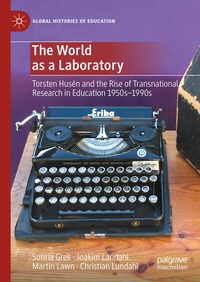
The World as a Laboratory
Description

This book covers the construction of international education research community in the 1950s-1990s, and the growth of its 'disembedded' laboratory i.e. networks, spaces, materiality, travelling, translations. The book follows a sociology of science theoretical framework in order to examine the research-archive of the Swedish internationally renowned educational scholar Torsten Husén (1916-2009). The archive reveals the shifting and heterogenous transnational networks that contribute to the development of social science research beyond fixed time and space dimensions, and that extends social science beyond individual ideas, researchers, environments, institutions and universities. These are practices that create, mobilise, sustain and challenge relations between actors in innovations, knowledge creation and various social activities. In other words, the archive represents the socio-material manifestation not only of the intellectual trajectory of a key education actor but the growing organisation of a whole scientific field at the time.
More details
Other editions
Additional editions
Persons
Sotiria Grek is Professor of European and Global Education Governance at the School of Social and Political Science, University of Edinburgh. Sotiria's work focuses on the field of quantification in global public policy, with a specialisation in the policy arenas of education and sustainable development.
Joakim Landahl is Professor of Education at Stockholm University, Sweden where he leads the research group 'History of education and sociology of education'. His current research is centered on the history of international comparisons of education, the history of educational research, and the role school student activism.
Martin Lawn is Honorary Professor, at the School of Social and Political Science, University of Edinburgh, UK. He is the Founding Editor of the European Educational Research Journal. Martin is researching the postwar Americanization of European educational research.
Christian Lundahl is Professor of education at Örebro University, Sweden. Lundahl is specialized in the history of assessments, evaluation, and of educational research.
Content
Chapter 1: Organising the Future of Educational Research in Post-war Europe and Beyond.- Chapter 2: Forming Transnational Networks: The Early 1950s in Europe.- Chapter 3: Collecting International Data: Husén and the International Association for the Evaluation of Educational Achievement.- Chapter 4: The Rise of a Global Expert Network: The International Institute for Educational Planning, 1963-1973.- Chapter 5: Education Futuramas: Torsten Husén and Futurological Thinking in Education.- Chapter 6: Editing the International Encyclopedia of Education, 1980-1994.- Chapter 7: Words for the World: Writing and Publishing Strategies for an International Book Market.
