

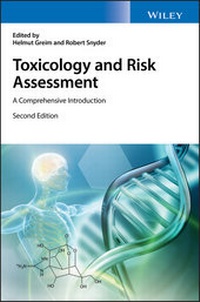
Toxicology and Risk Assessment
Description

Toxicology and Risk Assessment: A Comprehensive Introduction, Second Edition reflects recent advances in science and technology, and provides the scientific background and methodological issues to enable the reader to understand the basic principles in toxicology and to evaluate the health risks of specific exposure scenarios.
Completely updated with the latest information, this book offers a concise introduction to the subject. It is divided into five sections: Principles in Toxicology, Organ Toxicology, Methods in Toxicology, Regulatory Toxicology, and Specific Toxicity. The 2nd Edition adds new chapters that cover recent scientific and technological advances and current topics including the endocrine system, alternatives to animal testing, risk assessment and thresholds for carcinogens, European and international regulation, nanomaterials, fuels, fragrances, and agrochemicals.
* Concentrates on the basic concepts of toxicology and provides sufficient information for the reader to become familiar with them in order to understand the principles and to evaluate the risks at given exposures
* 30% new chapters cover recent scientific and technological advances including alternatives to animal testing; genotoxic carcinogens; REACH regulations; nanomaterials; fuels; fragrances; PAHs; and agrochemicals
* Written by a team of international specialists, and edited by two outstanding scientists in the field
Fully updated and expanded, Toxicology and Risk Assessment: A Comprehensive Introduction, Second Edition is an essential text for any student or researcher with an interest in toxicology and related risk assessments.
More details
Other editions
Additional editions
Persons
Helmut Greim, MD, is a toxicologist and former chair of the Institute of Toxicology and Environmental Hygiene at the Technical University of Munich, Germany. His research experience is in drug metabolism, toxicokinetics, mechanisms of carcinogenic agents, and in vitro test systems.
Robert Snyder, PhD, is Associate Dean for Research, Ernest Mario School of Pharmacy at the Environmental and Occupational Health Sciences Institute, New Jersey, USA. His research areas are in the toxicology of bone marrow, impact of chemicals on the "niche," mechanisms of benzene toxicology, and leukemogenesis.
Content
List of Contributors xv
Short CVs of Authors xix
Preface xxix
Dedication xxxi
List of Abbreviations xxxiii
1 Introduction to the Discipline of Toxicology 1
Helmut Greim and Robert Snyder
1.1 Introduction 1
1.2 The Risk Assessment Process 2
1.2.1 Hazard Identification 2
1.2.2 Dose Response and Toxic Potency 3
1.2.3 Exposure Assessment 4
1.2.4 Risk Characterization 6
1.3 Toxicological Evaluation of New and Existing Chemicals 6
1.3.1 General Requirements for Hazard Identification and Risk Assessment 7
1.3.2 General Approach for Hazard Identification and Risk Assessment (for details see Chapter 2.1) 12
1.3.3 Toxicological Issues related to Specific Chemical Classes 13
1.3.4 Existing Chemicals 14
1.3.5 Test Guidelines (Chapter 4.1) 14
1.3.6 Alternatives to Animal Experiments (Chapter 4.5) 15
1.3.7 Evaluation of Mixtures (Chapter 2.7) 15
1.3.8 Evaluation of Uncertainties 16
1.3.9 The Precautionary Principle 16
1.3.10 The TTC Concept 17
1.3.11 Classification and Labeling of Chemicals 17
1.4 Summary 18
2 Principles in Toxicology 21
2.1 General Concepts of Human Health Risk Assessment 21
Paul T.C. Harrison, Philip Holmes, and Ruth Bevan
2.1.1 Introduction 21
2.1.2 Principles of Risk Assessment 21
2.1.3 Application of Risk Assessment in Setting Exposure Standards and Limits 30
2.1.4 The Wider Importance of Risk Assessment 32
2.1.5 Summary 32
2.2 Toxicokinetics 34
Johannes G. Filser
2.2.1 Definition and Purpose 34
2.2.2 Absorption, Distribution, and Elimination 35
2.2.3 Toxicokinetic Models 47
2.2.4 Summary 61
2.3 Biotransformation of Xenobiotics 61
Wolfgang Dekant
2.3.1 Introduction 61
2.3.2 Phase I Reactions 64
2.3.3 Phase II Reactions 74
2.3.4 Factors that Influence the Biotransformation of Xenobiotics 80
2.3.5 Role of Bioactivation in Toxicity 87
2.3.6 Interactions of Reactive Intermediates formed during the Biotransformation 90
2.3.7 Summary 94
2.4 Cytotoxicity 98
Daniel Dietrich
2.4.1 Introduction 98
2.4.2 The Cell 102
2.4.3 Cellular Targets of Toxins 106
2.4.4 Mechanisms underlying Cell Death 115
2.4.5 Summary 120
2.5 Toxicogenetics 122
Lesley A. Stanley
2.5.1 Introduction 122
2.5.2 Toxicogenetics and Toxicogenomics 123
2.5.3 Genotype and Phenotype 123
2.5.4 The Role of Xenobiotic-metabolising Polymorphisms in Susceptibility to Toxic Agents 127
2.5.5 Study Numbers and Effect Size 135
2.5.6 Summary 139
2.6 Receptor-mediated Mechanisms 140
Jens Schlossmann and Franz Hofmann
2.6.1 Introduction 140
2.6.2 Ligand-Receptor Interactions 141
2.6.3 Biological Consequences of Ligand-Receptor Interactions 142
2.6.4 Receptor Signal Transduction 144
2.6.5 Summary 147
2.7 Mixtures and Combinations of Chemicals 148
Hermann Bolt
2.7.1 Introduction 148
2.7.2 Types of Mixed Exposures 148
2.7.3 Types of Joint Actions and their Role in Safety Evaluation 149
2.7.4 Role in Safety Evaluation 151
2.7.5 Summary 158
2.8 Chemical Carcinogenesis: Genotoxic and Non-Genotoxic Mechanisms 159
Thomas Efferth and Bernd Kaina
2.8.1 Introduction 159
2.8.2 Mechanisms of DNA Damage, Repair, and Carcinogenesis 160
2.8.3 Cancer Development 171
2.8.4 Non-Genotoxic Mechanisms of Carcinogenesis 181
2.8.5 Implications of Initiation and Promotion for Risk Assessment 184
2.8.6 Summary 185
2.9 Threshold Effects for Genotoxic Carcinogens 186
Helmut Greim
2.9.1 Introduction 186
2.9.2 Development of Cancer due to Genotoxic Carcinogens 187
2.9.3 Cellular Reaction to DNA Damage 187
2.9.4 Examples of Dose-dependent Reactions in Cases of Genotoxicity 193
2.9.5 Summary 193
2.10 Reproductive Toxicology 195
Horst Spielmann
2.10.1 Introduction 195
2.10.2 Characteristics of Reproductive Toxicology 196
2.10.3 Adverse Effects on Female and Male Fertility 197
2.10.4 International Test Methods in the Field of Reproductive Toxicology 199
2.10.5 Pre- and Postnatal Toxicology 201
2.10.6 Effects of Drugs and other Chemicals on Lactation 207
2.10.7 Endocrine Disrupters 208
2.10.8 Summary 208
2.11 Ecotoxicology: More than Wildlife Toxicology 209
Peter Calow and Valery E. Forbes
2.11.1 Introduction 209
2.11.2 Protection Targets 210
2.11.3 Necessary Information 211
2.11.4 Risk Assessment 216
2.11.5 Fast-track Approaches 217
2.11.6 Summary 218
3 Organ Toxicology 221
3.1 The Gastrointestinal Tract 221
Michael Schwenk
3.1.1 Introduction 221
3.1.2 Structure and Function 221
3.1.3 Fate of Xenobiotics in the GI Tract 223
3.1.4 Toxicology 226
3.1.5 Summary 231
3.2 The Liver 231
Jan G. Hengstler
3.2.1 Introduction 231
3.2.2 Structure and Function 232
3.2.3 Toxicology 237
3.2.4 Myths of the Liver 247
3.2.5 Summary 248
3.3 The Respiratory System 248
Florian Schulz
3.3.1 Introduction 248
3.3.2 Structure 249
3.3.3 Function 252
3.3.4 Protective Systems 254
3.3.5 The Respiratory Tract as a Target for Toxicity 256
3.3.6 Respiratory Allergy and Asthma 261
3.3.7 Lung Cancer 262
3.3.8 Test Systems to Detect the Toxic Effects of Inhaled Materials 263
3.3.9 Summary 263
3.4 The Nervous System 264
Gunter P. Eckert and Walter E. Müller
3.4.1 Structure and Function of the Nervous System 264
3.4.2 The Nervous System Site of Attack for Toxins 273
3.4.3 Clinical Signs and Symptoms induced by Neurotoxins 279
3.4.4 Summary 281
3.5 Behavioral Neurotoxicology 283
Andreas Seeber
3.5.1 Introduction 283
3.5.2 Exposure Assessment 283
3.5.3 Methods 284
3.5.4 Neurobehavioral Effects in Humans 291
3.5.5 Summary 295
3.6 The Skin 296
Brunhilde Blömeke
3.6.1 Structure 296
3.6.2 Function 298
3.6.3 Toxicology of the Skin and the Anterior Segment of the Eye 300
3.6.4 Summary 309
3.7 Kidney and Urinary Tract 311
Helmut Greim
3.7.1 Introduction 311
3.7.2 Anatomy and Function 311
3.7.3 Toxicology 313
3.7.4 Summary 319
3.8 The Hematopoietic System (Bone Marrow and Blood) 320
Robert Snyder
3.8.1 Introduction 320
3.8.2 Hematopoiesis 321
3.8.3 The Bone Marrow Niche 323
3.8.4 Toxicological Features of Circulating Blood Cells 323
3.8.5 Leucocytes (White Blood Cells) 326
3.8.6 Platelets (Thrombocytes) 328
3.8.7 Impairment of Bone Marrow Function 328
3.8.8 Mechanisms by which Chemicals can Induce Leukemia 330
3.8.9 Summary 330
3.9 The Immune System 331
Peter Griem
3.9.1 Introduction: the Innate and Specific Immune System 331
3.9.2 Antigen Recognition 333
3.9.3 Activation of T and B lymphocytes 334
3.9.4 Immunologic Tolerance 336
3.9.5 Sensitization and Allergy 337
3.9.6 Risk Assessment of Immunotoxic Effects 342
3.9.7 Chemical-induced Autoimmunity 345
3.9.8 General Immunostimulation by Chemicals 346
3.9.9 Chemical Immunosuppression 348
3.9.10 Summary 350
3.10 The Eye 351
Ines Lanzl
3.10.1 Introduction 351
3.10.2 Structure and Function of the Eye 351
3.10.3 Routes of Delivery of Xenobiotics to the Eye 354
3.10.4 Specific Toxicology of the Eye 355
3.10.5 Summary 363
3.11 The Cardiovascular System 364
Helmut Greim
3.11.1 Structure and Function 364
3.11.2 Toxicology 366
3.11.3 Summary 371
3.12 The Endocrine System 372
Gerlinde Schriever-Schwemmer
3.12.1 Introduction 372
3.12.2 Structure and Function 373
3.12.3 Foetal Development of the Hypothalamus-Pituitary-Gonad Axis 381
3.12.4 Testing of Sexual Function in Toxicology 383
3.12.5 Hazard Identification and Risk Assessment of Endocrine Disruptors 386
3.12.6 Summary 386
4 Methods in Toxicology 389
4.1 OECD Test Guidelines for Toxicity Tests in vivo 389
Rüdiger Bartsch
4.1.1 Introduction 389
4.1.2 Requirements for in vivo Tests 390
4.1.3 Acute Toxicity 392
4.1.4 Skin and Eye Irritation 394
4.1.5 Skin Sensitization 397
4.1.6 Toxicity after Repeated Dosing 398
4.1.7 Reproductive Toxicity 401
4.1.8 Other Test Guidelines 406
4.1.9 Other Regulatory Bodies 407
4.1.10 Summary 407
4.2 Genotoxicity 408
4.2A In vitro Tests for Genotoxicity 408
Hans-Jörg Martus
4.2A.1 Introduction 408
4.2A.2 Bacterial Test Systems 409
4.2A.3 Test Systems employing Mammalian Cells 411
4.2A.4 Cell Transformation Assays 420
4.2A.5 Xenobiotic Metabolism 420
4.2A.6 Summary 421
4.2B Mutagenicity tests in vivo 422
Ilse-Dore Adler and Gerlinde Schriever-Schwemmer
4.2B.1 Introduction 422
4.2B.2 Chromosomal Mutations in Somatic Cells 424
4.2B.3 Gene Mutations in Somatic Cells 427
4.2B.4 Chromosome Mutations in Germ Cells 429
4.2B.5 Gene Mutations in Germ Cells 433
4.2B.6 Summary 435
4.3 Assessment of the Individual Exposure to Xenobiotics (Biomonitoring) 440
Thomas Göen
4.3.1 Introduction 440
4.3.2 Prerequisites for Carrying Out Biomonitoring 442
4.3.3 Examples of Biomonitoring of Special Substance Groups or Special Biomonitoring Parameters 447
4.3.4 Summary 449
4.4 Epidemiology 450
Kurt Ulm
4.4.1 Introduction 450
4.4.2 Measures to Describe the Risk 450
4.4.3 Standardization 452
4.4.4 Types of Epidemiological Studies 454
4.4.5 Statistics 456
4.4.6 Meta-analysis 457
4.4.7 Bias, Confounding, Chance, Causality 459
4.4.8 Summary 460
4.5 Alternatives to Animal Testing 461
Thomas Hartung
4.5.1 Introduction 461
4.5.2 The Birth of Doubt in Animal Experiments 461
4.5.3 Early Successful Alternatives 463
4.5.4 The Replacement of Animal Tests is Possible 463
4.5.5 Validation of Alternative Methods: Animal Welfare must not Trump Patient and Consumer Safety 466
4.5.6 How Reliable are Animal Tests? 467
4.5.7 The Animal Test Ban for Cosmetics in Europe as an Engine of Change 467
4.5.8 "Toxicological Ignorance": the European REACH Program as a Driver for Alternative Methods 468
4.5.9 Outlook 469
4.5.10 Summary 471
4.6 Omics in Toxicology 472
Laura Suter-Dick
4.6.1 Introduction 472
4.6.2 Concept of Toxicogenomics 472
4.6.3 Technology Platforms 475
4.6.4 Bioinformatics and Biostatistics 480
4.6.5 Applications of Toxicogenomics 481
4.6.6 Summary 484
4.7 Introduction to the Statistical Analysis of Experimental Data 486
György Csanády
4.7.1 Introduction 486
4.7.2 Descriptive Statistics 488
4.7.3 Error Propagation 491
4.7.4 Probability Distribution 492
4.7.5 Inferential Statistics 496
4.7.6 Regression Analysis 504
4.7.7 Probit Analysis 506
4.7.8 Experimental Designs 507
4.7.9 Statistical Software 508
4.7.10 Summary 509
4.8 Mathematical Models for Risk Extrapolation 510
Jürgen Timm
4.8.1 Introduction 510
4.8.2 Basic Approach of Linear Extrapolation 512
4.8.3 Some Special Methods of Linear Extrapolation 514
4.8.4 Consideration of Time Aspects 515
4.8.5 Models of Carcinogenesis 518
4.8.6 Assumptions and Limits of Extrapolation in Mathematical Models 521
4.8.7 Summary 523
5 Regulatory Toxicology 525
5.1 Regulations on Chemical Substances in the European Union 525
Werner Lilienblum and Klaus-Michael Wollin
5.1.1 Introduction 525
5.1.2 Current Legislation in the EU 526
5.1.3 Risk Issues and Some Definitions in Terms of Chemical Substances 528
5.1.4 International Co-operation and Harmonization Supported and Implemented by the EU 531
5.1.5 EU Legislation on Chemical Substances and Their Uses 535
5.1.6 Legislation on Chemical Substances in the Environment 552
5.1.7 Summary 556
5.2 Regulations Regarding Chemicals and Radionuclides in the Environment, Workplace, Consumer Products, Foods, and Pharmaceuticals in the United States 557
Dennis J. Paustenbach
5.2.1 Introduction 557
5.2.2 Occupational Health Regulations 558
5.2.3 Food and Drug Regulations 561
5.2.4 Environmental Regulations 563
5.2.5 Consumer Product Regulations 568
5.2.6 Radionuclides Regulations 569
5.2.7 Governmental Agencies on Human Health 570
5.2.8 Centers for Disease Control 571
5.2.9 Litigation is Nearly as Effective as Regulation in the United States 571
5.2.10 Summary 572
5.3 The Concept of REACH 573
Jörg Lebsanft
5.3.1 Introduction 573
5.3.2 Historical Development 574
5.3.3 Substances, Mixtures and Articles 574
5.3.4 The Main Elements of REACH 575
5.3.5 Allocation of Responsibilities and Administration of REACH 580
5.3.6 Downstream Users 582
5.3.7 Outlook 583
5.3.8 Summary 583
6 Specific Toxicology 585
6.1 Persistent Halogenated Aromatic Hydrocarbons 585
Heidrun Greim and Karl K. Rozman
6.1.1 Introduction 585
6.1.2 Polychlorinated Dibenzodioxins and Dibenzofurans 586
6.1.3 Polychlorinated Biphenyls 588
6.1.4 Dichlorodiphenyltrichloroethane 589
6.1.5 Hexachlorobenzene 590
6.1.6 Physico-chemical Properties 591
6.1.7 Toxicity 592
6.1.8 Mechanisms of Action 600
6.1.9 Metabolism 603
6.1.10 Enzyme Induction 603
6.1.11 Kinetics 604
6.1.12 Summary 606
6.2 Metals 607
Andrea Hartwig and Gunnar Jahnke
6.2.1 General Aspects 607
6.2.2 The Importance of Bioavailability 608
6.2.3 Acute and Chronic Toxicity as well as Carcinogenicity 609
6.2.4 Toxicology of Selected Metal Compounds 611
6.2.5 Summary 624
6.3 Toxicology of Fibers and Particles 625
Paul J.A. Borm
6.3.1 Introduction 625
6.3.2 Particle Toxicology: Basic Concepts 626
6.3.3 Particle Properties 633
6.3.4 Nanoparticles: A Special Case? 636
6.3.5 Special Particle Effects 637
6.3.6 Summary 640
6.4 Principles of Nanomaterial Toxicology 641
Thomas Gebel
6.4.1 Introduction 641
6.4.2 Toxicology 643
6.4.3 Summary 648
6.5 Endocrine Active Compounds 649
Volker Strauss and Bennard van Ravenzwaay
6.5.1 Introduction 649
6.5.2 Thyroid Hormone Affecting Compounds 651
6.5.3 Sex Hormones 654
6.5.4 Low-dose, Non-monotonic Dose-effect Relation and Additive Effects 659
6.5.5 Summary 659
6.6 Assessment of Xenoestrogens and Xenoantiandrogens 661
Helmut Greim
6.6.1 Introduction 661
6.6.2 Modes of Action and Testing 662
6.6.3 A Weight of Evidence Approach and Future Improvements 666
6.6.4 Limited Evidence for Endocrine Disruption 667
6.6.5 Summary 667
6.7 Solvents 671
Wolfgang Dekant
6.7.1 Introduction 671
6.7.2 Toxicology of Selected Solvents 672
6.7.3 Hydrocarbons 677
6.7.4 Aliphatic Alcohols 680
6.7.5 Summary 685
6.8 Noxious Gases 686
Kai Kehe and Horst Thiermann
6.8.1 Introduction 686
6.8.2 Airborne Systemic Poisons 686
6.8.3 Respiratory Tract Irritants 692
6.8.4 Irritant Gases 694
6.8.5 Summary 698
6.9 Fragrance Materials 699
Anne Marie Api
6.9.1 Introduction 699
6.9.2 Evaluation of Toxicity 699
6.9.3 A Tiered Approach to the Risk Assessment of Fragrances 700
6.9.4 Summary 702
6.10 Pesticides 703
Roland Alfred Solecki and Vera Ritz
6.10.1 Introduction 703
6.10.2 Toxicity of Selected Pesticidal Active Substances 706
6.10.3 Fungicides 709
6.10.4 Insecticides 711
6.10.5 Substances of Biological Origin 713
6.10.6 Insect Growth Regulators 714
6.10.7 Other Pesticidal Active Substances 715
6.10.8 Regulatory Toxicology of Pesticidal Active Substances 716
6.10.9 Toxicological Endpoints 717
6.10.10 Classification and Cut-off Criteria 718
6.10.11 Human Health Risk Assessment 718
6.10.12 Summary 720
6.11 Polycyclic Aromatic Hydrocarbons 722
Heidrun Greim and Hermann Bolt
6.11.1 Introduction 722
6.11.2 Physico-chemical Properties 722
6.11.3 Occurrence in the Environment and in the Workplace 723
6.11.4 Toxicity 724
6.11.5 Mechanisms of Action 729
6.11.6 Evaluation by National and International Organisations 730
6.11.7 Toxicity Equivalency Factors for PAHs 731
6.11.8 Summary 732
6.12 Diesel Engine Emissions 733
Heidrun Greim
6.12.1 Introduction 733
6.12.2 Contents of Diesel Engine Emissions 734
6.12.3 Toxicokinetics 735
6.12.4 Toxicity 736
6.12.5 Mechanisms of the Carcinogenic Effects of Diesel Engine Emissions 738
6.12.6 The Exposure of Humans to Diesel Engine Emissions 740
6.12.7 Evaluation by International Organizations 740
6.12.8 Summary 741
6.13 Animal and Plant Toxins 742
Thomas Zielker
6.13.1 Introduction 742
6.13.2 Animal Toxins 742
6.13.3 Plant Toxins 751
6.13.4 Summary 759
Glossary of Important Terms in Toxicology 761
Index 769
Short CVs of Authors
Adler, Ilse-DoreIlse-Dore Adler studied biology, chemistry and geography in Berlin and Tübingen to become a high school teacher. She graduated in Berlin (1965) and did her PhD thesis work (1965-1968) in Heidelberg at the Institute of Human Genetics on the topic of the genetic effects of caffeine on the germ cells of mice. After a post-doctoral period (1970-1971) at the Children's Cancer Research Foundation, Harvard Medical School, Boston, USA, she joined the Institute of Mammalian Genetics of the GSF, Neuherberg, Germany (now Helmholz-Zentrum München) and worked there on germ cell mutagenesis topics until her retirement in 2004. She served as Secretary and then President of the EEMS, was Adjunct Professor (1989-2004) at the Texas University Medical School, Galveston, USA) and served as advisor and reviewer of scientific projects of NIEHS.
Api, Anne MarieAnne Marie Api is Vice President, Human Health Sciences at the Research Institute for Fragrance Materials, Inc. (RIFM). Dr. Api has used her advanced knowledge of fragrance ingredient safety to establish a quality record of managing fragrance ingredient safety at RIFM. She has authored over 100 scientific publications and is a member of numerous scientific organizations. She received for the 2018 Toxicology Forum Philippe Shubik Distinguished Scientist Award.
Bartsch, RüdigerDr. Rüdiger Bartsch is certified expert in toxicology (DGPT) and has worked for more than 20 years in the scientific secretariat of the Permanent Senate Commission for the Investigation of Health Hazards of Chemical Compounds in the Work Area of the German Research Foundation. His main work is the derivation of occupational exposure levels for industrial chemicals, focusing on the underlying toxic mechanism. Dr. Bartsch is a biologist and received his PhD from the Technical University of Munich.
Bevan, RuthDr. Ruth Bevan has considerable expertise in toxicology and human health risk assessment in areas connected with environmental or occupational exposure to chemicals. She has published on a broad range of environment and health issues, notably in the field of occupational cancer burden and biomonitoring of environmental exposures (including via consumer articles, drinking water, food and air).
Blömeke, BrunhildeBrunhilde Blömeke received her PhD in biology and started her academic career as a molecular toxicologist. At present she holds the position of Professor for Environmental Toxicology at the University of Trier, Germany. Her primary research interest is focused on the molecular mechanisms of chemicals and the development of in vitro methods for their detection and risk assessment. She serves as member of several advisory committees, including the DFG Permanent Senate Commission for the Investigation of Health Hazards of Chemical Compounds in the Work Area (German MAK commission).
Bolt, HermannProfessor Dr. Hermann Bolt studied medicine and biochemistry at the universities of Cologne and Tübingen, and started his academic career in the Institute of Toxicology at the University of Tübingen. In 1979 he became head of the Section of Toxicology at the Institute of Pharmacology, University of Mainz and in 1982 Professor of Toxicology and Occupational Medicine at the University of Dortmund with the position of Director of the Institute of Occupational Health of the Leibniz Research Center for Working Environment and Human Factors. Dr. Bolt is a general toxicologist with major research experience in the metabolism and toxic mechanisms of steroids and industrial chemicals. Dr. Bolt has served in many national and international committees and chaired the Scientific Committee on Occupational Exposure Limits of the General Directorate Employment of the European Commission.
Borm, PaulPaul Borm holds degrees in biochemistry (MSc) and pharmacology (PhD), and has focused his academic career (1984-2004) on inhalation toxicology and risk assessment. Since 2011 Paul Borm has been CSO and shareholder of Nano-Imaging (Aachen), as well as managing director of Nanoconsult. He supports both start-ups in business development and advises major international companies with regard to risk management and product stewardship. In addition he holds a professorship at the University of Düsseldorf and teaches medical imaging.
Calow, PeterPeter Calow is a professor at the Humphrey School of Public Affairs, University of Minnesota and has held previous professorial positions at the universities of Nebraska-Lincoln (USA), Sheffield (UK), and Roskilde (Denmark). His current research is on the interface between science and public policy, with special interest in the better use of risk assessment in environmental policy and regulation. He has written more than 300 articles and edited/authored more than 20 books.
Csanády, György AndrásGyörgy András Csanády (1958-2011) studied chemistry at the Eötvös-Loránd-University, Budapest, where he received his PhD. After research positions in Austria and the chemical industry at the Institute of Toxicology, North Carolina he joined the Institute of Toxicology at the federal Research Center in Munich, Germany. His research activities focused on the development of physiological based toxicokinetic models for the risk assessment of chemicals. He held the position of Associate Professor at the Technical University of Munich.
Dekant, WolfgangDr. Wolfgang Dekant has been Professor of Toxicology at the Department of Pharmacology and Toxicology of the University of Würzburg since 1992. He is involved in international toxicology research projects as well as advisory services and collaborates with the relevant authorities and organizations, including the European Union, the World Health Organization, the US Environmental Protection Agency, the Federal Environment Agency, and federal ministries in Germany. He is also responsible for numerous scientific publications as an author and editor.
Dietrich, DanielProfessor Daniel Dietrich, PhD, ERT, FATS, studied biochemistry and biology at the University of Zurich and ETH Zurich, gaining a Master of Science (1984) and a PhD in toxicology (Institute of Toxicology ETH Zurich, 1988). He is head of the Institute of Human and Environmental Toxicology at the University of Konstanz, elected external expert "Life Sciences for Human Well-being" for the European Parliament, ad hoc expert for the High Level Group of the European Commission's Scientific Advice Mechanism, and Academic Advisor for the European Risk Forum.
Eckert, Gunter PeterProfessor Dr. Gunter Peter Eckert is full-professor for nutrition in prevention and therapy at the Justus-Liebig-University of Giessen. He studied food chemistry and environmental toxicology, and holds a PhD in pharmacology. He is a trained pharmacologist at the Goethe-University in Frankfurt, where he is responsible for teaching toxicology.
Efferth, ThomasProfessor Dr. Thomas Efferth is chair of the Department of Pharmaceutical Biology, Institute of Pharmacy and Biochemistry, Johannes Gutenberg University, Mainz, Germany. He is honorary professor at the Northeast Forestry University, Harbin, and at the Zhejiang Chinese Medical University, Hangzhou, China. Moreover, he is visiting professor at the Zhejiang University of Science and Technology, Hangzhou, China. He has published over 490 PubMed-listed papers in the field of cancer research, pharmacology, and natural products, and is editor-in-chief of the journal Phytomedicine. He is scientific advisory board member of the German Pharmaceutical Society and several other institutions.
Filser, Johannes G.Johannes G. Filser, PhD, studied biochemistry at the University of Tübingen; habilitation thesis at the University of Mainz in 1987. His main research topics at the Institutes of Toxicology at the Universities of Tübingen and Mainz and later on at the federal Research Center (former GSF) were toxicokinetics and metabolism of xenobiotics in laboratory animals and humans. Between 1993 and 2012 he served as associate professor at the Technical University of Munich.
Forbes, ValeryValery Forbes is Dean of the College of Biological Sciences at the University of Minnesota, a position she has held since July 2015. A marine biologist by training, Dr. Forbes' research aims to improve the science underlying risk assessments of chemicals and other stressors on ecological systems.
Gebel, ThomasProfessor Dr. Thomas Gebel is head of the toxicology unit at the German BAuA, the Federal Institute for Occupational Safety and Health. He deals with the toxicological evaluation of workplace chemicals with respect to both hazard classification and occupational exposure limit setting. He is associate professor for environmental toxicology at the Technical University of Dortmund.
Göen, ThomasProfessor Dr. Thomas Göen is a chemist and expert in the human metabolism of hazardous substances as well as analytical procedures for the determination of such substances and their metabolites in biological matrices. He is a member of the DFG Senate Commission for the Investigation of Hazardous Compounds in the Work Area and the Human Biomonitoring Commission of the German Federal Environment Agency. He is also engaged in the organization of the German External Quality Assessment Scheme, which offers the proficiency control of laboratories worldwide for about 200 biomonitoring...
