

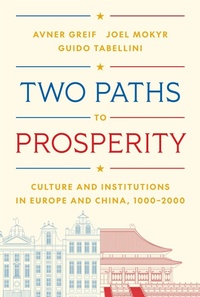
Two Paths to Prosperity
Culture and Institutions in Europe and China, 1000-2000
1st Edition
Published on 4. November 2025
544 pages
978-0-691-26771-5 (ISBN)
Description

How the social organization of Europe and China shaped their divergent economic and political trajectories over the past millennium
In the eleventh century, when Europe was still backward and poor, China was a rich and sophisticated civilization. Yet Europe became the birthplace of democracy and the Industrial Revolution, driving the Great Enrichment, while China stagnated until the end of the twentieth century and was always ruled by autocracies. Two Paths to Prosperity traces the emergence of two very different social organizations in premodern China and Europe-the clan and the corporation-showing how they were key factors in the economic and political divergence of these two great civilizations.
In this landmark book, three leading economists offer a bold new account of why Europe and China evolved along such different trajectories. In the early Middle Ages, public goods like risk sharing, religious worship, education, and conflict resolution were provided by nonstate organizations in both societies. China increasingly relied on kin-based cooperation within clans, while weaker kinship ties in Europe gave rise to corporations such as guilds, universities, and self-governing towns. Despite performing similar functions, clans and corporations were built on very different principles-with lasting consequences until today.
Providing a novel answer to a fundamental question in economic and political history, Two Paths to Prosperity shows how extended kinship in Chinese society facilitated the consolidation of autocracy and hindered innovation and economic development, and how corporations in Europe influenced emerging state institutions and set the stage for the Industrial Revolution.
In the eleventh century, when Europe was still backward and poor, China was a rich and sophisticated civilization. Yet Europe became the birthplace of democracy and the Industrial Revolution, driving the Great Enrichment, while China stagnated until the end of the twentieth century and was always ruled by autocracies. Two Paths to Prosperity traces the emergence of two very different social organizations in premodern China and Europe-the clan and the corporation-showing how they were key factors in the economic and political divergence of these two great civilizations.
In this landmark book, three leading economists offer a bold new account of why Europe and China evolved along such different trajectories. In the early Middle Ages, public goods like risk sharing, religious worship, education, and conflict resolution were provided by nonstate organizations in both societies. China increasingly relied on kin-based cooperation within clans, while weaker kinship ties in Europe gave rise to corporations such as guilds, universities, and self-governing towns. Despite performing similar functions, clans and corporations were built on very different principles-with lasting consequences until today.
Providing a novel answer to a fundamental question in economic and political history, Two Paths to Prosperity shows how extended kinship in Chinese society facilitated the consolidation of autocracy and hindered innovation and economic development, and how corporations in Europe influenced emerging state institutions and set the stage for the Industrial Revolution.
More details
Language
English
Place of publication
Princeton, NJ
United States
Publishing group
De Gruyter
Target group
Professional and scholarly
Edition type
Digital original
Product notice
Reflowable
Illustrations
16 b/w illus. 11 tables. 1 map.
File size
2,79 MB
ISBN-13
978-0-691-26771-5 (9780691267715)
Schweitzer Classification
Other editions
Additional editions

Avner Greif | Joel Mokyr | Guido Tabellini
Two Paths to Prosperity
Culture and Institutions in Europe and China, 1000-2000
Book
approx. 11/2025
Princeton University Press
€44.00
Not yet published
Persons
Avner Greif is the Bowman Family Endowed Professor Emeritus in Humanities and Sciences and Professor of Economics at Stanford University. Joel Mokyr, winner of the Nobel Prize in Economics, is the Robert H. Strotz Professor of Arts and Sciences and Professor of Economics and History at Northwestern University and Sackler Professor at the Eitan Berglas School of Economics at Tel Aviv University. Guido Tabellini is the Intesa Sanpaolo Chair in Political Economics and Vice President at Bocconi University.
Content
- Cover
- Contents
- Acknowledgments
- 1. Introduction
- 2. The Great Divergence
- 3. Morality and Social Organizations
- 4. The Social and Cultural Origins of the Great Bifurcation
- 5. The Clan and the Corporation
- 6. Social Organizations in Europe and China
- 7. Political Divergence
- 8. The State and Social Organizations
- 9. The Industrial Revolution
- 10. Modern China
- 11. Conclusions
- References
- Index
