

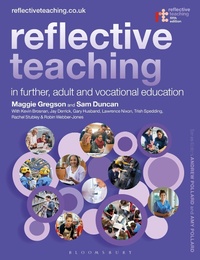
Reflective Teaching in Further, Adult and Vocational Education
5th Edition
Published on 14. May 2020
504 pages
978-1-350-10202-6 (ISBN)
Description

The definitive textbook for reflective professionals in further, adult and vocational education. Now updated with the latest research, the book offers extensive support for trainee and practising teachers in a variety of settings, for both practice-based training and career-long professionalism.
Written by a collaborative author team of sector experts led by Maggie Gregson and Sam Duncan, Reflective Teaching in Further, Adult and Vocational Education offers two levels of support:
- practical guidance for practitioner success, with a focus on the key issues including planning and assessing learning and collaborative approaches to reflective practice
- evidence-informed 'principles' to aid understanding of how theories can effectively inform and develop teaching practices
In addition to new case studies from a wider range of settings than ever before, the new edition offers broader national and international coverage, greater emphasis on work-based learning, and more ideas for exploring classroom communication and meeting a wider range of learner needs.
Readings for Reflective Teaching in Further, Adult and Vocational Education directly compliments this book, providing access to key texts, working as a compact and portable library.
reflectiveteaching.co.uk provides a treasure trove of additional support, including supplementary sector-specific material for considering questions around society's educational aims.
Written by a collaborative author team of sector experts led by Maggie Gregson and Sam Duncan, Reflective Teaching in Further, Adult and Vocational Education offers two levels of support:
- practical guidance for practitioner success, with a focus on the key issues including planning and assessing learning and collaborative approaches to reflective practice
- evidence-informed 'principles' to aid understanding of how theories can effectively inform and develop teaching practices
In addition to new case studies from a wider range of settings than ever before, the new edition offers broader national and international coverage, greater emphasis on work-based learning, and more ideas for exploring classroom communication and meeting a wider range of learner needs.
Readings for Reflective Teaching in Further, Adult and Vocational Education directly compliments this book, providing access to key texts, working as a compact and portable library.
reflectiveteaching.co.uk provides a treasure trove of additional support, including supplementary sector-specific material for considering questions around society's educational aims.
More details
Series
Edition
5th edition
Language
English
Place of publication
London
United Kingdom
Publishing group
Bloomsbury Publishing PLC
Target group
Professional and scholarly
Illustrations
39 bw illus
ISBN-13
978-1-350-10202-6 (9781350102026)
Copyright in bibliographic data and cover images is held by Nielsen Book Services Limited or by the publishers or by their respective licensors: all rights reserved.
Schweitzer Classification
Other editions
Additional editions
Margaret Gregson | Sam Duncan | Kevin Brosnan
Reflective Teaching in Further, Adult and Vocational Education
Book
06/2020
5th Edition
Bloomsbury Academic
€151.90
Shipment within 15-20 days
Persons
Margaret Gregson is Director of the Sunderland University Centre for Excellence in Teacher Training (SUNCETT) and Professor of Vocational Education at the University of Sunderland, UK.
Sam Duncan is Lecturer in Education in the Department of Lifelong and Comparative Education at IOE, UCL's Faculty of Education and Society, University College London, UK.
The author team: Kevin Brosnan and Gary Husband (University of Stirling, UK) | Jay Derrick (IOE, UCL's Faculty of Education and Society, University College London, UK) | Lawrence Nixon and Trish Spedding (University of Sunderland, UK) | Rachel Stubley (University of South Wales, UK) | Robin Webber-Jones (Sheffield College, UK)
Sam Duncan is Lecturer in Education in the Department of Lifelong and Comparative Education at IOE, UCL's Faculty of Education and Society, University College London, UK.
The author team: Kevin Brosnan and Gary Husband (University of Stirling, UK) | Jay Derrick (IOE, UCL's Faculty of Education and Society, University College London, UK) | Lawrence Nixon and Trish Spedding (University of Sunderland, UK) | Rachel Stubley (University of South Wales, UK) | Robin Webber-Jones (Sheffield College, UK)
Content
Foreword
How to Use this Book
Introduction
Part I: Becoming Reflective
1. Identity. Who are we? What do we stand for?
2. Learning. How can we understand learner development?
3. Reflection. How can we develop the quality of our practice
4. Principles. What are the foundations of effective teaching and learning?
Part II: Creating Conditions for Learning
5. Contexts. What is, and what might be?
6. Relationships. How are we getting on together?
7. Engagement. How are we preparing for teaching?
8. Spaces. How are we creating environments for learning?
Part III: Learning for Teaching
9. Curriculum. What is to be taught and learnt?
10. Planning. How are we implementing the curriculum?
11. Pedagogy. How can we develop effective strategies?
12. Communication. How can we support learning through dialogue?
13. Assessment. How are we providing feedback for learning?
Part IV: Reflecting on Outcomes
14. Quality. How are we evaluating student learning experiences/achievements?
15. Inclusion. How are we enabling opportunities?
Part V: Deepening Understanding
16. Expertise. How can we engage in conceptual, career-long, practice-focused professional development?
17. Professionalism. How does reflective teaching contribute to society and to ourselves?
Epilogue
Reflective activities
List of case studies and figures
Acknowledgements
Glossary
Bibliography
Index
How to Use this Book
Introduction
Part I: Becoming Reflective
1. Identity. Who are we? What do we stand for?
2. Learning. How can we understand learner development?
3. Reflection. How can we develop the quality of our practice
4. Principles. What are the foundations of effective teaching and learning?
Part II: Creating Conditions for Learning
5. Contexts. What is, and what might be?
6. Relationships. How are we getting on together?
7. Engagement. How are we preparing for teaching?
8. Spaces. How are we creating environments for learning?
Part III: Learning for Teaching
9. Curriculum. What is to be taught and learnt?
10. Planning. How are we implementing the curriculum?
11. Pedagogy. How can we develop effective strategies?
12. Communication. How can we support learning through dialogue?
13. Assessment. How are we providing feedback for learning?
Part IV: Reflecting on Outcomes
14. Quality. How are we evaluating student learning experiences/achievements?
15. Inclusion. How are we enabling opportunities?
Part V: Deepening Understanding
16. Expertise. How can we engage in conceptual, career-long, practice-focused professional development?
17. Professionalism. How does reflective teaching contribute to society and to ourselves?
Epilogue
Reflective activities
List of case studies and figures
Acknowledgements
Glossary
Bibliography
Index
