

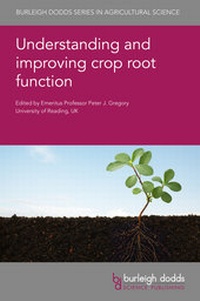
Understanding and improving crop root function
Published on 19. January 2021
686 pages
978-1-78676-362-4 (ISBN)
Description

".a well-curated collection of chapters that provides a broad state-of-the-art survey of how roots contribute to plant crop performance and edaphic stress tolerance.Given the urgency to deploy sustainable and resilient agricultural technologies, this excellent collection demonstrates how novel approaches and collaborative trans-disciplinarity can prepare the field of root biology for transformative, real-world impacts." (Annals of Botany)
Recent decades have seen a dramatic increase in research on plant roots. A deeper understanding of the complex ways roots interact with soils is making it possible to 'design' roots to optimise nutrient/water uptake in low-input environments, as well as deliver other benefits such as improved soil health and reduced nutrient leaching. Continued research is needed in this important area so that it can contribute to more sustainable, 'climate-smart' crop production.
Understanding and improving crop root function features authoritative reviews of current research in all aspects of root science, including root growth regulators, root anatomy, nutrient acquisition and root system architecture. This collection discusses the responses of plant roots to abiotic and biotic stresses and how understanding nutrient uptake can be exploited to optimise root function. The book concludes with a dedicated section on methods used to improve crop root function and crop nutrient use efficiency, such as the use of plant growth-promoting rhizobacteria (PGPR).
With its eminent editor and international array of expert authors, Understanding and improving crop root function will be a standard reference for university researchers in crop physiology and nutrition, government and other agencies supporting agriculture, companies supplying crop nutrition products and services, as well as farmers.
Recent decades have seen a dramatic increase in research on plant roots. A deeper understanding of the complex ways roots interact with soils is making it possible to 'design' roots to optimise nutrient/water uptake in low-input environments, as well as deliver other benefits such as improved soil health and reduced nutrient leaching. Continued research is needed in this important area so that it can contribute to more sustainable, 'climate-smart' crop production.
Understanding and improving crop root function features authoritative reviews of current research in all aspects of root science, including root growth regulators, root anatomy, nutrient acquisition and root system architecture. This collection discusses the responses of plant roots to abiotic and biotic stresses and how understanding nutrient uptake can be exploited to optimise root function. The book concludes with a dedicated section on methods used to improve crop root function and crop nutrient use efficiency, such as the use of plant growth-promoting rhizobacteria (PGPR).
With its eminent editor and international array of expert authors, Understanding and improving crop root function will be a standard reference for university researchers in crop physiology and nutrition, government and other agencies supporting agriculture, companies supplying crop nutrition products and services, as well as farmers.
More details
Series
Language
English
Place of publication
Cambridge
United Kingdom
Publishing group
Burleigh Dodds
Target group
University researchers in crop physiology and nutrition; government and other agencies supporting agriculture; companies supplying crop nutrition products and services; farmers
Illustrations
Color tables, photos and figures
ISBN-13
978-1-78676-362-4 (9781786763624)
DOI
10.19103/AS.2020.0075
Schweitzer Classification
Other editions
Additional editions
Peter J. Gregory
Understanding and Improving Crop Root Function
Book
01/2021
Burleigh Dodds Science Publishing Limited
€303.50
Shipment within 3-4 weeks
Persons
Editor
University of Reading
Dr Peter J. Gregory is Emeritus Professor of Global Food Security at the University of Reading, UK, where he was previously Professor of Soil Science. Amongst many distinctions, Professor Gregory is a former President of the International Society of Root Research (ISRR) as well as former Chief Executive of the Scottish Crop Research Institute (now part of the James Hutton Institute) and East Malling Research (now NIAB-EMR). He is internationally-renowned for his research in soil and crop root science.
Dr Peter J. Gregory is Emeritus Professor of Global Food Security at the University of Reading, UK, where he was previously Professor of Soil Science. Amongst many distinctions, Professor Gregory is a former President of the International Society of Root Research (ISRR) as well as former Chief Executive of the Scottish Crop Research Institute (now part of the James Hutton Institute) and East Malling Research (now NIAB-EMR). He is internationally-renowned for his research in soil and crop root science.
Contributions
Forschungszentrum Jülich (Germany)
The Pennsylvania State University (United States)
Nanjing Agricultural University
Ghent University
Ghent University
Tom Beeckman received his master's degree in Botany from the University of Ghent, Belgium, in 1985 and completed his Belgian interuniversity postgraduate education in Marine Biology in 1989. After performing postdoctoral research at the Laboratory of Genetics (Ghent University), he became Group Leader of the Root Development Group at the Flanders Institute of Biotechnology (VIB) in 2001. He then became a Professor at Ghent University in 2007, teaching plant developmental biology. His current work aims to understand how the branching pattern of roots becomes established by disentangling the molecular basis of lateral root spacing mechanisms that guarantee an optimal uptake.
Tom Beeckman received his master's degree in Botany from the University of Ghent, Belgium, in 1985 and completed his Belgian interuniversity postgraduate education in Marine Biology in 1989. After performing postdoctoral research at the Laboratory of Genetics (Ghent University), he became Group Leader of the Root Development Group at the Flanders Institute of Biotechnology (VIB) in 2001. He then became a Professor at Ghent University in 2007, teaching plant developmental biology. His current work aims to understand how the branching pattern of roots becomes established by disentangling the molecular basis of lateral root spacing mechanisms that guarantee an optimal uptake.
University of Nottingham
University of Nottingham
Amanda Rasmussen is Assistant Professor in the School of Biosciences at the University of Nottingham. She obtained her PhD at the University of Queensland, Australia (2011) before embarking on a Marie Curie International Incoming Fellowship at the University of Ghent (Belgium), followed by a Newton International Fellowship and the Nottingham Research Fellowship both at the University of Nottingham (UK).
Amanda Rasmussen is Assistant Professor in the School of Biosciences at the University of Nottingham. She obtained her PhD at the University of Queensland, Australia (2011) before embarking on a Marie Curie International Incoming Fellowship at the University of Ghent (Belgium), followed by a Newton International Fellowship and the Nottingham Research Fellowship both at the University of Nottingham (UK).
Agricultural University of Athens
Agricultural University of Athens
The James Hutton Institute
The James Hutton Institute
University of Dundee (United Kingdom)
Australian National University
La Trobe University
Chinese Academy of Sciences (China)
Forschungszentrum Juelich GmbH (Germany)
Western Sydney University (Australia)
Western Sydney University (Australia)
CSIC (Spain)
CSIC
Hawkesbury Institute for the Environment - Western Sydney University (Australia)
Hawkesbury Institute for the Environment - Western Sydney University (Australia)
University of California-Davis (United States)
The James Hutton Institute
Rothamsted Research
Professor Malcolm Hawkesford is head of the Plant Sciences Department at Rothamsted Research and leads the Institutes contribution to the UK Designing Future Wheat strategic research programme. He is a Honorary Professor in Plant Sciences in the School of Biosciences, University of Nottingham. He is an investigator on multiple international programmes with Brazil and India, is a lead investigator in the Defra-funded Wheat Genetic Improvement Network, participates in multiple BBSRC-funded projects aimed at optimizing resource use in wheat and is the lead scientist for major wheat GMO field experiments at Rothamsted. He is chair of the Nutrient Use Efficiency Expert Working Group of the International Wheat Initiative.
Professor Malcolm Hawkesford is head of the Plant Sciences Department at Rothamsted Research and leads the Institutes contribution to the UK Designing Future Wheat strategic research programme. He is a Honorary Professor in Plant Sciences in the School of Biosciences, University of Nottingham. He is an investigator on multiple international programmes with Brazil and India, is a lead investigator in the Defra-funded Wheat Genetic Improvement Network, participates in multiple BBSRC-funded projects aimed at optimizing resource use in wheat and is the lead scientist for major wheat GMO field experiments at Rothamsted. He is chair of the Nutrient Use Efficiency Expert Working Group of the International Wheat Initiative.
Rothamsted Research
The University of Western Australia (Australia)
The University of Western Australia (Australia)
The University of Western Australia (Australia)
The University of Western Australia (Australia)
China Agricultural University (China)
China Agricultural University (China)
China Agricultural University (China)
University of Western Australia
China Agricultural University (China)
University of Bayreuth (Germany)
Helmholtz Centre for Environmental Research-UFZ (Germany)
ETH Zurich
University of Bologna
Dr Roberto Tuberosa is Professor of Plant Biotechnology and Breeding in the Department of Agriculture and Food Science at the University of Bologna, Italy. Professor Tuberosa is internationally renowned for his genomic studies to dissect the genetic basis of drought resistance in cereals and how to leverage this knowledge toward the release of climate-resilient cultivars. He is on the editorial board of several leading journals, has been involved in many European and international research projects in cereal breeding, represents Europe in the International Crop Science Society (ICSS) and has published over 170 articles as well as edited a number of books. He has organised international congresses on genomics and breeding of cereals under drought conditions and is a member of the scientific board of the Wheat Initiative and of the PlantStress advisory board. Amongst other honours, Professor Tuberosa has been elected a Fellow of the Crop Society of America.
Dr Roberto Tuberosa is Professor of Plant Biotechnology and Breeding in the Department of Agriculture and Food Science at the University of Bologna, Italy. Professor Tuberosa is internationally renowned for his genomic studies to dissect the genetic basis of drought resistance in cereals and how to leverage this knowledge toward the release of climate-resilient cultivars. He is on the editorial board of several leading journals, has been involved in many European and international research projects in cereal breeding, represents Europe in the International Crop Science Society (ICSS) and has published over 170 articles as well as edited a number of books. He has organised international congresses on genomics and breeding of cereals under drought conditions and is a member of the scientific board of the Wheat Initiative and of the PlantStress advisory board. Amongst other honours, Professor Tuberosa has been elected a Fellow of the Crop Society of America.
University of Bologna
University of Bologna
University of Bologna
University of British Columbia
University of British Columbia
University of Leeds
University of Leeds
University of Leeds
University of Sheffield (United Kingdom)
University of Sheffield (United Kingdom)
CSIRO Agriculture and Food (Australia)
CSIRO Agriculture and Food (Australia)
CEBAS-CSIC
CSIR-Crops Research Institute (Ghana)
Lancaster Environment Centre (United Kingdom)
CSIRO Agriculture and Food (Australia)
CSIRO Agriculture and Food (Australia)
Graham Advisory (Australia)
Content
Part 1 Analysing root system architecture, growth and interactions with the rhizosphere
1.Advances in root architectural modeling: Johannes A. Postma, Forschungszentrum Jülich, Germany; and Christopher K. Black, The Pennsylania State University, USA;
2.The development of crop root architecture and optimization of nutrition acquisition: the case of rice: Wei Xuan, Nanjing Agricultural University, China; Yuanming Xie, Nanjing Agricultural University, China and Ghent University and VIB-UGent Center for Plant Systems Biology, Belgium; and Tom Beeckman, Ghent University and VIB-UGent Center for Plant Systems Biology, Belgium;
3.Advances in understanding plant root growth regulators: Findimila Dio Ishaya and Amanda Rasmussen, University of Nottingham, UK;
4.Advances in understanding plant root anatomy and nutrient acquisition: Dimitris L. Bouranis and Styliani N. Chorianopoulou, Agricultural University of Athens, Greece;
5.Advances in understanding plant root hairs in relation to nutrient acquisition and crop root function: Timothy S. George and Lawrie K. Brown, The James Hutton Institute, UK; and A. Glyn Bengough, University of Dundee, UK;
6.Understanding plant-root interactions
with rhizobacteria to improve biological nitrogen fixation in crops: Ulrike Mathesius, Australian National University, Australia; Jian Jin, La Trobe
University, Australia and Chinese Academy of Sciences, China; Yansheng Li, Chinese Academy of Sciences, China; and Michelle Watt, Forschungszentrum Juelich GmbH, Germany and University of Melbourne, Australia;
7.Advances in understanding
arbuscular mycorrhizal fungal effects on soil nutrient cycling: Haiyang Zhang and Jeff R. Powell, Western Sydney University, Australia;
Part 2 Root response to biotic threats
8.Advances in understanding plant root response to weedy root parasites: M. Fernández-Aparicio and D. Rubiales, CSIC, Spain;
9.Advances in understanding plant root responses to root-feeding insects: Scott N. Johnson, Hawkesbury Institute for the Environment - Western Sydney University, Australia; and Ximena Cibils-Stewart, Hawkesbury Institute
for the Environment - Western Sydney University, Australia and Instituto Nacional de Investigación Agropecuaria (INIA), Uruguay;
10.Advances in understanding plant root response to nematode attack: Shahid Siddique, University of California-Davis, USA; and John T. Jones, The James Hutton Institute and University of St Andrews, UK;
Part 3 Root uptake of nutrients and water
11.Advances in the understanding of nitrogen (N) uptake by plant roots: Malcolm J. Hawkesford and William R. Whalley, Rothamsted Research, UK;
12.Advances in understanding plant root uptake of phosphorus: Jiayin Pang, The University of Western Australia, Australia; Zhihui Wen, The University of Western Australia, Australia and China Agricultural University, China; Daniel Kidd and Megan H. Ryan, The University of Western Australia, Australia; Rui-Peng Yu, Long Li and Wen-Feng Cong, China Agricultural University, China; Kadambot H. M. Siddique, The University of Western Australia, Australia; and Hans Lambers, The University of Western Australia, Australia and China Agricultural University, China;
13.Advances in understanding plant root water uptake: Mutez Ali Ahmed, University of Bayreuth, Germany; Doris Vetterlein, Helmholtz Centre for Environmental Research-UFZ, Germany; and Andrea Carminati, University of Bayreuth, Germany;
Part 4 Improving root function
14.Understanding and exploiting the genetics of plant root traits: Roberto Tuberosa, Elisabetta Frascaroli, Marco Maccaferri and Silvio Salvi, University of Bologna, Italy;
15.The use of plant growth-promoting rhizobacteria (PGPR) to
improve root function and crop nutrient use efficiency: Melissa M. Larrabee and Louise M. Nelson, University of British Columbia, Canada;
16.The use of arbuscular mycorrhizal fungi to improve root function and nutrient-use efficiency: Tom Thirkell, Grace Hoysted, Ashleigh Elliott and Katie Field, University of Leeds, UK; and Tim Daniell, University of Sheffield, UK;
17.Using systems agronomy to
exploit deep roots in crops: John Kirkegaard and Julianne Lilley, CSIRO Agriculture and Food, Australia;
18.Rootstocks to improve root function and resource-use efficiency: Francisco Pérez-Alfocea, CEBAS-CSIC, Spain; Stephen Yeboah, CSIR-Crops Research Institute,
Ghana; and Ian C. Dodd, Lancaster Environment Centre, UK;
19.Delivering improved phosphorus acquisition by root systems in pasture and arable crops: Richard J. Simpson and Rebecca E. Haling, CSIRO Agriculture and Food, Australia; and Phillip Graham, Graham Advisory, Australia;
1.Advances in root architectural modeling: Johannes A. Postma, Forschungszentrum Jülich, Germany; and Christopher K. Black, The Pennsylania State University, USA;
2.The development of crop root architecture and optimization of nutrition acquisition: the case of rice: Wei Xuan, Nanjing Agricultural University, China; Yuanming Xie, Nanjing Agricultural University, China and Ghent University and VIB-UGent Center for Plant Systems Biology, Belgium; and Tom Beeckman, Ghent University and VIB-UGent Center for Plant Systems Biology, Belgium;
3.Advances in understanding plant root growth regulators: Findimila Dio Ishaya and Amanda Rasmussen, University of Nottingham, UK;
4.Advances in understanding plant root anatomy and nutrient acquisition: Dimitris L. Bouranis and Styliani N. Chorianopoulou, Agricultural University of Athens, Greece;
5.Advances in understanding plant root hairs in relation to nutrient acquisition and crop root function: Timothy S. George and Lawrie K. Brown, The James Hutton Institute, UK; and A. Glyn Bengough, University of Dundee, UK;
6.Understanding plant-root interactions
with rhizobacteria to improve biological nitrogen fixation in crops: Ulrike Mathesius, Australian National University, Australia; Jian Jin, La Trobe
University, Australia and Chinese Academy of Sciences, China; Yansheng Li, Chinese Academy of Sciences, China; and Michelle Watt, Forschungszentrum Juelich GmbH, Germany and University of Melbourne, Australia;
7.Advances in understanding
arbuscular mycorrhizal fungal effects on soil nutrient cycling: Haiyang Zhang and Jeff R. Powell, Western Sydney University, Australia;
Part 2 Root response to biotic threats
8.Advances in understanding plant root response to weedy root parasites: M. Fernández-Aparicio and D. Rubiales, CSIC, Spain;
9.Advances in understanding plant root responses to root-feeding insects: Scott N. Johnson, Hawkesbury Institute for the Environment - Western Sydney University, Australia; and Ximena Cibils-Stewart, Hawkesbury Institute
for the Environment - Western Sydney University, Australia and Instituto Nacional de Investigación Agropecuaria (INIA), Uruguay;
10.Advances in understanding plant root response to nematode attack: Shahid Siddique, University of California-Davis, USA; and John T. Jones, The James Hutton Institute and University of St Andrews, UK;
Part 3 Root uptake of nutrients and water
11.Advances in the understanding of nitrogen (N) uptake by plant roots: Malcolm J. Hawkesford and William R. Whalley, Rothamsted Research, UK;
12.Advances in understanding plant root uptake of phosphorus: Jiayin Pang, The University of Western Australia, Australia; Zhihui Wen, The University of Western Australia, Australia and China Agricultural University, China; Daniel Kidd and Megan H. Ryan, The University of Western Australia, Australia; Rui-Peng Yu, Long Li and Wen-Feng Cong, China Agricultural University, China; Kadambot H. M. Siddique, The University of Western Australia, Australia; and Hans Lambers, The University of Western Australia, Australia and China Agricultural University, China;
13.Advances in understanding plant root water uptake: Mutez Ali Ahmed, University of Bayreuth, Germany; Doris Vetterlein, Helmholtz Centre for Environmental Research-UFZ, Germany; and Andrea Carminati, University of Bayreuth, Germany;
Part 4 Improving root function
14.Understanding and exploiting the genetics of plant root traits: Roberto Tuberosa, Elisabetta Frascaroli, Marco Maccaferri and Silvio Salvi, University of Bologna, Italy;
15.The use of plant growth-promoting rhizobacteria (PGPR) to
improve root function and crop nutrient use efficiency: Melissa M. Larrabee and Louise M. Nelson, University of British Columbia, Canada;
16.The use of arbuscular mycorrhizal fungi to improve root function and nutrient-use efficiency: Tom Thirkell, Grace Hoysted, Ashleigh Elliott and Katie Field, University of Leeds, UK; and Tim Daniell, University of Sheffield, UK;
17.Using systems agronomy to
exploit deep roots in crops: John Kirkegaard and Julianne Lilley, CSIRO Agriculture and Food, Australia;
18.Rootstocks to improve root function and resource-use efficiency: Francisco Pérez-Alfocea, CEBAS-CSIC, Spain; Stephen Yeboah, CSIR-Crops Research Institute,
Ghana; and Ian C. Dodd, Lancaster Environment Centre, UK;
19.Delivering improved phosphorus acquisition by root systems in pasture and arable crops: Richard J. Simpson and Rebecca E. Haling, CSIRO Agriculture and Food, Australia; and Phillip Graham, Graham Advisory, Australia;
