

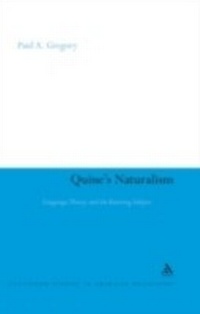
Quine's Naturalism
Language, Theory and the Knowing Subject
1st Edition
Published on 8. August 2008
156 pages
978-1-4411-1145-6 (ISBN)
Description

W. V. Quine was the most important naturalistic philosopher of the twentieth century and a major impetus for the recent resurgence of the view that empirical science is our best avenue to knowledge. His views, however, have not been well understood. Critics charge that Quine's naturalized epistemology is circular and that it cannot be normative. Yet, such criticisms stem from a cluster of fundamental traditional assumptions regarding language, theory, and the knowing subject - the very presuppositions that Quine is at pains to reject. Through investigation of Quine's views regarding language, knowledge, and reality, the author offers a new interpretation of Quine's naturalism. The naturalism/anti-naturalism debate can be advanced only by acknowledging and critiquing the substantial theoretical commitments implicit in the traditional view.
Gregory argues that the responses to the circularity and non-normativity objections do just that. His analysis further reveals that Quine's departure from the tradition penetrates the conception of the knowing subject, and he thus offers a new and engaging defence of Quine's naturalism.
Gregory argues that the responses to the circularity and non-normativity objections do just that. His analysis further reveals that Quine's departure from the tradition penetrates the conception of the knowing subject, and he thus offers a new and engaging defence of Quine's naturalism.
Reviews / Votes
'Paul Gregory has written a wonderfully clear and useful book on Quine's naturalistic epistemology. Gregory does a fine job of explaining central Quinean doctrines and their interrelationship, as well as providing an illuminating defense of these views against various objections.' Professor Hilary Kornblith, University of Massachusetts Amherst, USA Mention -Chronicle of Higher Education, February 27, 2009 'A useful book ... illuminating.' - International Studies in the Philosophy of Science 'An important contribution to the ongoing debate over philosophical naturalism. Gregory carefully articulates and answers the main objections that have been raised against Quine ... The book brings out very clearly the power of Quine's attack on traditional epistemology, and also the connections between Quine's epistemological tradition and of the classical analytic philosophers in the background of Quine's work. This clearly and engagingly written work casts important new light on Quine's contributions to the theory of knowledge, and to the development of contemporary naturalism.' Matthew Moore, CUNY * Blurb from reviewer * "the historical figure as he or she really was. In this I believe Gregory, with his firm command of a wide range of Quinean texts, and his close attention to implicit connections, has succeeded remarkably well." - Notre Dame Philosophical Review * Notre Dame Philosophical Reviews *More details
Series
Edition
1. Auflage
Language
English
Place of publication
New York
United States
Target group
Professional and scholarly
ISBN-13
978-1-4411-1145-6 (9781441111456)
Copyright in bibliographic data and cover images is held by Nielsen Book Services Limited or by the publishers or by their respective licensors: all rights reserved.
Schweitzer Classification
Other editions
Additional editions
Book
01/2012
Continuum Publishing Corporation
€55.60
Shipment within 15-20 days
Book
08/2008
Continuum International Publishing Group Ltd.
€221.80
Shipment within 15-20 days
Person
Paul A. Gregory is an Assistant Professor in Philosophy at Washington and Lee University, Virginia, USA.
Content
1. Introduction
2. "Epistemology Naturalized" and Naturalized Epistemology 3. Language, Theory, and Beginning In Mediis Rebus
4. Circularity and Beginning In Mediis Rebus
5. Normativity and Objectivity
6. Changing the Subject
Bibliography
2. "Epistemology Naturalized" and Naturalized Epistemology 3. Language, Theory, and Beginning In Mediis Rebus
4. Circularity and Beginning In Mediis Rebus
5. Normativity and Objectivity
6. Changing the Subject
Bibliography
