

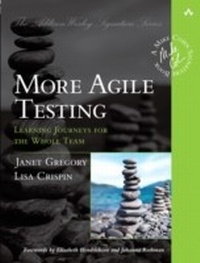
More Agile Testing
Learning Journeys for the Whole Team
1st Edition
Published on 30. September 2014
544 pages
978-0-13-374956-4 (ISBN)
Description

Janet Gregory and Lisa Crispin pioneered the agile testing discipline with their previous work, Agile Testing. Now, in More Agile Testing, they reflect on all they've learned since. They address crucial emerging issues, share evolved agile practices, and cover key issues agile testers have asked to learn more about.
Packed with new examples from real teams, this insightful guide offers detailed information about adapting agile testing for your environment; learning from experience and continually improving your test processes; scaling agile testing across teams; and overcoming the pitfalls of automated testing. You'll find brand-new coverage of agile testing for the enterprise, distributed teams, mobile/embedded systems, regulated environments, data warehouse/BI systems, and DevOps practices.
You'll come away understanding
* How to clarify testing activities within the team
* Ways to collaborate with business experts to identify valuable features and deliver the right capabilities
* How to design automated tests for superior reliability and easier maintenance
* How agile team members can improve and expand their testing skills
* How to plan "just enough," balancing small increments with larger feature sets and the entire system
* How to use testing to identify and mitigate risks associated with your current agile processes and to prevent defects
* How to address challenges within your product or organizational context
* How to perform exploratory testing using "personas" and "tours"
* Exploratory testing approaches that engage the whole team, using test charters with session- and thread-based techniques
* How to bring new agile testers up to speed quickly-without overwhelming them
The eBook edition of More Agile Testing also is available as part of a two-eBook collection, The Agile Testing Collection (9780134190624).
Packed with new examples from real teams, this insightful guide offers detailed information about adapting agile testing for your environment; learning from experience and continually improving your test processes; scaling agile testing across teams; and overcoming the pitfalls of automated testing. You'll find brand-new coverage of agile testing for the enterprise, distributed teams, mobile/embedded systems, regulated environments, data warehouse/BI systems, and DevOps practices.
You'll come away understanding
* How to clarify testing activities within the team
* Ways to collaborate with business experts to identify valuable features and deliver the right capabilities
* How to design automated tests for superior reliability and easier maintenance
* How agile team members can improve and expand their testing skills
* How to plan "just enough," balancing small increments with larger feature sets and the entire system
* How to use testing to identify and mitigate risks associated with your current agile processes and to prevent defects
* How to address challenges within your product or organizational context
* How to perform exploratory testing using "personas" and "tours"
* Exploratory testing approaches that engage the whole team, using test charters with session- and thread-based techniques
* How to bring new agile testers up to speed quickly-without overwhelming them
The eBook edition of More Agile Testing also is available as part of a two-eBook collection, The Agile Testing Collection (9780134190624).
All prices
More details
Series
Edition
1. Auflage
Language
English
Place of publication
Boston
United States
Publishing group
Pearson Education (US)
Target group
College/higher education
File size
9,92 MB
ISBN-13
978-0-13-374956-4 (9780133749564)
Copyright in bibliographic data and cover images is held by Nielsen Book Services Limited or by the publishers or by their respective licensors: all rights reserved.
Schweitzer Classification
Other editions
Additional editions
Lisa Crispin | Janet Gregory
More Agile Testing: Learning Journeys for the Whole Team
Learning Journeys for the Whole Team
Book
10/2014
1st Edition
Addison Wesley
€47.99
Shipment within 10-20 days
Persons
Janet Gregory is an agile testing coach and process consultant with DragonFire Inc. She is coauthor with Lisa Crispin of Agile Testing: A Practical Guide for Testers and Agile Teams (Addison-Wesley, 2009) and More Agile Testing: Learning Journeys for the Whole Team (Addison-Wesley, 2015). She is also a contributor to 97 Things Every Programmer Should Know. Janet specializes in showing agile teams how testers can add value in areas beyond critiquing the product, for example, guiding development with business-facing tests. Janet works with teams to transition to agile development and teaches agile testing courses and tutorials worldwide. She contributes articles to publications such as Better Software, Software Test & Performance Magazine, and Agile Journal and enjoys sharing her experiences at conferences and user group meetings around the world. For more about Janet's work and her blog, visit www.janetgregory.ca. You can also follow her on Twitter: @janetgregoryca.
Lisa Crispin is the coauthor with Janet Gregory of Agile Testing: A Practical Guide for Testers and Agile Teams (Addison-Wesley, 2009) and More Agile Testing: Learning Journeys for the Whole Team (Addison-Wesley,2015); she is also coauthor with Tip House of Extreme Testing (Addison-Wesley, 2002), and a contributor to Experiences of Test Automation by Dorothy Graham and Mark Fewster (Addison-Wesley, 2011) and Beautiful Testing (O'Reilly, 2009). Lisa was honored by her peers who voted her the Most Influential Agile Testing Professional Person at Agile Testing Days 2012. Lisa enjoys working as a tester with an awesome agile team. She shares her experiences via writing, presenting, teaching, and participating in agile testing communities around the world. For more about Lisa's work, visit www.lisacrispin.com, and follow @lisacrispin onTwitter.
Lisa Crispin is the coauthor with Janet Gregory of Agile Testing: A Practical Guide for Testers and Agile Teams (Addison-Wesley, 2009) and More Agile Testing: Learning Journeys for the Whole Team (Addison-Wesley,2015); she is also coauthor with Tip House of Extreme Testing (Addison-Wesley, 2002), and a contributor to Experiences of Test Automation by Dorothy Graham and Mark Fewster (Addison-Wesley, 2011) and Beautiful Testing (O'Reilly, 2009). Lisa was honored by her peers who voted her the Most Influential Agile Testing Professional Person at Agile Testing Days 2012. Lisa enjoys working as a tester with an awesome agile team. She shares her experiences via writing, presenting, teaching, and participating in agile testing communities around the world. For more about Lisa's work, visit www.lisacrispin.com, and follow @lisacrispin onTwitter.
Content
Part I: Introduction
Chapter 1: How Agile Testing Has Evolved
Chapter 2: The Importance of Organizational Culture
Part II: Learning for Better Testing
Chapter 3: Roles and Competencies
Chapter 4: Thinking Skills for Testing
Chapter 5: Technical Awareness
Chapter 6: How to Learn
Part III: Planning-So You Don't Forget the Big Picture
Chapter 7: Levels of Precision for Planning
Chapter 8: Using Models to Help Plan
Part IV: Testing Business Value
Chapter 9: Are We Building the Right Thing?
Chapter 10: The Expanding Tester's Mindset: Is This My Job?
Chapter 11: Getting Examples
Part V: Investigative Testing
Chapter 12: Exploratory Testing
Chapter 13: Other Types of Testing
Part VI: Test Automation
Chapter 14: Technical Debt in Testing
Chapter 15: Pyramids of Automation
Chapter 16: Test Automation Design Patterns and Approaches
Chapter 17: Selecting Test Automation Solutions
Part VII: What Is Your Context?
Chapter 18: Agile Testing in the Enterprise
Chapter 19: Agile Testing on Distributed Teams
Chapter 20: Agile Testing for Mobile and Embedded Systems
Chapter 21: Agile Testing in Regulated Environments
Chapter 22: Agile Testing for Data Warehouses and Business Intelligence Systems
Chapter 23: Testing and DevOps
Part VIII: Agile Testing in Practice
Chapter 1: How Agile Testing Has Evolved
Chapter 2: The Importance of Organizational Culture
Part II: Learning for Better Testing
Chapter 3: Roles and Competencies
Chapter 4: Thinking Skills for Testing
Chapter 5: Technical Awareness
Chapter 6: How to Learn
Part III: Planning-So You Don't Forget the Big Picture
Chapter 7: Levels of Precision for Planning
Chapter 8: Using Models to Help Plan
Part IV: Testing Business Value
Chapter 9: Are We Building the Right Thing?
Chapter 10: The Expanding Tester's Mindset: Is This My Job?
Chapter 11: Getting Examples
Part V: Investigative Testing
Chapter 12: Exploratory Testing
Chapter 13: Other Types of Testing
Part VI: Test Automation
Chapter 14: Technical Debt in Testing
Chapter 15: Pyramids of Automation
Chapter 16: Test Automation Design Patterns and Approaches
Chapter 17: Selecting Test Automation Solutions
Part VII: What Is Your Context?
Chapter 18: Agile Testing in the Enterprise
Chapter 19: Agile Testing on Distributed Teams
Chapter 20: Agile Testing for Mobile and Embedded Systems
Chapter 21: Agile Testing in Regulated Environments
Chapter 22: Agile Testing for Data Warehouses and Business Intelligence Systems
Chapter 23: Testing and DevOps
Part VIII: Agile Testing in Practice
