

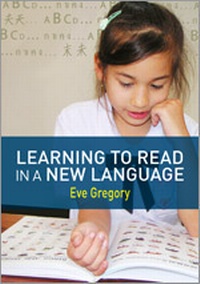
Learning to Read in a New Language
Making Sense of Words and Worlds
2nd Edition
Published on 3. March 2008
256 pages
978-1-84920-491-0 (ISBN)
Description

'[This book] is a helpful edition to a field where there is a limited amount of good literature to support teachers dealing with second language acquisition in the classroom' - ESCalate
`Gregory's book is an important and timely contribution to the literature on literacy, biliteracy, second language learning and early childhood education, synthesizing cutting-edge research, perspectives and teaching approaches in a clear and accessible way. Overall, it is a terrific resource' - Dinah Volk
Across the world, an increasing number of young children are learning to read in languages different from their mother tongue, and there is a clear need for a book which addresses the ways in which these children should be taught. Eve Gregory's book is unique in doing so.
Building upon the ideas proposed in Making Sense of a New World, this second edition widens its scope, arguing for the limitations of policies designed for 'monolingual minds' in favour of methodologies which put plurilingualism at the centre of literacy tuition.
This book offers a practical reading programme -- an 'Inside-Out' (starting from experience) and 'Outside-In' (starting from literature) approach to teaching which can be used with individuals, small groups and whole classes. It uses current sociocultural theory, while drawing on examples of children from America, Australia, Britain, China, France, Singapore, South Africa and Thailand who are engaged in learning to read nursery rhymes and songs, storybooks, letters, the Bible and the Qur'an as well as school texts, in languages they do not speak fluently.
Gregory argues that, in order for literacy tuition to be successful, reading must make sense -- children must feel part of a community of readers. There is no common method which they use to learn, but rather a shared aim to which they aspire: making sense of a new world through new words.
Eve Gregory is Professor of Language and Culture in Education at Goldsmiths, University of London.
`Gregory's book is an important and timely contribution to the literature on literacy, biliteracy, second language learning and early childhood education, synthesizing cutting-edge research, perspectives and teaching approaches in a clear and accessible way. Overall, it is a terrific resource' - Dinah Volk
Across the world, an increasing number of young children are learning to read in languages different from their mother tongue, and there is a clear need for a book which addresses the ways in which these children should be taught. Eve Gregory's book is unique in doing so.
Building upon the ideas proposed in Making Sense of a New World, this second edition widens its scope, arguing for the limitations of policies designed for 'monolingual minds' in favour of methodologies which put plurilingualism at the centre of literacy tuition.
This book offers a practical reading programme -- an 'Inside-Out' (starting from experience) and 'Outside-In' (starting from literature) approach to teaching which can be used with individuals, small groups and whole classes. It uses current sociocultural theory, while drawing on examples of children from America, Australia, Britain, China, France, Singapore, South Africa and Thailand who are engaged in learning to read nursery rhymes and songs, storybooks, letters, the Bible and the Qur'an as well as school texts, in languages they do not speak fluently.
Gregory argues that, in order for literacy tuition to be successful, reading must make sense -- children must feel part of a community of readers. There is no common method which they use to learn, but rather a shared aim to which they aspire: making sense of a new world through new words.
Eve Gregory is Professor of Language and Culture in Education at Goldsmiths, University of London.
Reviews / Votes
'Ever Gregory writes with understanding and passion about how children learn to read in a new language, and how they become bi-literate....The book requires no specialist knowledge on the part of the reader; Gregory writes in plain English and any technical terms are clearly explained' - Speaking English'[This book] is a helpful edition to a field where there is a limited amount of good literature to support teachers dealing with second language acquisition in the classroom' - ESCalate
'Gregory's book is an important and timely contribution to the literature on literacy, biliteracy, second language learning, and early childhood education, synthesizing cutting-edge research, perspectives, and teaching approaches in a clear and accessible way. Overall, it is a terrific resource' - Dinah Volk
All prices
More details
Edition
Second Edition
Language
English
Place of publication
London
United Kingdom
Target group
College/higher education
Professional and scholarly
ISBN-13
978-1-84920-491-0 (9781849204910)
Copyright in bibliographic data and cover images is held by Nielsen Book Services Limited or by the publishers or by their respective licensors: all rights reserved.
Schweitzer Classification
Other editions
Additional editions
Book
03/2008
2nd Edition
SAGE Publications Inc
€122.90
Shipment within 10-20 days
Book
03/2008
2nd Edition
SAGE Publications Inc
€252.55
Shipment within 10-20 days
Person
Eve Gregory is Head of the Department of Educational Studies at Goldsmiths University of London.
Content
Setting the Scene
Learning to Read Differently
The Social Context: Important Practices
Family and Community Contexts: Important Others
The Context of the Mind: Important Knowledge
Using the Same Clues Differently
From Theory to Practice
Starting with the Word: The 'Inside-Out' Approach to Reading
Starting with the World: The 'Outside-In' Approach to Reading
Linking the 'Inside-Out' and 'Outside-In' Approaches: Ideas for Groups and Classes
Learning to Read Differently
The Social Context: Important Practices
Family and Community Contexts: Important Others
The Context of the Mind: Important Knowledge
Using the Same Clues Differently
From Theory to Practice
Starting with the Word: The 'Inside-Out' Approach to Reading
Starting with the World: The 'Outside-In' Approach to Reading
Linking the 'Inside-Out' and 'Outside-In' Approaches: Ideas for Groups and Classes
