

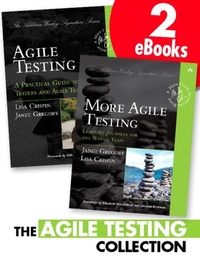
Agile Testing Collection, The
1st Edition
Published on 22. June 2015
1114 pages
978-0-13-419063-1 (ISBN)
Description

A Comprehensive Collection of Agile Testing Best Practices: Two Definitive Guides from Leading Pioneers
Janet Gregory and Lisa Crispin haven't just pioneered agile testing, they have also written two of the field's most valuable guidebooks. Now, you can get both guides in one indispensable eBook collection: today's must-have resource for all agile testers, teams, managers, and customers. Combining comprehensive best practices and wisdom contained in these two titles, The Agile Testing Collection will help you adapt agile testing to your environment, systematically improve your skills and processes, and strengthen engagement across your entire development team.
The first title, Agile Testing: A Practical Guide for Testers and Agile Teams, defines the agile testing discipline and roles, and helps you choose, organize, and use the tools that will help you the most. Writing from the tester's viewpoint, Gregory and Crispin chronicle an entire agile software development iteration, and identify and explain seven key success factors of agile testing.
The second title, More Agile Testing: Learning Journeys for the Whole Team, addresses crucial emerging issues, shares evolved practices, and covers key issues that delivery teams want to learn more about. It offers powerful new insights into continuous improvement, scaling agile testing across teams and the enterprise, overcoming pitfalls of automation, testing in regulated environments, integrating DevOps practices, and testing mobile/embedded and business intelligence systems.
The Agile Testing Collection will help you do all this and much more.
Customize agile testing processes to your needs, and successfully transition to them
Organize agile teams, clarify roles, hire new testers, and quickly bring them up to speed
Engage testers in agile development, and help agile team members improve their testing skills
Use tests and collaborate with business experts to plan features and guide development
Design automated tests for superior reliability and easier maintenance
Plan "just enough," balancing small increments with larger feature sets and the entire system
Test to identify and mitigate risks, and prevent future defects
Perform exploratory testing using personas, tours, and test charters with session- and thread-based techniques
Help testers, developers, and operations experts collaborate on shortening feedback cycles with continuous integration and delivery
Both guides in this collection are thoroughly grounded in the authors' extensive experience, and supported by examples from actual projects. Now, with both books integrated into a single, easily searchable, and cross-linked eBook, you can learn from their experience even more easily.
Janet Gregory and Lisa Crispin haven't just pioneered agile testing, they have also written two of the field's most valuable guidebooks. Now, you can get both guides in one indispensable eBook collection: today's must-have resource for all agile testers, teams, managers, and customers. Combining comprehensive best practices and wisdom contained in these two titles, The Agile Testing Collection will help you adapt agile testing to your environment, systematically improve your skills and processes, and strengthen engagement across your entire development team.
The first title, Agile Testing: A Practical Guide for Testers and Agile Teams, defines the agile testing discipline and roles, and helps you choose, organize, and use the tools that will help you the most. Writing from the tester's viewpoint, Gregory and Crispin chronicle an entire agile software development iteration, and identify and explain seven key success factors of agile testing.
The second title, More Agile Testing: Learning Journeys for the Whole Team, addresses crucial emerging issues, shares evolved practices, and covers key issues that delivery teams want to learn more about. It offers powerful new insights into continuous improvement, scaling agile testing across teams and the enterprise, overcoming pitfalls of automation, testing in regulated environments, integrating DevOps practices, and testing mobile/embedded and business intelligence systems.
The Agile Testing Collection will help you do all this and much more.
Customize agile testing processes to your needs, and successfully transition to them
Organize agile teams, clarify roles, hire new testers, and quickly bring them up to speed
Engage testers in agile development, and help agile team members improve their testing skills
Use tests and collaborate with business experts to plan features and guide development
Design automated tests for superior reliability and easier maintenance
Plan "just enough," balancing small increments with larger feature sets and the entire system
Test to identify and mitigate risks, and prevent future defects
Perform exploratory testing using personas, tours, and test charters with session- and thread-based techniques
Help testers, developers, and operations experts collaborate on shortening feedback cycles with continuous integration and delivery
Both guides in this collection are thoroughly grounded in the authors' extensive experience, and supported by examples from actual projects. Now, with both books integrated into a single, easily searchable, and cross-linked eBook, you can learn from their experience even more easily.
All prices
More details
Series
Edition
1. Auflage
Language
English
Place of publication
Boston
United States
Publishing group
Pearson Education (US)
Target group
College/higher education
File size
16,57 MB
ISBN-13
978-0-13-419063-1 (9780134190631)
Copyright in bibliographic data and cover images is held by Nielsen Book Services Limited or by the publishers or by their respective licensors: all rights reserved.
Schweitzer Classification
Persons
Janet Gregory is an agile testing coach and process consultant with DragonFire Inc. She is coauthor with Lisa Crispin of Agile Testing: A Practical Guide for Testers and Agile Teams (Addison-Wesley, 2009) and More Agile Testing: Learning Journeys for the Whole Team (Addison-Wesley, 2015). She is also a contributor to 97 Things Every Programmer Should Know. Janet specializes in showing agile teams how testers can add value in areas beyond critiquing the product, for example, guiding development with business-facing tests. Janet works with teams to transition to agile development and teaches agile testing courses and tutorials worldwide. She contributes articles to publications such as Better Software, Software Test & Performance Magazine, and Agile Journal, and enjoys sharing her experiences at conferences and user group meetings around the world. For more about Janet's work and her blog, visit janetgregory.ca. You can also follow her on Twitter: @janetgregoryca.
Lisa Crispin is the coauthor with Janet Gregory of Agile Testing: A Practical Guide for Testers and Agile Teams (Addison-Wesley, 2009) and More Agile Testing: Learning Journeys for the Whole Team (Addison-Wesley, 2015); she is also coauthor with Tip House of Extreme Testing (Addison-Wesley, 2002), and a contributor to Experiences of Test Automation byDorothy Graham and Mark Fewster (Addison-Wesley, 2011) and Beautiful Testing (O'Reilly, 2009). Lisa was honored by her peers, who voted her the Most Influential Agile Testing Professional Person at Agile Testing Days 2012. Lisa enjoys working as a tester and works with an awesome agile team. She shares her experiences via writing, presenting, teaching, and participating in agile testing communities around the world. For more about Lisa's work, visit lisacrispin.com, and follow her on Twitter: @lisacrispin.
Lisa Crispin is the coauthor with Janet Gregory of Agile Testing: A Practical Guide for Testers and Agile Teams (Addison-Wesley, 2009) and More Agile Testing: Learning Journeys for the Whole Team (Addison-Wesley, 2015); she is also coauthor with Tip House of Extreme Testing (Addison-Wesley, 2002), and a contributor to Experiences of Test Automation byDorothy Graham and Mark Fewster (Addison-Wesley, 2011) and Beautiful Testing (O'Reilly, 2009). Lisa was honored by her peers, who voted her the Most Influential Agile Testing Professional Person at Agile Testing Days 2012. Lisa enjoys working as a tester and works with an awesome agile team. She shares her experiences via writing, presenting, teaching, and participating in agile testing communities around the world. For more about Lisa's work, visit lisacrispin.com, and follow her on Twitter: @lisacrispin.
Content
Agile Testing: A Practical Guide for Testers and Agile Teams
Note from the Publisher iiA
Foreword by Mike Cohn xxxvA
Foreword by Brian Marick xxxviiA
Preface xviiiiA
Acknowledgments xlixA
About the Authors liiiA
Part I: Introduction 1A
Chapter 1: What Is Agile Testing, Anyway? 3A
Agile Values 3A
What Do We Mean by "Agile Testing"? 4A
A Little Context for Roles and Activities on an Agile Team 7A
How Is Agile Testing Different? 9A
Whole-Team Approach 15A
Summary 17A
Chapter 2: Ten Principles for Agile Testers 19A
What's an Agile Tester? 19A
The Agile Testing Mind-Set 20A
Applying Agile Principles and Values 21A
Adding Value 31A
Summary 33A
Part II: Organizational Challenges 35A
Chapter 3: Cultural Challenges 37A
Organizational Culture 37A
Barriers to Successful Agile Adoption by Test/QA Teams 44A
Introducing Change 49A
Management Expectations 52A
Change Doesn't Come Easy 56A
Summary 58A
Chapter 4: Team Logistics 59A
Team Structure 59A
Physical Logistics 65A
Resources 66A
Building a Team 69A
Summary 71A
Chapter 5: Transitioning Typical Processes 73A
Seeking Lightweight Processes 73A
Metrics 74A
Defect Tracking 79A
Test Planning 86A
Existing Processes and Models 88A
Summary 93A
Part III: The Agile Testing Quadrants 95A
Chapter 6: The Purpose of Testing 97A
The Agile Testing Quadrants 97A
Knowing When a Story Is Done 104A
Managing Technical Debt 106A
Testing in Context 106A
Summary 108A
Chapter 7: Technology-Facing Tests that Support the Team 109A
An Agile Testing Foundation 109A
Why Write and Execute These Tests? 112A
Where Do Technology-Facing Tests Stop? 119A
What If the Team Doesn't Do These Tests? 121A
Toolkit 123A
Summary 127A
Chapter 8: Business-Facing Tests that Support the Team 129A
Driving Development with Business-Facing Tests 129A
T
Note from the Publisher iiA
Foreword by Mike Cohn xxxvA
Foreword by Brian Marick xxxviiA
Preface xviiiiA
Acknowledgments xlixA
About the Authors liiiA
Part I: Introduction 1A
Chapter 1: What Is Agile Testing, Anyway? 3A
Agile Values 3A
What Do We Mean by "Agile Testing"? 4A
A Little Context for Roles and Activities on an Agile Team 7A
How Is Agile Testing Different? 9A
Whole-Team Approach 15A
Summary 17A
Chapter 2: Ten Principles for Agile Testers 19A
What's an Agile Tester? 19A
The Agile Testing Mind-Set 20A
Applying Agile Principles and Values 21A
Adding Value 31A
Summary 33A
Part II: Organizational Challenges 35A
Chapter 3: Cultural Challenges 37A
Organizational Culture 37A
Barriers to Successful Agile Adoption by Test/QA Teams 44A
Introducing Change 49A
Management Expectations 52A
Change Doesn't Come Easy 56A
Summary 58A
Chapter 4: Team Logistics 59A
Team Structure 59A
Physical Logistics 65A
Resources 66A
Building a Team 69A
Summary 71A
Chapter 5: Transitioning Typical Processes 73A
Seeking Lightweight Processes 73A
Metrics 74A
Defect Tracking 79A
Test Planning 86A
Existing Processes and Models 88A
Summary 93A
Part III: The Agile Testing Quadrants 95A
Chapter 6: The Purpose of Testing 97A
The Agile Testing Quadrants 97A
Knowing When a Story Is Done 104A
Managing Technical Debt 106A
Testing in Context 106A
Summary 108A
Chapter 7: Technology-Facing Tests that Support the Team 109A
An Agile Testing Foundation 109A
Why Write and Execute These Tests? 112A
Where Do Technology-Facing Tests Stop? 119A
What If the Team Doesn't Do These Tests? 121A
Toolkit 123A
Summary 127A
Chapter 8: Business-Facing Tests that Support the Team 129A
Driving Development with Business-Facing Tests 129A
T
