

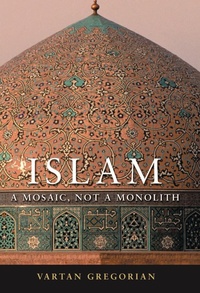
Islam
A Mosaic, Not a Monolith
1st Edition
Published on 29. May 2003
144 pages
978-0-8157-9602-2 (ISBN)
Description

After World War II, leading western powers focused their attention on fighting the ""Red Menace,"" Communism. Today, as terrorist activity is increasingly linked to militant Islamism, some politicians and scholars fear a ""Green Menace,"" a Pan-Islamic totalitarian movement fueled by monolithic religious ideology. Such fears have no foundation in history, according to Vartan Gregorian. In this succinct, powerful survey of Islam, Gregorian focuses on Muslim diversity and division, portraying the faith and its people as a mosaic, not a monolith. The book begins with an accessible overview of Islam's tenets, institutions, evolution, and historical role. Gregorian traces its origins and fundamental principles, from Muhammad's call to faith nearly 1,400 years ago to the defeat of the Ottoman Empire in World War I, and the subsequent abolition of the Caliphate. He focuses particular attention on the intense struggle between modernists and traditionalists, interaction between religion and nationalism, and key developments that have caused bitter divisions among Muslim nations and states: the partitions of Palestine, the break up and Islamization of Pakistan, the 1978 revolution in Iran, and the 1979 Soviet invasion of Afghanistan. Today Islamist views range across the entire spectra of religious and political thought, and Islamism is anything but a unified movement. While religious extremists have attempted to form a confederacy of like-minded radicals in many countries, much of the Muslim population lives in relatively modern, secular states. Gregorian urges Westerners to distinguish between activist Islamist parties, which promote¿sometimes violently¿Islam as an ideology in a theocratic state, and Islamic parties, whose traditional members want their secular political systems to co-exist with the moral principles of their religion. Gregorian emphasizes the importance of religion in today's world and urges states,societies, and intellectuals to intervene in order
More details
Edition
1. Auflage
Language
English
Place of publication
New York
United States
Publishing group
Bloomsbury Publishing Plc
ISBN-13
978-0-8157-9602-2 (9780815796022)
Copyright in bibliographic data and cover images is held by Nielsen Book Services Limited or by the publishers or by their respective licensors: all rights reserved.
Schweitzer Classification
Other editions
Person
By Vartan Gregorian
Content
- Cover
- Title Page
- Contents
- Preface
- Introduction
- Chapter One. A Brief Survey of Islam
- Chapter Two. Clash of Modernists and Traditionalists
- Chapter Three. Challenges of the Twentieth Century
- Chapter Four. Islamism: Liberation Politics
- Chapter Five. Quests for Democracy and Modernity
- Chapter Six. Need for Mutual Knowledge and Understanding
- Notes
- Index
