

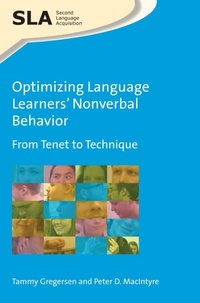
Optimizing Language Learners' Nonverbal Behavior
From Tenet to Technique
Published on 8. March 2017
400 pages
978-1-78309-738-8 (ISBN)
Description

This book highlights the pivotal role that nonverbal behavior plays in target language communication, affect and cognition. It integrates research tenets and video demonstrations of nonverbal behavior with structured activities that will guide teachers and learners of any language to capitalize on the nonverbal means at their disposal. It does not shy away from the challenges that nonverbal communication poses in target language communication, including issues of personal and cultural identity that emerge with languages around the world. With its easy-to-use format, solid research support, and fully integrated activities and videos, this book is an essential resource for anyone interested in working with the nonverbal dimensions of communication. The text will be especially valuable for language educators, pre- and in-service teachers who are looking for classroom resources and ideas, who want to create positive classroom environments and want to improve learner interaction and communication while increasing language proficiency. This book is a valuable resource for anyone who interacts with other people in more than one language.
Reviews / Votes
A must-read for 2017, this book is an excellent primer in nonverbal behavior and its related concepts. The text is easy to read, discusses the nonverbal codes at length, and contains detailed exercises on all the chapters. The book includes many research citations, so you can be confident that you are getting an up-to-date tool. Please be sure to put this on the top of your adoption book list in the beginning of the year. -- Michael H. Eaves, Valdosta State University, USA Gregersen and MacIntyre steer us skilfully through the complex field of nonverbal communication. They provide an in-depth examination of the multitude of ways nonverbal behaviour influences communication, and a cornucopia of activities for teachers to use with their learners. This book is a welcome addition to the literature that succeeds in moving this important field forward. -- Marion Williams, University of Exeter, UK Gregersen and MacIntyre focus attention on the often neglected aspects of non-verbal behavior, giving first an overview of key areas, and then presenting more than a hundred ready-made activities for language teachers to use in the classroom. A valuable addition to the library of any language teacher or motivated intercultural traveler. -- Joe McVeigh, co-author Tips for Teaching Culture: A Practical Approach to Intercultural Communication, USAMore details
Series
Language
English
Place of publication
Bristol
United Kingdom
Publishing group
Channel View Publications Ltd
Target group
College/higher education
Professional and scholarly
Product notice
Reflowable
ISBN-13
978-1-78309-738-8 (9781783097388)
Copyright in bibliographic data and cover images is held by Nielsen Book Services Limited or by the publishers or by their respective licensors: all rights reserved.
Schweitzer Classification
Other editions
Additional editions
Tammy Gregersen | Peter D. MacIntyre
Optimizing Language Learners' Nonverbal Behavior
From Tenet to Technique
Book
03/2017
Multilingual Matters
€57.00
Shipment within 10-20 days
Persons
Tammy Gregersen is Professor of TESOL at the University of Northern Iowa, USA. Her research interests include language teacher education, individual differences, positive psychology, nonverbal communication, emotion and affect. She is the co-author (with Peter D. MacIntyre) of Capitalizing on Language Learners' Individuality (2014) and co-editor (with Peter D. MacIntyre and Sarah Mercer) of Positive Psychology in SLA (2016).
Peter D. MacIntyre is Professor of Psychology at Cape Breton University, Canada. He has published widely on the themes of emotion, motivation and cognition and is the co-editor (with Zoltan Doernyei and Alastair Henry) of Motivational Dynamics in Language Learning (2014).
Peter D. MacIntyre is Professor of Psychology at Cape Breton University, Canada. He has published widely on the themes of emotion, motivation and cognition and is the co-editor (with Zoltan Doernyei and Alastair Henry) of Motivational Dynamics in Language Learning (2014).
Content
Part 1: Introduction
Part 2: Codes
1. Gesture
2. Posture
3. Facial Expression
4. Eye Behavior
5. Space and Touch
6. Prosody
Part 3: Activities
1. Communicative Techniques
2. Affective Techniques
3. Cognitive Techniques
Conclusion - Nonverbal Positive Communication
References
Author Index
Subject Index
Part 2: Codes
1. Gesture
2. Posture
3. Facial Expression
4. Eye Behavior
5. Space and Touch
6. Prosody
Part 3: Activities
1. Communicative Techniques
2. Affective Techniques
3. Cognitive Techniques
Conclusion - Nonverbal Positive Communication
References
Author Index
Subject Index
