

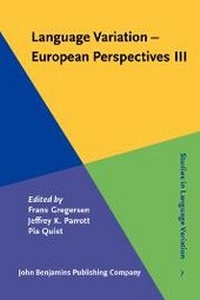
Language Variation - European Perspectives III
Selected papers from the 5th International Conference on Language Variation in Europe (ICLaVE 5), Copenhagen, June 2009
1st Edition
Published on 16. March 2011
VI, 260 pages
978-90-272-8737-3 (ISBN)
Description

Language Variation - European Perspectives III contains 18 selected papers from the International Conference on Language Variation in Europe which took place in Copenhagen 2009. The volume includes plenaries by Penelope Eckert ('Where does the social stop?') and Brit Mæhlum (on how cities have been viewed by dialectologists, sociolinguists - and lay people). In between these two longer papers, the editors have selected 16 others ranging over a wide field of interest from phonetics (i.a. Stuart-Smith, Timmins and Alam) via syntax (Wiese) to information structure (Moore and Snell) and from cognitive semantics (Levshina, Geeraerts and Spelman) to the perceptual study of intonation (Feizollahi and Soukup). Several of the papers concern methodological questions within corpus based studies of variation (Buchstaller and Corrigan, Vangsnes and Johannessen, and Ruus and Duncker). Taken as a whole the papers demonstrate how wide the field of variation studies has become during the last two decades. It is now central to almost all linguistic subfields.
More details
Other editions
Additional editions
Frans Gregersen | Jeffrey K. Parrott | Pia Quist
Language Variation - European Perspectives III
Selected papers from the 5th International Conference on Language Variation in Europe (ICLaVE 5), Copenhagen, June 2009
Book
03/2011
John Benjamins Publishing Co
€104.94
Shipment within 10-15 days
Persons
Content
- Language Variation - European Perspectives III
- Editorial page
- Title page
- LCC data
- Table of contents
- Introduction
- 1. History of ICLaVE
- 2. Mission of ICLaVE
- 3. The papers introduced
- 4. Themes and perspectives
- References
- Where does the social stop?
- 1. Pushing on the meaning of variation
- 2. How do kids learn the meaning of variation?
- 3. Size, affect, and sound symbolism
- 3.1 Colette
- 3.2 Rachel
- 4. Conclusion
- References
- The role of intonation in Austrian listeners' perceptions of standard-dialect shifting
- 1. Theoretical background: 'Speaker Design'
- 2. Sociolinguistic background: Language use and perception in Austria
- 3. The perception experiment
- 4. Results
- 5. Conclusion
- References
- Appendix
- Short sentence - intonational contours recorded:
- Declaratives
- Questions
- Hybridity and ethnic accents
- 1. Background
- 2. Methodology
- 3. The vowels FACE and GOAT in Glasgow Asian
- 4. Syllable-initial /l/ in Glasgow Asian
- 5. Discussion
- 6. Conclusions
- References
- A contact-linguistic view on Finland-Swedish quotatives vara, 'be', and att, 'that'
- 1. Vara
- 1.1 Finnish and English counterparts
- 1.2 Internal explanations
- 2. Att
- 2.1 Finnish and English counterparts
- 2.2 Internal explanations
- 3. Conclusions
- References
- Quotations and quotatives in the speech of three Danish generations
- 1. Introduction
- 2. Definition of quotations
- 2.1 Proposed definition
- 3. Quotations in three Danish generations
- 3.1 Data
- 3.2 Frequency
- 3.3 Quotation markers
- 3.4 Quotative verbs
- 3.4.1 Quotative particles
- 3.4.2 Interjections as quotation markers
- 4. Conclusion
- References
- The role of information structure in linguistic variation
- 1. Introduction
- 2. Grammatical reduction and innovation in a German multiethnolect: Kiezdeutsch
- 3. Information structure as a source of new variation
- 3.1 Word order variation in the left periphery of sentences
- 3.2 New usages of the particle "so"
- 4. Conclusion: Language variation and the interface between grammar and information structure
- References
- Oh, they're top, them
- 1. Introduction
- 2. The data
- 3. Noun phrase tags
- 4. Pronoun tags
- 5. Conclusion
- Transcription Notations
- References
- Changing the world vs. changing the mind
- 1. Introduction
- 2. The Dutch causative construction with doen
- 3. Method and data
- 4. Results of the distinctive collexeme analyses
- 4.1 The Causer slot
- 4.2 The Causee
- 4.3 The Effected Predicate slot
- 4.4 Summary
- 5. Control of the results in a thematically balanced corpus
- 6. Conclusions
- References
- Variation in long-distance dependencies
- 1. Introduction
- 2. LD-movement
- 3. The analogy account
- 4. Dutch diachronic corpus data
- 4.1 Matrix predicates
- 4.2 Type of matrix subject
- 5. Diachronic development of LD-movement in Dutch
- 6. Conclusion
- References
- Reconciling corpus and questionnaire data in microcomparative syntax:
- 1. Introduction
- 2. The ScanDiaSyn research infrastructures
- 2.1 The Scandinavian Dialect Syntax project
- 2.2 The Nordic Dialect Corpus
- 2.3 The Nordic Syntactic Judgment Database
- 3. The morphosyntax of how in North Germanic
- 3.1 The morphology of North Germanic how
- 3.2 Adnominal how
- 3.3 Questionnaire data on adnominal how in Norwegian dialects
- 3.4 Corpus data on adnominal how in Norwegian dialects
- 3.5 The morphology of how and corpus data
- 4. Conclusion
- References
- Judge not lest ye be judged
- 1. General considerations
- 1.1 Social factors
- 1.2 Linguistic factors
- 1.3 Cognitive/Processing factors
- 2. Testing and comparing instruments
- 2.1 The direct grammaticality judgement task
- 2.2 The indirect grammaticality judgement task
- 2.3 The pictorial elicitation task
- 2.4 The reformulation task
- 3. Conclusion
- References
- Corpus-based variation studies - A methodology
- 1. Introduction
- 2. Procedure for multi-level annotation
- 3. Synchronic variation and diachronic variation
- 4. Cumulative annotation technique
- 5. Benefits of the MLT approach
- 6. Ongoing work
- References
- Dialect convergence across language boundaries
- 1. Introduction
- 2. Does Norwegian have relative pronouns?
- 3. Areal patterns and dialect convergence across language boundaries
- 3.1 Pseudocoordination in Germanic
- 3.2 Vowel qualities and polytonicity around the Baltic Sea
- 3.3 Clause linking in Old Swedish
- 4. Conclusion
- References
- The role of morphology in phonological change
- 1. Introduction
- 2. Data and method
- 3. Variables under study and the role of morphology in phonological change
- 4. The theory of morphological diffusion
- 5. Contact-induced changes
- 6. Language-internal changes
- 7. Discussion
- References
- Spelling variants of the present participle in a selection of northern English and Scots texts of the late 14 th and the 15th centuries*
- 1. Introduction
- 2. Definitions
- 3. Definitions of the present participle in Modern English
- 3.1 Appositive constructions
- 3.2 Adjectival constructions
- 3.3 Progressive constructions
- 4. Present participle in Middle English and Older Scots
- 5. Methodology
- 5.1 Corpora
- 5.2 Research method and normalisation of results
- 6. Analysis of the spelling of the present participle in Northern Middle English and Early Scots
- 7. Additional construction types in Northern Middle English and Early Scots data sets
- 7.1 Northern Middle English
- 7.2 Early Scots
- 7.3 Northern Middle English and Early Scots
- 8. Conclusions
- References
- Collocations, attitudes, and English loan words in Finnish
- 1. Data
- 2. Collocation
- 3. A case study: semantic preference and semantic prosody of loan words in the light of an interview
- 4. Conclusion
- References
- The variety and richness of words for relatives in Slovene
- 1. Words for relatives in the Slovene Linguistic Atlas (SLA)
- 2. Slovene Linguistic Atlas
- 3. Methods of inscribing and mapping - Geolinguistic presentation of dialect material
- 4. Lexical maps
- 5. Spatial distribution of lexemes
- 6. Frequency of lexemes
- 7. Origin of the lexemes
- 7.1 Slovene words for 'male cousin'
- 7.2 Adopted words for 'male cousin'
- 8. Notes on the maps
- 9. Conclusions
- References
- A den of iniquity" or "The hotbed of civilization"? Urban areas as locations for linguistic studies in Norway
- 1. Introduction
- 2. A general historical backdrop
- 3. The linguistic backdrop
- 4. Early urban studies
- 5. Urbanity within the period of 'real' sociolinguistics
- 6. Concluding remarks
- References
- Index
- The Studies in Language Variation Series
