

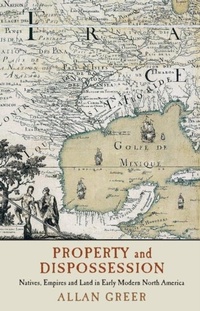
Property and Dispossession
Natives, Empires and Land in Early Modern North America
Published on 28. December 2017
978-1-108-54877-9 (ISBN)
Description

Allan Greer examines the processes by which forms of land tenure emerged and natives were dispossessed from the sixteenth to the eighteenth centuries in New France (Canada), New Spain (Mexico), and New England. By focusing on land, territory, and property, he deploys the concept of 'property formation' to consider the ways in which Europeans and their Euro-American descendants remade New World space as they laid claim to the continent's resources, extended the reach of empire, and established states and jurisdictions for themselves. Challenging long-held, binary assumptions of property as a single entity, which various groups did or did not possess, Greer highlights the diversity of indigenous and Euro-American property systems in the early modern period. The book's geographic scope, comparative dimension, and placement of indigenous people on an equal plane with Europeans makes it unlike any previous study of early colonization and contact in the Americas.
Reviews / Votes
'This fascinating book complicates the processes that led to the formation of colonial property. It suggests that the regimes we witness today were the result of dynamic and fluid developments that involved actors of all shapes and sizes. In this story, communal lands were as important as private property, art was an essential component of map-making, and a sense of places was more crucial than abstract territorial claims.' Tamar Herzog, Harvard University, Massachusetts 'Although landed property is a foundation of our legal, political, and economic systems, too rarely has it been explored in its historically contingent and even kaleidoscopic nature. In a colossal feat of research and synthesis, Allan Greer looks across an entire continent to explore the varied forms of property formation in the early modern era - and the inextricably related processes of Native dispossession. From one of our most eminent historians at the height of his powers, this book will serve as the starting point for all future discussion on the subject.' Francois Furstenberg, The Johns Hopkins University 'Monumental and mighty in its range and its depth, Property and Dispossession explores the surprisingly disparate ways in which empire-making in the early Americas did and did not allow for indigenous tenure, ultimately showing that it was not until the nineteenth-century era of state building that nation builders truly sought to liquidate Native communities through the destruction of their distinctive homelands. Native resistance took equally disparate forms over these centuries as indigenous communities fought to thwart dispossession - a fight that continues through the present day as battles for property and sovereignty remain in full throttle.' Juliana Barr, Duke University, North Carolina 'In this astonishingly important book, Greer has set an agenda for global debates about the history of colonialism, landed empires, and strategies of dispossession. Colonial property was not the triumph of any single logic. Ideas and practices of ownership were contingent, grounded in relationships that date back to the earliest encounters and exchanges.' Jeremy Adelman, Princeton University, new Jersey 'This important book challenges the usual understandings of how European colonists acquired land from Native American inhabitants. ... The result is a nuanced understanding of how European colonization led to Native dispossession of territory. Highly recommended.' E. Eslinger, ChoiceMore details
Series
Language
English
Place of publication
Cambridge
United Kingdom
Target group
Professional and scholarly
Illustrations
Worked examples or Exercises; 4 Maps; 21 Halftones, black and white
File size
10,64 MB
ISBN-13
978-1-108-54877-9 (9781108548779)
Copyright in bibliographic data and cover images is held by Nielsen Book Services Limited or by the publishers or by their respective licensors: all rights reserved.
Schweitzer Classification
Other editions
Additional editions
Book
01/2018
Cambridge University Press
€137.30
Shipment within 15-20 days
Person
Allan Greer is a professor in the Department of History and Classical Studies at McGill University in Montreal, Canada. He holds the Canada Research Chair in Colonial North America at McGill University, Montreal. He has published seven books, including Mohawk Saint: Catherine Tekakwitha and the Jesuits (2005) and La Nouvelle-France et le monde (2009).
Content
1. Introduction: property and colonization; Part I. Three Zones Of Colonization: 2. Indigenous forms of property; 3. Early contacts; 4. New Spain; 5. New France; 6. New England; Part II. Aspects of Property Formation: 7. The colonial commons; 8. Spaces of property; 9. A survey of surveying; 10. Empires and colonies; Part III. Conclusion and Epilogue: 11. Property and dispossession in an age of revolution.
