

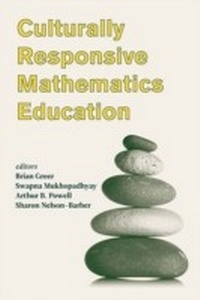
Culturally Responsive Mathematics Education
1st Edition
Published on 20. May 2009
400 pages
978-1-135-59333-9 (ISBN)
Description

At a time of rapid demographic change and amidst the many educational challenges facing the US, this critical new collection presents mathematics education from a culturally responsive perspective. It tackles the most crucial issues of teaching mathematics to an ethnically diverse school population, including the political dimension of mathematics education within the context of governmental efforts to improve achievement in school mathematics. Culturally Responsive Mathematics Education moves beyond a point of view that is internal to mathematics education as a discipline, and instead offers a broad perspective of mathematics as a significant, liberating intellectual force in our society. The editors of this volume bring together contributions from many of the leading teachers, teacher educators, researchers, scholars, and activists who have been working to reorient mathematics education in ways that reflect mathematics education as accomplished, first and foremost, through human interactions.
Reviews / Votes
"In closing, I would like to draw attention to how, in my view, many mathematics education research endeavors continue to talk the good talk of culturally responsive pedagogy in mathematics education, but walking the walk in practice remains much more elusive....I applaud the sincere efforts of the authors in this book to ground the 'good talk' (the theoretical discussions) in specific classroom and curricular experiences that do, indeed, serve as pointers to possibilities for real change."--Teachers College Record"Culturally Responsive Mathematics Education seeks to establish mathematics as a human activity, constructed by those who practice it and subject to the uncertainties of any human endeavor."-Education Review
More details
Series
Language
English
Place of publication
London
United Kingdom
Publishing group
Taylor & Francis Ltd
Target group
College/higher education
Product notice
Reflowable
Illustrations
9 s/w Tabellen
9 Tables, black and white
File size
2,25 MB
ISBN-13
978-1-135-59333-9 (9781135593339)
Copyright in bibliographic data and cover images is held by Nielsen Book Services Limited or by the publishers or by their respective licensors: all rights reserved.
Schweitzer Classification
Other editions
Additional editions
Brian Greer | Swapna Mukhopadhyay | Arthur B. Powell
Culturally Responsive Mathematics Education
Book
03/2009
1st Edition
Routledge
€118.10
Shipment within 10-20 days
Brian Greer | Swapna Mukhopadhyay | Arthur B. Powell
Culturally Responsive Mathematics Education
Book
03/2009
1st Edition
Routledge
€267.85
Article not available at the moment
Persons
Dr. Brian Greer is an independent scholar and Adjunct Professor in the Graduate School of Education at Portland State University.
Dr. Swapna Mukhopadhyay is an Associate Professor in the Graduate School of Education at Portland State University.
Dr. Arthur B. Powell is an Associate Professor of Mathematics Education in the Department of Urban Education and Associate Director of the Robert B. Davis Institute for Learning at Rutgers University.
Dr. Sharon Nelson-Barber is a sociolinguist and directs the Center for the Study of Culture and Language in Education Research at WestEd.
Dr. Swapna Mukhopadhyay is an Associate Professor in the Graduate School of Education at Portland State University.
Dr. Arthur B. Powell is an Associate Professor of Mathematics Education in the Department of Urban Education and Associate Director of the Robert B. Davis Institute for Learning at Rutgers University.
Dr. Sharon Nelson-Barber is a sociolinguist and directs the Center for the Study of Culture and Language in Education Research at WestEd.
Content
Foreword, Ubiratan D'Ambrosio
Acknowledgments
Introduction, Brian Greer, Swapna Mukhopadhyay, Sharon Nelson-Barber, and Arthur B. Powell
Part I: Foundations and Backgrounds
1. Culture and the Development of Mathematics: An Historical Perspective, Frank J. Swetz
2. New Philosophy of Mathematics: Implications for Mathematics Education, Paul Ernest
3. An Ethnomathematical Perspective on Culturally Responsive Mathematics Education, Swapna Mukhopadhyay, Arthur B. Powell and Marilyn Frankenstein
4. Seeing With Many Eyes: Connections Between Anthropology and Mathematics, Jim Barta and Mary E. Brenner
5. What Mathematics Teachers Need to Know about Culture and Language, Judit Moschkovich and Sharon Nelson-Barber
6. The Politics of Mathematics Education in the United States: Dominant and Counter Agendas, Eric Gutstein
7. Conceptions of Assessment of Mathematical Proficiency and their Implications for Cultural Diversity, Dalton Miller-Jones and Brian Greer
Part II: Teaching and Learning
8. Preparing Culturally Responsive Mathematics Teachers, Geneva Gay
9. Mathematics Literacy and Liberation: Reframing Mathematics Education for African American Children, Danny Bernard Martin and Ebony O. McGee
10. Culturally Responsive Mathematics Education in the Algebra Project, Robert Moses, Mary Maxwell West and Frank E. Davis
11. A Two-Way Process for Developing Effective Culturally Based Math: Examples from Math in a Cultural Context, Jerry Lipka, Evelyn Yanez, Dora Andrew-Ihrke and Shehenaz Adam
12. Native-American Analogues to the Cartesian Coordinate System, Ron Eglash
13. Privileging Mathematics and Equity in Teacher Education: Framework, Counter-Resistance Strategies and Reflections from a Latina Mathematics Educator, Julia M. Aguirre
14. Latina Mothers' Perceptions about the Teaching and Learning of Mathematics: Implications for Parental Participation, Marta Civil and Beatriz Quintos
15. Culturally Responsive College Level Mathematics, Mark K. Davis, Shandy Hauk and M. Paul Latiolais
Index
Acknowledgments
Introduction, Brian Greer, Swapna Mukhopadhyay, Sharon Nelson-Barber, and Arthur B. Powell
Part I: Foundations and Backgrounds
1. Culture and the Development of Mathematics: An Historical Perspective, Frank J. Swetz
2. New Philosophy of Mathematics: Implications for Mathematics Education, Paul Ernest
3. An Ethnomathematical Perspective on Culturally Responsive Mathematics Education, Swapna Mukhopadhyay, Arthur B. Powell and Marilyn Frankenstein
4. Seeing With Many Eyes: Connections Between Anthropology and Mathematics, Jim Barta and Mary E. Brenner
5. What Mathematics Teachers Need to Know about Culture and Language, Judit Moschkovich and Sharon Nelson-Barber
6. The Politics of Mathematics Education in the United States: Dominant and Counter Agendas, Eric Gutstein
7. Conceptions of Assessment of Mathematical Proficiency and their Implications for Cultural Diversity, Dalton Miller-Jones and Brian Greer
Part II: Teaching and Learning
8. Preparing Culturally Responsive Mathematics Teachers, Geneva Gay
9. Mathematics Literacy and Liberation: Reframing Mathematics Education for African American Children, Danny Bernard Martin and Ebony O. McGee
10. Culturally Responsive Mathematics Education in the Algebra Project, Robert Moses, Mary Maxwell West and Frank E. Davis
11. A Two-Way Process for Developing Effective Culturally Based Math: Examples from Math in a Cultural Context, Jerry Lipka, Evelyn Yanez, Dora Andrew-Ihrke and Shehenaz Adam
12. Native-American Analogues to the Cartesian Coordinate System, Ron Eglash
13. Privileging Mathematics and Equity in Teacher Education: Framework, Counter-Resistance Strategies and Reflections from a Latina Mathematics Educator, Julia M. Aguirre
14. Latina Mothers' Perceptions about the Teaching and Learning of Mathematics: Implications for Parental Participation, Marta Civil and Beatriz Quintos
15. Culturally Responsive College Level Mathematics, Mark K. Davis, Shandy Hauk and M. Paul Latiolais
Index
