

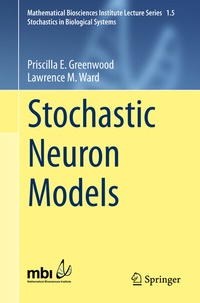
Stochastic Neuron Models
Description

This book will be useful for graduate students and instructors providing material and references for applying probability to stochastic neuron modeling. Methods and results are presented, but the emphasis is on questions where additional stochastic analysis may contribute neuroscience insight. An extensive bibliography is included.
Dr. Priscilla E. Greenwood is a Professor Emerita in the Department of Mathematics at the University of British Columbia. Dr. Lawrence M. Ward is a Professor in the Department of Psychology and the Brain Research Centre at the University of British Columbia.
Reviews / Votes
"This book is part of the Mathematical Biosciences Institute Lecture Series. Each book in this series is self-contained, tutorial in nature and inspired by the annual programs at the MBI. They are designed to be used as part of a two week module in a standard graduate course in mathematics. This book is 70 pages long and informally written, giving a quick introduction to stochastic neural models of varying levels." (Carlo Laing, zbMATH 1342.92007, 2016)
More details
Other editions
Additional editions
Persons
Dr. Priscilla E. Greenwood is a Professor Emerita in the Department of Mathematics at the University of British Columbia. She received a Ph.D. in mathematics from the University of Wisconsin in 1963. She has published extensively in several areas of probability and its applications, including stochastic processes, random fields, and asymptotic statistics for stochastic processes. She has also authored the following books: Contiguity and the Statistical Invariance Principle (1985, Philadelphia: Gordon and Breach), (with A.N. Shiryaev); Markov Fields over Countable Partially Ordered Sets: Extrema and Splitting (1994, Providence, RI: American Mathematical Society), (with I.,V. Evstigneev), 1994; and A guide to chi-squared testing (1996, New York: Wiley), (with M.S. Nikulin). Her current work centers around stochastic dynamical systems, and, in particular, stochastic neural dynamics.
Dr. Lawrence M. Ward is a Professor in the Department of Psychology and the Brain Research Centre at the University of British Columbia. He received a Ph.D. from Duke University in 1971, where he studied experimental psychology and mathematics. He has published many research articles and book chapters in psychophysics, cognitive neuroscience, biophysics, and computational neuroscience. He has also authored several books: Sensation and Perception (now in its 6 th edition, 2004, Hoboken, NJ: Wiley), (with S. Coren and J.T. Enns), Dynamical Cognitive Science (2001, Cambridge, MA: MIT Press), and Orienting of Attention (2008, New York: Oxford University Press; with Richard D. Wright). His current work is concerned with issues in (i) the cognitive neuroscience of attention, memory, reading, and consciousness, (ii) biophysics and psychophysics of stochastic facilitation, (iii) mathematical and computer modeling of neuronal oscillations and synchronization, and (iv) applications of nonlinear dynamical systems theory in cognitive neuroscience.
