

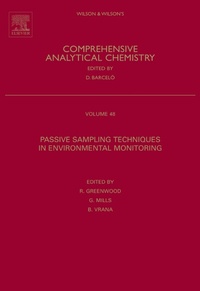
Passive Sampling Techniques in Environmental Monitoring
Published on 3. July 2007
486 pages
978-0-08-048950-6 (ISBN)
Description

Monitoring pollutants in air, soil and water is a routine requirement in the workplace, and in the wider environment. Passive samplers can provide a representative picture of levels of pollutants over a period of time from days to months by measuring the average concentrations to which they have been exposed. Air monitors are widely used, for instance to measure the exposure of workers to volatile compounds, but also for monitoring the fate of pollutants in the atmosphere. Passive sampling devices are now becomining increasingly used to monitor pollutants in rivers, coastal waters and ground water where contamination results from sources such as domestic and industrial discharges, and the use of agrochemicals. Passive Sampling Techniques in Environmental Monitoring provides a timely collection of information on a set of techniques that help monitor the quality of air, surface and ground waters. Passive sampling can provide an inexpensive means of obtaining a representative picture of quality over a period of time, even where levels of pollutants fluctuate due to discontinuous discharges or seasonal application of chemicals such as pesticides. Recent changes in legislation have increased the pressure to obtain better information than that provided by classical infrequent spot sampling.Brought together in one source, this book looks at the performance of a range of devices for the passive sampling of metals, and of non-polar and polar organic chemicals in air and in water. The strengths and weaknesses and the range of applicability of the technology are considered.* Comprehensive review of passive sampling - covering air, water and majority of available technologies in one volume* Chapters written by international specialist experts * Covers theory and applications, providing background information and guidelines for use in the field
More details
Other editions
Additional editions
Richard Greenwood | Graham Mills | Bran Vrana
Passive Sampling Techniques in Environmental Monitoring: Volume 48
Book
05/2007
Elsevier
€259.50
Article exhausted; check different version
Content
Proposed Contents1. Introduction2. Theoretical overviewAir Sampling3. Introduction and theoretical aspects4. Solid phase Microextraction Devices (SPME)5. Semi-Permeable Membrane Devices (SPMD)6. Diffusion tubes/3M badges (dosimetry)7. Conifer needles/mosses8. MESCO samplersWater Sampling9. Theoretical aspects, calibration / modelling10. Semi-Permeable Membrane Devices (SPMD)11. Polar Organic Compound Integrative Sampler (POCIS)12. University of Portsmouth samplers13. MESCO samplers14. Diffusion Gradient Devices15. Groundwater devices based on ceramic tubes16. Field study considerations (Protocols)Soil Sediment17. Diffusion Gradient Devices18. Semi-Permeable Membrane Devices (SPMD)19. Measuring dissolved sediment porewater concentration using passive samplersBioassays20. Biomimetic sampling21. Toximeter22. Comparison for passive sampling to biomonitoring organisms23. Combination of passive sampling with bioassays
