

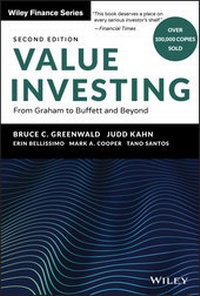
Value Investing
Description

The substantially rewritten Second Edition of Value Investing: From Graham to Buffett and Beyond delivers an incisive and refined approach to investing grounded on almost 100 years of history, beginning with Graham and Dodd. Founded on the value investing course taught for almost twenty-five years by co-author Bruce Greenwald at Columbia Business School, the book helps investors consistently land on the profitable side of the trade.
Readers will learn how to search for underpriced securities, value them accurately, hone a research strategy, and apply it all in the context of a risk management practice that mitigates the chance of a permanent loss of capital.
The new edition includes:
* Two innovative new chapters discussing the valuation of growth stocks, a perennial problem for investors in the Graham and Dodd tradition
* New profiles of successful investors, including Tom Russo, Paul Hilal, and Andrew Weiss
* An extended discussion of risk management, including modern best practices in an environment where it is often divorced from individual security selection
A substantive expansion of an already highly regarded book, Value Investing: From Graham to Buffett and Beyond is the premier text discussing the application of timeless investing principles within a transformed economic environment. It is an essential resource for portfolio managers, retail and institutional investors, and anyone else with a professional or personal interest in securities valuation and investing.
Successful value investing practitioners have graced both the course and this book with presentations describing what they really do when they are at work. Find brief descriptions of their practices within, and video presentations available on the web site that accompanies this volume:
http://www.wiley.com/go/greenwald/valueinvesting2e
More details
Other editions
Additional editions
Persons
JUDD KAHN is currently a partner in Davidson Kahn Capital Management. He started his professional career as a historian, worked as a consultant and financial executive, and has been involved in investment management since 2000. He has a doctorate in history from UC Berkeley.
Content
Acknowledgments ix
Preface xi
Introduction xi
1 Value Investing: Definitions, Distinctions, Results, Risks, Principles 1
2 Searching for Value: Finding the Right Side of the Trade 17
3 Valuation in Principle, Valuation in Practice 41
4 Valuing the Assets: From Book Value to Replacement Costs 71
Example One: Hudson General 91
5 Earnings Power Value 103
Example Two: Magna International 123
6 Growth 141
7 "Good" Businesses 161
8 The Valuation of Franchise Stocks 187
Appendix to Chapter 8: Return Calculations for Franchise Businesses 217
Example Three: WD-40 231
Example Four: Intel 253
9 Research Strategy 301
10 Risk Management and Building Portfolios 321
Investor Profiles 339
Warren Buffett 343
Robert H. Heilbrunn 375
Walter and Edwin Schloss 381
Mario Gabelli 393
Glenn Greenberg 395
Paul Hilal 399
Jan Hummel 403
Seth Klarman 407
Michael Price 411
Thomas Russo 415
Andrew Weiss 419
Index 423
Introduction
In 1999, when we began to write the first edition of this book, value investing as conceived by Benjamin Graham and David Dodd and developed by their successors was in eclipse as a method of stock selection. Academic finance had for 30 years embraced the Efficient Markets Theory (EMT), which rejected the possibility of consistently successful active investing. The stock market boom produced by the first Internet bubble appeared to invalidate all the analytical principles on which value investing was based. Value practitioners, with the notable exception of Warren Buffett, were dismissed as old-fashioned and out of touch with contemporary economic reality. Fortunately, the collapse of tech and telecom stocks between 2000 and 2002, coupled with the superior performance by value investors, revived interest in the Graham and Dodd approach. At the same time, a mass of published academic evidence powerfully contradicted EMT. Statistically constructed value portfolios generally outperformed the stock market as a whole over almost all extended periods in almost all the national markets for which sufficient historical data were available.
Increasingly accepted academic studies in psychology, pioneered by Daniel Kahneman and Amos Tversky, spawned the field of behavioral finance and provided an explanation for the historical outperformance of these value portfolios, grounding it in deeply embedded human behavioral biases. As a result, a "value premium" in returns appeared likely to be a persistent feature of future financial markets. These studies and continuing innovation by value practitioners led to a more thorough understanding of Graham and Dodd principles and marked improvements in value investing practices, especially with respect to identifying and evaluating what are designated as "franchise" businesses.
The long bull market since the depths of the 2008-9 financial crisis has once again raised questions about the validity of a Graham and Dodd approach. During the years since 2009, many notable value investors have significantly underperformed national and global market indices. Carefully constructed statistical value portfolios have seen the gap between value and overall market performance narrow significantly if not entirely disappear. A new generation of technology stocks have provided sustained returns that again appear to contradict established value principles. And value investors are once again being dismissed as old-fashioned and out of touch with current economic reality.
In part, a decline in the relative performance of value portfolios is a predictable result of the valuation excesses of the later phases of any long bull market. Value investors have historically performed relatively poorly in these periods, as they did in the late 1990s. However, other important factors appear to be at work. First the renewed success of Graham and Dodd investing in the years from 2000 through 2007 increased the popularity of a value approach. Especially in the United States, the proportion of value oriented investors rose significantly. An increased demand for value stocks may have compressed the spread between glamour and value stock valuation multiples, although the evidence is mixed. Second, economic developments have complicated the task of applying Graham and Dodd principles. The shift in economic activity from industry/manufacturing to services has increased the importance of intangible capital-customers, trained employees, product portfolios, and brand images-relative to tangible capital-inventories, accounts receivable, property, plant, and equipment that accountants have traditionally included on a business's balance sheet. Moreover, since investments in intangibles-advertising, hiring, training, and product development-are often counted as current expenses for accounting purposes, defining and measuring current earnings power has become more difficult. Technological developments have had a similar impact. Modern computer and Internet-based firms like Amazon, Google, Oracle, Facebook, Microsoft, and Netflix have relatively little physical capital. Much of their growth related investments are, for accounting purposes, buried in expenses, where they depress, perhaps excessively, reported earnings and raise some valuation multiples.
A further complicating factor is the increasing extent to which service and modern technology companies operate in local geographic markets or niche product markets. These local/niche markets are characterized by potential economies of scale and, through continuous customer interactions, high degrees of customer captivity. The result is an increased incidence of dominant local/niche market competitors who benefit from significant barriers to entry. In the language of value investing, "franchise" businesses with wide "moats" constitute an increasingly large fraction of overall economic activity. For franchise businesses, net assets play a diminished role in determining profits and growth contributes significantly to overall value. The consequence is that equity valuations depend heavily on future cash flows, and often far distant future cash flows, whose values are difficult to measure using Graham and Dodd asset value/earnings power value methods. Also for franchise businesses, management performance, especially with respect to capital allocation, has an enhanced impact on firm valuations. Not surprisingly in this environment, many traditional balance sheet focused value investors have not done well.
A final newly important factor that plays a role in the valuation of franchise businesses is the heightened potential for disruptive change that may undermine a firm's franchise position. For competitive businesses without significant economies of scale, any decline in profitability should be roughly offset by fixed and working capital recoveries as the business contracts. For franchise businesses, where earnings power value exceeds asset value, disruptive decline has much more serious consequences. Loss of economies of scale undermines earnings without any compensating return of capital. High returns on capital mean that lost earnings are only slightly offset by any realized capital recoveries. Dying franchise businesses are far less valuable relative to their pre-disruption positions than dying "cigar butt" businesses. Any attempt to invest in undervalued franchise businesses requires a careful assessment of the consequences of disruption.
These changes mean that we have to revisit all aspects of the approach to value investing laid out in the first edition of this book. We have rethought the imperatives of searching for and then valuing potentially attractive opportunities once they have been identified. We have also carefully examined active research processes once a preliminary valuation has been made and have looked at the issue of risk management far more extensively than we did in the first edition. In this revision we have benefited from observing practicing value investors and noting the adaptations they have made to changing economic circumstances. In all these areas, we have explicitly measured the advantages of a modern Graham and Dodd approach against what is ultimately the fundamental challenge facing any active investor. While there is now overwhelming evidence that financial markets are not efficient in the academic sense, there is a fundamental and inescapable way in which markets are efficient. The average return to all investors in any asset class must be equal to the average return to all the assets in that asset class (i.e., the "market" return for that asset class). All the assets are owned by somebody and derivative arrangements (e.g., uncovered short sales) net out since for every seller there is an offsetting buyer. Therefore, if one investor outperforms the market for a particular asset class, another investor must underperform by a compensating amount, weighted by the assets under management. Since this constraint applies to all asset classes, it applies to investments as a whole.
Graham and Dodd were fully aware of this efficiency constraint although they described it in slightly different terms. They understood that every time someone bought a security thinking it was likely to do well relative to alternative opportunities, someone else was selling that security because they thought it would underperform the relevant alternative opportunities. Depending on the outcome, one of these investors always had to be wrong. The essential characteristic of a well-conceived investment process is that at every step-search, valuation, research process, risk management-it should place an investor on the right side of the trade. The process must be superior to that of the investor on the other side of the trade. This criterion is what we have used to explicitly measure the modern value investing practices described in this second edition.
The search process involves not only a value orientation, a preference for non-glamorous, ugly, out-of-favor, and obscure stocks, but also some degree of specialization. If I, as a generalist, trade with an equally capable and highly disciplined specialist, the specialist will usually have superior understanding and information. He or she will therefore more often than not be on the right side of the trade. In this edition we have extended the search chapter to include a discussion of effective specialization strategies. Recent experience supports this point. Highly focused value investors tend to be unusually successful even compared to the value community as a whole. Successful but more broadly oriented value investors tend to perform better...
