

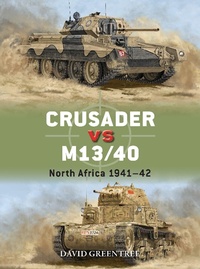
Crusader vs M13/40
North Africa 1941-42
1st Edition
Published on 15. August 2024
80 pages
978-1-4728-6111-5 (ISBN)
Description

This illustrated study assesses the British Crusader and the Italian M13/40, two medium tanks that played crucial roles in World War II's Desert War.
Making its combat debut in North Africa during December 1940, Italy's M13/40 medium tank was armed with a 47mm main gun. Its British opposite number, the Crusader I, was armed with a 2-pdr (40mm) main gun; it entered the fighting in June 1941. While the M13/40 could fire armour-piercing rounds but also high-explosive ammunition against infantry and towed-gun targets, the Crusader could only fire armour-piercing ammunition. In this book, David Greentree charts the evolution of these two tanks as the Desert War raged on.
While the Crusader III, making its debut at the Second Battle of El Alamein in October 1942, was armed with the much more effective 6-pdr (57mm), the M13/40 could not be upgunned or uparmoured; new types such as the US-built M3 Grant tipped the balance in favour of the British. Joined in the front line by the similar M14/41, the M13/40 soldiered on; as the M4 Sherman also entered British service, the Italian tanks were largely wiped out as the Axis forces retreated from Egypt.
Featuring all-new full-colour artwork, archive photographs and expert analysis, this engaging study assess the origins, development and combat effectiveness of these two mainstays of the Desert War during 1941-42.
Making its combat debut in North Africa during December 1940, Italy's M13/40 medium tank was armed with a 47mm main gun. Its British opposite number, the Crusader I, was armed with a 2-pdr (40mm) main gun; it entered the fighting in June 1941. While the M13/40 could fire armour-piercing rounds but also high-explosive ammunition against infantry and towed-gun targets, the Crusader could only fire armour-piercing ammunition. In this book, David Greentree charts the evolution of these two tanks as the Desert War raged on.
While the Crusader III, making its debut at the Second Battle of El Alamein in October 1942, was armed with the much more effective 6-pdr (57mm), the M13/40 could not be upgunned or uparmoured; new types such as the US-built M3 Grant tipped the balance in favour of the British. Joined in the front line by the similar M14/41, the M13/40 soldiered on; as the M4 Sherman also entered British service, the Italian tanks were largely wiped out as the Axis forces retreated from Egypt.
Featuring all-new full-colour artwork, archive photographs and expert analysis, this engaging study assess the origins, development and combat effectiveness of these two mainstays of the Desert War during 1941-42.
More details
Series
Edition
1. Auflage
Language
English
Place of publication
London
United Kingdom
Publishing group
Bloomsbury Publishing PLC
Illustrations
Colour illustrations throughout, including profiles, technical drawings, battlescene artworks, maps and photographs.
ISBN-13
978-1-4728-6111-5 (9781472861115)
Copyright in bibliographic data and cover images is held by Nielsen Book Services Limited or by the publishers or by their respective licensors: all rights reserved.
Schweitzer Classification
Other editions
Additional editions
Book
08/2024
Osprey Publishing
€22.00
Shipment within 3-4 weeks
Persons
David Greentree served in the Royal Air Force in Oman and Afghanistan. His many titles for Osprey include British Airborne Soldier vs Waffen-SS Soldier and British Destroyer vs German Destroyer.
Johnny Shumate works as an illustrator in Tennessee. His greatest influences are Angus McBride, Don Troiani and Édouard Detaille.
Alan Gilliland writes, illustrates and publishes fiction (www.ravensquill.com), as well as illustrating for several publishers (alangillilandillustration.blogspot.com).
Johnny Shumate works as an illustrator in Tennessee. His greatest influences are Angus McBride, Don Troiani and Édouard Detaille.
Alan Gilliland writes, illustrates and publishes fiction (www.ravensquill.com), as well as illustrating for several publishers (alangillilandillustration.blogspot.com).
Content
Introduction
Chronology
Design and Development
Technical Specifications
The Combatants
The Strategic Situation
Combat
Analysis
Aftermath
Bibliography
Index
Chronology
Design and Development
Technical Specifications
The Combatants
The Strategic Situation
Combat
Analysis
Aftermath
Bibliography
Index
