

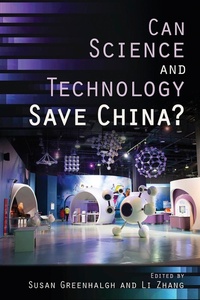
Can Science and Technology Save China?
Description

Can Science and Technology Save China? assesses the intimate connections between science and society in China, offering an in-depth look at how an array of sciences and technologies are being made, how they are interfacing with society, and with what effects.
Focusing on critical domains of daily life, the chapters explore how scientists, technicians, surgeons, therapists, and other experts create practical knowledges and innovations, as well as how ordinary people take them up as they pursue the good life. Editors Greenhalgh and Zhang offer a rare, up-close view of the politics of Chinese science-making, showing how everyday logics, practices, and ethics of science, medicine, and technology are profoundly reshaping contemporary China. By foregrounding the notion of "governing through science," and the contested role of science and technology as instruments of change, this timely book addresses important questions regarding what counts as science in China, what science and technology can do to transform China, as well as their limits and unintended consequences.
More details
Other editions
Additional editions
Persons
Susan Greenhalgh is the John King and Wilma Cannon Fairbank Research Professor of Chinese Society in the department of Anthropology at Harvard University.
Li Zhang is Professor of Anthropology at the University of California-Davis.
Content
Acknowledgments
Introduction: Governing through Science: The Anthropology of Science and Technology in Contemporary China, by Susan Greenhalgh
1. Numbers and the Assembling of a Community Mental Health Infrastructure in Postsocialist China, by Zhiying Ma
2. Embracing Psychological Science for the "Good Life"?, by Li Zhang
3. Negotiating Evidence and Efficacy in Experimental Medicine, by Priscilla Song
4. Divergent Trust and Dissonant Truths in Public Health Science, by Katherine A. Mason
5. China's Eco-Dream and the Making of Invisibilities in Rural-Environmental Research, by Elizabeth Lord
6. The Good Scientist and the Good Multinational: Managing the Ethics of Industry-Funded Science, by Susan Greenhalgh
7. The Black Soldier Fly: An Indigenous Innovation for Waste Management in Guangzhou, by Amy Zhang
8. Unmasking a Gendered Materialism: Air Filtration, Cigarettes, and Domestic Discord in Urban China, by Matthew Kohrman
Afterword
List of Contributors
Index
