

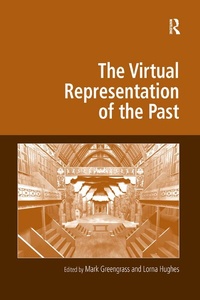
The Virtual Representation of the Past
Published on 15. May 2017
276 pages
978-1-317-01258-0 (ISBN)
Description

This unique book critically evaluates the virtual representation of the past through digital media. A distinguished team of leading experts in the field approach digital research in history and archaeology from contrasting viewpoints, including philosophical, methodological and technical. They illustrate the challenges involved in representing the past digitally by focusing on specific cases of a particular historical period, place or technical problem.
Reviews / Votes
'In an age when the objects of scholarly analysis in the arts and humanities are rapidly moving from the physical world to the virtual realm, researchers from all disciplines need a better understanding of the possibilities and potential of computational theory and methods. The fascinating essays in 'The Virtual Representation of the Past' explore the cutting edge of new techniques enabled by the digital age - from data- and text-mining to search to spatial technology - while remaining firmly rooted in the humanistic tradition. The book is approachable and thought-provoking.' Daniel Cohen, George Mason University, USA 'This excellent volume, by established and younger scholars, offers a definitive overview of the current landscape from a multidisciplinary perspective. The transformative opportunities that technology has to offer humanities researchers are highlighted, together with the scale of the challenges in an age of where so little thought is given to interoperability and long-term issues such as sustainability.' Jane Ohlmeyer, Trinity College, Ireland '...plenty of food for thought for readers wishing to utilise technologies to analyse and represent meta-data visually....a valuable model worthy of emulation across other countries and professions.' Australian Academic & Research Libraries '...more than just a fascinating read about how historians and archaeologists are beginning to use digital technologies. It asks subtle questions about what happens to the past when it is represented digitally, about how digital technology can be used to reveal the layers of interpretation which have accumulated around surviving traces of past activity, and at the same time how it adds new layers of meaning which somehow must also be recognized and revealed...Librarians and archivists might well compare their own practices and values with those described here and think about the ways in which they are also creating virtual representations of the past.' The ElectroniMore details
Series
Language
English
Place of publication
London
United Kingdom
Publishing group
Taylor & Francis Ltd
Target group
College/higher education
File size
12,44 MB
ISBN-13
978-1-317-01258-0 (9781317012580)
Copyright in bibliographic data and cover images is held by Nielsen Book Services Limited or by the publishers or by their respective licensors: all rights reserved.
Schweitzer Classification
Other editions
Additional editions
Mark Greengrass | Lorna Hughes
The Virtual Representation of the Past
Book
11/2016
1st Edition
Routledge
€85.60
Shipment within 10-20 days
Mark Greengrass | Lorna Hughes
The Virtual Representation of the Past
Book
11/2008
1st Edition
Routledge
€215.41
Shipment within 10-20 days
Persons
Mark Greengrass is Professor of Early Modern History at the University of Sheffield, UK and Lorna Hughes is Professor of Digital Humanities, School of Advanced Study, University of London, UK
Content
Contents: Introduction, Mark Greengrass; Part I The Virtual Representation of Text: The imaging of historical documents, Andrew Prescott; Virtual restoration and manuscript archaeology, Meg Twycross; Representations of sources and data: working with exceptions to hierarchy in historical documents, Donald Spaeth. Part II Virtual Histories and Pre-Histories: Finding Meanings: Finding needles in haystacks: data-mining in distributed historical datasets, Fabio Ciravegna, Mark Greengrass, Tim Hitchcock, Sam Chapman, Jamie McLaughlin and Ravish Bhagdev; Digital searching and the re-formulation of historical knowledge, Tim Hitchcock; Using computer-assisted qualitative data analysis software in collaborative historical research, Caroline Bowden; Stepping back from the trench edge: an archaeological perspective on the development of standards for recording and publication, Julian D. Richards and Catherine Hardman. Part III The Virtual Representation of Place and Time: Which? What? When? On the virtual representation of time, Manfred Thaller; In the kingdom of the blind: visualization and e-science in archaeology, the arts and humanities, Vincent Gaffney; Using geographical information systems to explore space and time in the humanities, Ian Gregory; Spatial technologies in archaeology in the 21st century, Paul Cripps. Part IV The Virtual Representation of Historical Objects and Events: Digital artefacts: possibilities and purpose, David Arnold; 'Oh, to make boards to speak! There's a task!' Towards a poetics of paradata, Richard Beacham; Electronic corpora of artefacts: the example of the Corpus of Romanesque Sculpture in Britain and Ireland, Anna Bentkowska-Kafel; Conclusion: virtual representation of the past: new research methods, tools and communities of practice, Lorna Hughes; Appendix; Bibliography; Index.
