

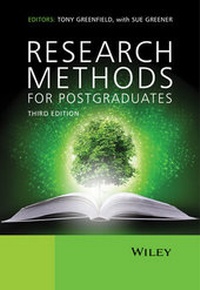
Research Methods for Postgraduates
Description

More details
Other editions
Additional editions
Persons
Content
Preface to the Third Edition
"Would you like to produce a third edition?" asked Heather. "Wiley have bought the rights from Hodder. I read the second edition and looked for competition. There is no other book about research methods as good as yours".
She assured me that I could apply my own style and that she and others at Wiley would help me as much as they could.
Years have passed since the first edition, and I have grown old, so this is my last work for the scientific and technical literature. I have depended entirely on all authors of chapters, for whose patience and understanding I am immensely grateful. They are all erudite and enthusiastic about their own subjects and eager to inspire you, our students, to do first-class research. I hope my own story will also inspire you.
This is a personal story. Perhaps this is the wrong place for a personal story but I want to tell it, as my attempt to inspire you.
"Is statistics a science?" is a hackneyed old question. It discomforts me. The question is needless. It is needless because it is predicated by the assumption that there are many sciences.
We have split science into several separate sciences, but the splits are artificial.
What is my science? I am a scientist. (No splits.)
We do split science into subject areas for pedagogical convenience in schools and universities. I do remember most of the chemistry, physics and biology I learned at school 70 years ago. I could not claim to be a chemist, physicist or biologist. But I would not say, as I was once shocked to hear a statistician say, "I cannot discuss the design of an aerofoil because I am not an aeronautical engineer; I am a statistician".
Statistics is a part of science, but it is not 'a science'; it is a subject area within science just as is chemistry. And it has no discrete boundary, as neither does chemistry.
Statistics provides method to science:
Do you ever notice something; describe it; ask yourself, "What is it? Why is it? Where it it? Is it useful to me or to anybody else? Does it have any relationship to anything else?" Then you have the makings of a scientist.
But, and this is where the usefulness of statistics arrives, do you then invent a working assumption, called a hypothesis, that is consistent with what you have observed? If you do, can you then use the hypothesis to make predictions?
Now, you must see clearly that statistics is an essential tool of science. You can test your predictions by experiments or further observations and modify the hypothesis in the light of your results. The scientific method insists that you keep revising your hypothesis and experimenting until you can detect no discrepancies between your hypothesis and your observations. You may then, correctly in the scientific realm, tell the world that you have a theory that may explain a class of phenomena.
A theory, by my description and by dictionary definition, is a framework within which observations are explained and predictions are made.
I once proposed a curriculum approach to representation of statistics as the cement for binding science's subject areas. This was in a paper, The polymath consultant, at the first meeting of ICOTS (International Conference on Teaching Statistics). The Times newspaper published a short version of it. The UK secretary of state for education, Keith Joseph, was interested enough to invite me to discuss it, and he encouraged me to promote the idea in universities. Nobody else took any notice. Yet I still believe that there was an idea that could be developed as part of our search for the future of data analysis. We must teach that statistical methods are just as part of, and just as applicable, in social studies as they are in physics and chemistry; and that they are as useful in linguistics, history and geography as much as they are in engineering and marketing.
Collections of worked practical cases, such as those by Cox and Snell (1981), must help and we need more of them. A recent book (Greenfield and Metcalfe 2007) aims at this with more than 50 worked cases about school absence, metro noise levels, water fluoridation, diamond prospecting, wine tasting, compulsive gambling, prosthetic heart valves and many more.
Evidence is the life-blood of science and scepticism is its spark of life. Data analysis is the flux of evidence. We should continue to ensure that all scientists, in all subject areas, and these include you, perceive it as such. Always you must be sceptical about any assertion that has no evidential support. Nullius in verba.
Frances Ashcroft, a truly great scientist of this, the twenty-first century, tells us in a recent book how her own research excited her.
I discovered that the KATP channel sits in the membrane that envelops the beta-cell and regulates its electrical activity and thereby insulin release.. The breakthrough came late at night when I was working alone.. I was ecstatic. I was dancing in the air, shot high into the sky on the rocket of excitement with the stars exploding in vivid colours all around me. Even recalling that moment sends excitement fizzing through my veins, and puts a smile on my face.
There is nothing - nothing at all - that compares to the exhilaration of discovery, of being the first person on the planet to see something new and understand what it means. It comes all too rarely to a scientist, perhaps just once in a lifetime, and usually requires years of hard grind to get there. But the delight of discovery is truly magical, a life-transforming event that keeps you at the bench even when times are tough. It makes science an addictive pursuit.
That night I felt like stout Cortez, silent upon his peak in Darien, gazing out across not the Pacific Ocean, but a landscape of the mind. It was crystal clear where my mental journey must take me, what experiments were needed and what the implications were.
Next morning, all certainty swept away, I felt sure my beautiful result was merely a mistake. There was only one way to find out. Repeat the experiment - again and again and again. That is the daily drudgery of a scientific life: it is very far from the ecstasy of discovery.
The Spark of Life Electricity in the Human Body
Frances Ashcroft
Such reporting inspired me to read the rest of the book even though, in her last paragraph, she warns that all of us, including you, cannot expect winning without drudgery. Thomas Edison expressed this well:
Genius is one percent inspiration, ninety-nine percent perspiration.
Spoken statement (c. 1903); published in Harper's Monthly (September 1932)
Many writers in the past have felt the same elation as Frances Ashcroft. John Keats, for example, recorded that feeling:
Then felt I like some watcher of the skies
When a new planet swims into his ken;
Or like stout Cortez when with eagle eyes
He star'd at the Pacific - and all his men
Look'd at each other with a wild surmise -
Silent, upon a peak in Darien.
John Keats
Mary Shelley told us how Doctor Frankenstein's feeling went further from the beauty of scientific achievement to disgust at what he had done.
The different accidents of life are not so changeable as the feelings of human nature. I had worked hard for nearly two years, for the sole purpose of infusing life into an inanimate body. For this I had deprived myself of rest and health. I had desired it with an ardour that far exceeded moderation; but now that I had finished, the beauty of the dream vanished, and breathless horror and disgust filled my heart.
Frankenstein (chapter 5) Mary Wolstencroft Shelley
If, as a scientist, you can keep powering the bellows that inflame your spark of inspiration into a bright light of scientific achievement, scientists will acknowledge that you are one of them. But, first, you must be sure that you believe you are a scientist. You must have started somewhere, sometime. Here is how and when and where I started.
"Tell Father that lunch is ready," said Mother. "He's in the garage".
I loved Sunday lunch when I was six, especially when it was roast beef, Yorkshire pudding, dark green cabbage and rich gravy. I went to the garage to summon Father to the table where he would display his knife sharpening and carving skills.
He was on the floor, asleep, and his face had a bluish greenish tinge.
I ran to Mother. She quickly opened the doors and windows and called an ambulance. She dragged him onto the lawn and pumped his chest. He breathed and his face turned grey. An ambulance arrived. The men put a mask over his face. It was connected by a rubber tube to a cylinder of oxygen. His face turned pink. The ambulance drove away and we had lunch, a little late.
Carbon black is an amorphous carbon with a high surface-area-to-volume ratio. It is used as a pigment and reinforcement in rubber and plastic products. It also helps to conduct heat away from the tread and belt area of the tyre, reducing thermal damage and increasing tyre life. It is very expensive. It was even more expensive when I was six and Father thought he could make a lot of money by producing it from cheap by-products, usually discarded, from coal distillation or coke making. One of these was naphtha and, as a chemical engineer, he knew where he...
