

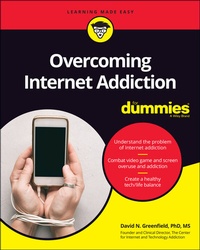
Overcoming Internet Addiction For Dummies
Description

There's no escaping it--we live in a digital world. We work, play, socialize, and learn online, and the Internet provides many amazing opportunities. Unfortunately, because of our basic biology, we're all susceptible to overuse and addiction to screens. Video games, social media, porn, and even scrolling online, taps into that pleasurable dopamine reward system. So, when is it time to log off or put the phone down and get help? Overcoming Internet Addiction For Dummies gives you the information, resources, and the self-assessment tools you need to discover how much is too much, along with practical suggestions on what to do about it.
Learn how to take back control of your time and attention--or help your kids or loved ones get control of theirs. This comprehensive, user-friendly overview of Internet addiction is full of helpful and proven methods to help foster a healthy, balanced, and sustainable life with screens.
* Discover the basic biology of addiction, including why children and teens are especially susceptible.
* Become aware of the cognitive, psychological, and physical effects excess Internet and screen use.
* Learn how social media, video gaming, and Internet pornography could be getting in the way of real-time living.
* Find out why smartphones are not smart for you to use all the time.
* Understand the science of how and why you can become addicted to your screens so you can unplug more easily and use your time for what matters most.
* Empower yourself and your children to build a positive relationship with the Internet and digital technology.
This book can help you and your loved ones plug back into life and show you where you can find information, resources, support, and treatment. Overcoming Internet Addiction is about taking back control of your time and attention and learning to manage your screen use, so it doesn't manage you.
More details
Other editions
Additional editions
Person
Content
Introduction
You can only experience life in the present moment. Internet overuse and addiction interrupts the process of being present in the moment and can rob you of the ability to fully experience living. When you're online, interaction with the world occurs through reflections found on a web page, app, video game, or the latest social media update. The Internet supports the illusion that you are in two places at once, and it appears to create this dissociation, in part, by the Internet's ability to distort time when you're on a screen.
Internet addiction is not new. Although the Internet may be the latest behavior that we discovered to be addictive, the propensity to become addicted to pleasurable substances and behaviors is not unique to Internet use. The structure and function of the reward center of the brain makes you particularly susceptible to the influence of dopamine and the activities that can elevate it - especially when those activities are provided in a variable and unpredictable format.
The brain loves the experience of maybe; addiction is about maybe finding the same pleasure again, or maybe it being even more fun. This is not a conscious process, but rather, it happens automatically, thus becoming a neurobiological chase for the previous pleasurable hit. The Internet, in a sense, programs you through the pleasure chemical dopamine, and you don't realize you're being conditioned by your screens. Content developers and Internet service providers know these basic behavioral and neuroscience principles, and they use and manipulate them to sell you products and influence what you consume online - including how much time and attention you devote to your screens.
Many people overuse their Internet screens and devices, and end up spending far too much time on them. For some, this use rises to the level of an addiction, where balanced living becomes affected and other psychiatric issues may develop or become pronounced. The Internet is a powerful digital drug, and as such, it must be moderated like any other addictive substance or behavior. This book is intended to help people who may lose their way online and especially for those who become addicted.
About This Book
This book is written in discrete chapters and is set up with multiple independent, but related, topics. Feel free to start wherever you like; some information and key concepts are repeated for emphasis, and refer you back and forth to different chapters. The idea is to immerse yourself and start wherever you feel comfortable. I trust that you'll find the information you need to discover, and because this isn't a novel, each chapter stands alone. If you're unfamiliar with this subject, then jump in and start at Chapter 1; the book is written to build on basic information and concepts, then onto application, and lastly, implementation.
The order of the book presents progressively more interrelated information, such as Chapter 2 on the biology of addiction, Chapter 5 on social media, and Chapter 7 on video games and video game addiction. Part 3 of the book offers information on diagnosis, followed by Part 4, which focuses on living a balanced life with proper screen use.
I want to clarify the perspective from which I write this book. I've conducted research and published in the field of Internet, video game, and technology addiction and its treatment, as well as workplace Internet issues and smartphones and driving, but I still consider myself primarily a clinician. This book is written from a scientifically informed clinical perspective; I've treated or consulted with hundreds of individuals over the last 25 years, many with significant life impacts related to their Internet, video game, and screen use. Numerous references throughout the book will represent my opinions based on these clinical experiences, some of which should be considered anecdotal and case based. I don't represent that everything stated in the book has been scientifically validated, as frankly, we're not quite at that point in the science of the diagnosis and treatment of Internet-related disorders.
A word about addiction: Please note that this is discussed at numerous points throughout the book, but I want to start by clarifying that the word addiction is perhaps not the best term per se. My approach tends to follow the definition of addiction offered by the American Society of Addiction Medicine, which is deeply clinical in nature. This definitional distinction may seem odd because the word addiction is used throughout this text, as well as in the fields of clinical psychology, psychiatry, and addiction medicine; however, I'm using this label throughout the book because it's the term that most of us understand and relate to when describing the complex biopsychosocial phenomenon that produces something we define as addiction (see Chapters 1 and 2).
With specific regard to Internet and technology addiction, no scientific agreement currently exists on what the final diagnostic labels will be. It is my best guess, based on the state of the research and clinical trends (including those established by the World Health Organization, the American Psychiatric Association, and the American Psychological Association), that the final diagnoses beyond Internet gaming disorder may include a variety of Internet-mediated use disorders that would involve symptoms of abuse and overuse of Internet-based screen technologies. This would be similar to the current diagnostic labeling that we see with alcohol and substance use disorders. Internet use disorders will probably follow suit and will most likely include several diagnoses that overlap or may be related to a specific type of content or Internet portal.
A quick note: Sidebars (shaded boxes of text) dig into the details of a given topic, but they aren't crucial to understanding it. Feel free to read them or skip them. You can also pass over the text accompanied by the Technical Stuff icon, as it offers some interesting but nonessential information about Internet addiction.
Finally, within this book, you may note that some web addresses break across two lines of text. If you're reading this book in print and want to visit one of these web pages, simply key in the web address exactly as it's noted in the text, pretending the line break doesn't exist. If you're reading this as an ebook, you've got it easy - just click the web address to be taken directly to the web page.
Foolish Assumptions
Here are some assumptions about you, the reader, and why you are picking up this book now:
- You or someone you love may be spending far too much time on one or more screens, and you've noticed the impact that this behavior has on you, on them, or on both of you.
- You or your loved one are finding the Internet almost too enjoyable (or certainly captivating), and at times you find yourself lost in the bits and bytes of cyberspace - so much so that at times, you lose track of time and also of your larger goals, values, and desires.
- You want to change your relationship to this useful, but addictive, technology, or you would like to see your children or loved one regain some balance and perspective about their screens. Perhaps surfing, social media, YouTube, pornography, video games, or never putting down their (or your) smartphone has become less tolerable and may even seem harmful at this point.
- You, just like myself, see the unavoidable pull of the Internet and screens. You recognize that you need to use them, but that perhaps you recognize that you do not need to use them in the manner you currently do, and you'd like to achieve a more mindful, moderated, and sustainable way to live with your Internet screen technologies, as opposed to living for them.
- You know that the Internet and accessible screens are not going anywhere, and that if anything, they will become even more prevalent and intrusive. You also see that this is not all positive and that too much of a good thing is not a good thing, and you must exercise your choice and ability to limit your screen use.
Icons Used in This Book
Like all For Dummies books, this book features icons to help you navigate the information. Here is what they mean.
If you take away anything about Internet addiction from this book, it should be the information marked with this icon.
This icon flags information that delves a little broader or deeper than usual into Internet addiction.
This icon highlights especially helpful advice about understanding, diagnosing, or treating Internet addiction.
This icon points out situations and actions to avoid as you work to overcome Internet addiction.
Beyond the Book
In addition to the material in the print or ebook you're reading right now, this product comes with some access-anywhere goodies on the web. Check out the free Cheat Sheet for information on Internet addiction basics, reasons why the Internet is addictive, diagnosing and treating an Internet addiction, and living a balanced life that includes the proper amount of screen use.
To get this Cheat Sheet, simply go to www.dummies.com and search for "Overcoming Internet Addiction For Dummies Cheat Sheet" in the Search...
